The aspect of the Conjugate Method that sets it apart from any other approach to strength and conditioning is the ability of the coach or athlete to modify the training as needed on a day-to-day or week-to-week basis. Conjugate allows for a consistently high level of training optimization to be achieved, provided the coach or athlete has a proper understanding of the individual's current circumstances and needs.
We can consistently adjust our approach based on training feedback, which is provided to us in various forms. Each week, we can evaluate absolute and explosive strength, work capacity, and physical conditioning. This feedback provides an accurate understanding of the current level of fatigue an athlete is experiencing, along with a roadmap for modifying training to continue making meaningful progress.
Our ultimate goal with any training plan we construct is to achieve the highest level of effectiveness and efficiency based on the circumstances we are dealing with. If we are working with a powerlifter, our goal is to get as strong as possible as rapidly as possible while remaining injury-free. When working with an athlete, our goal is to enhance all sport-relevant strengths and traits as quickly as possible during the offseason, while maintaining and possibly building upon these gains throughout the season.
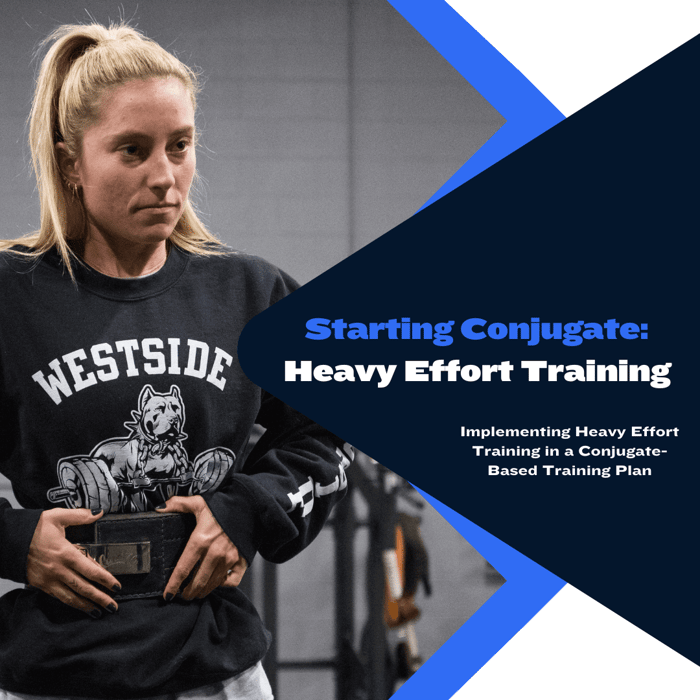
When seeking to enhance or maintain programming effectiveness and efficiency, one option at our disposal is to implement heavy effort training. Below, we will discuss the basics of heavy effort training, along with how to implement this approach in both lower and upper body training days.
What is Heavy Effort Training?
The standard Conjugate Method template calls for four training days per week, consisting of two maximal effort days and two dynamic effort days. Heavy effort training is a training approach that can be used in place of maximal effort training. This is because these two approaches focus on developing absolute strength.
Our heavy effort training will focus on training between 80% and 90%. This allows us to still achieve adequate training intensity to improve absolute strength to some degree, without dealing with fatigue levels typically incurred during maximal effort training.
This makes heavy effort training a valuable tool for powerlifters who need a way to manage fatigue without significantly reducing training effectiveness, or for athletes who require a method to modify maximal effort work in response to sports practice or competition demands. Heavy effort training is not something we use all the time, but it should definitely be used when the time is right.
Ultimately, maximal effort training will result in the most significant improvements in absolute strength but will also result in the most significant level of post-workout fatigue. Heavy effort training offers us a means of slightly lowering training intensity while still providing worthwhile stimulus capable of maintaining or improving absolute strength.
Typical max effort work calls for an athlete to work up to a top set single. However, we can execute our heavy effort work in two different ways. The first option is to work up to a top set, which can consist of 1, 2, 3, 4, or 5 reps. At Westside, we typically perform heavy effort work for a top set of single, triple, or five rep sets.
With this approach, our target training intensity will determine the number of reps for the top set. If we plan to reach 90% training intensity, we will aim for a top set of 1-3 reps. If we are working below 90%, we typically go with a top set of three to five repetitions. The goal is to recruit large motor units, but not to the degree of a standard maximum effort top set.
We can also work up to a specific training intensity and perform multiple sets and reps. For instance, instead of a top set triple at 90%, we can work up to three singles at 90%. We could do the same for a top set of five, performing five singles at 80-85%. This approach enables a higher level of technical execution to be achieved during each repetition, considering that there is no intra-set fatigue affecting the athlete.
The multiple single-rep approach can also be an excellent option for individuals who need to improve their technique. Heavy effort training intensity is near competition-relevant, making this technique significantly more valuable and relevant to sport than working with lighter barbells.

How to Program Heavy Effort Training
Heavy effort training will be very similar to maximal effort training, with the only difference being the intensity of the top set or sets. When it comes to exercise selection, essentially any exercise on the table for max effort training can be used during heavy effort work. However, some nuances should be mentioned.
The first is the use of joint-angle specific exercises during heavy effort work. Unless an athlete is dealing with a significant amount of fatigue, we opt for a full range of motion when performing heavy effort training. This is because heavy effort training already provides a training intensity and fatigue modifier, which is why we typically use joint-angle-specific training during maximal effort.
Aside from that, practically any exercise is on the table. One thing I will warn against is the use of bands during top sets of three or five repetitions. Bands will always provide an overspeed eccentric effect, which can be detrimental to an athlete performing a high-intensity multi-rep exercise.
As each rep is performed, intra-set fatigue increases, but the athlete must continue to deal with the overspeed eccentric effect caused by the band. This can result in significant technique breakdowns or injury. If we were to use bands during heavy effort training, we would do so when following the multiple top set single approach.
Here are a few examples of lower and upper heavy effort main exercise options:
Lower
Front Squat – work up to a top set of 5 reps @80%
Squat – 3 x 1 @90%
Box Squat – 5 x 1 @85% w/ Bands
Upper
Front Squat – work up to a top set of 3 reps @85%
Bench Press – 3 x 1 @90%
Floor Press – 5 x 1 @85% w/ Bands
As you can see, we opt for typical exercise selections, not much different from our usual maximal effort strategy.
However, it should be noted that when bands were added in, we went with a box squat and a floor press. These movements help break up the eccentric concentric chain and limit the overall range of motion. If a significant breakdown in technique due to fatigue were to happen, the risk of serious injury to the lower or upper body would be reduced.
The Importance of Maximal Effort Training
While heavy effort training can be a helpful option, it is not intended to replace maximal effort training in the long term. This approach is often used as a deload and is considered less effective than standard training. Heavy effort work cannot mimic the rate of absolute strength improvement associated with proper maximal effort training.
Maximal effort training provides the most significant improvements in absolute strength, bone and tissue density, and overall durability and resilience. The enhancement of absolute strength also affects all other strengths and athletic traits, essentially being the rising tide that raises all ships.
However, heavy effort training will provide the coach or athlete a means of maintaining training intensity near maximal effort levels, while avoiding the fatigue associated with maximal effort work.
The Conjugate Method is a strength training operating system. The ultimate goal is to provide the highest level of training effectiveness and efficiency, and we have many options at our disposal to realize this goal. The only thing that limits the Conjugate Method is the coach or athlete's understanding of the system and the options at their disposal.