
The dynamic effort method is one of the three primary strength-training methods used in the Conjugate System. This method focuses on improving an athlete’s rate of force development, which dictates how quickly an athlete can reach peak force output. We achieve this by training with submaximal weights (65-85%) and moving them at maximal velocity.
While the focus of maximal effort training is improving peak force output, dynamic effort training seeks to reduce the time to reach it. Whether we are working with strength or conventional athletes, dynamic effort training is a critical part of the training equation. We want strong and explosive athletes, capable of rapidly generating tremendous amounts of force to move a barbell, an opponent, or themselves.
At Westside, we execute dynamic effort training every week. When working with our conventional sports athletes, we include this training within our combined dynamic effort training day. As the name implies, this training day includes dynamic effort squat, deadlift, and bench press exercises.
The combined dynamic effort day consolidates barbell training into three total training days (max effort lower/upper and combined DE), leaving 1-2 additional days per week for speed and plyometric work. The combined dynamic effort day also serves to improve conditioning, given the training volume and density demands of this workout.
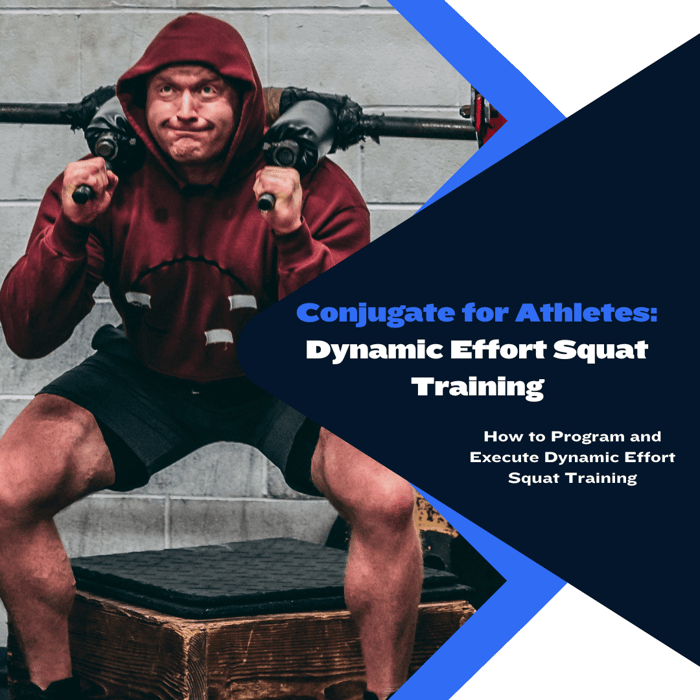
In this article, we will discuss the basics of dynamic effort squat training and the squat programming logic we use when working with athletes.
Combined Dynamic Effort Squat Execution
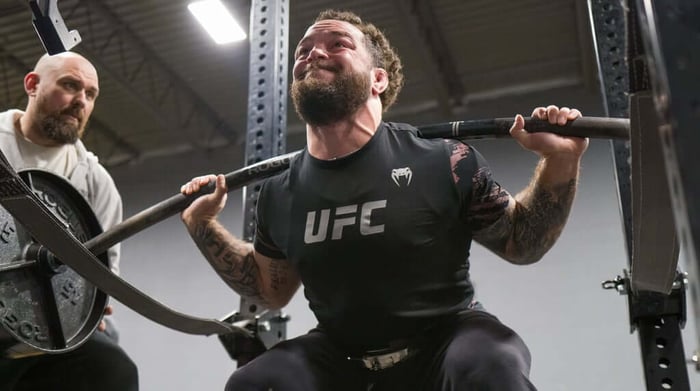
Combined dynamic effort squat training will be executed using variations of the box squat. To attain the highest level of adaptation from dynamic effort box squats, athletes must manage the training with control and proper intent. This not only includes adequate execution of the box squat movement but also the ability to adhere to the recommended average barbell velocity (.8 m/s).
Proper execution of a box squat requires athletes to use the box correctly. During a box squat, athletes will begin the eccentric portion of the lift, decelerate to make proper contact with the box, and then achieve both static and relaxed positioning on the box. The goal is to achieve both static and relaxed-overcome-by-dynamic training effects by properly sitting on the box.
Some coaches misunderstand the intent of the box squat and focus only on static positioning on the box. This has been purported to be beneficial to raw powerlifters, which is nonsense. Raw powerlifters are always the first to think all methods must be changed to meet the demands of their sport, which is also nonsense.
Achieving the static and relaxed-overcome-by-dynamic aspects of the box squat breaks up the eccentric-concentric chain, resulting in higher force production and greater reversal strength when transitioning between eccentric and concentric phases. If the goal is only to achieve static positioning, a pause squat is a much better option.
As for control, given the training's velocity goals, we must ensure athletes can maintain their technique at the required velocity. If we find that the current training weight does not allow athletes to meet the velocity requirement without technique breakdowns, we will lower the weekly training percentages by 5% until athletes can exhibit proper technique while meeting velocity targets.
Box Squat Training Waves
At Westside, our dynamic effort main exercise training is conducted using training waves. A training wave is an approach to ramping up intensity while reducing training volume over three weeks. Once the three-week wave is complete, we will change the barbell and/or accommodating resistance used and return to the week one intensity and volume parameters.
Not only is wave training an effective means of exposure to optimal levels of dynamic effort training intensity and volume, but it is also an effective way to achieve optimal fatigue management. When programming box squat training waves, we will most commonly program multiple sets of doubles or fives. We can also go with three-rep sets, though this is less common.
With doubles, we are, of course, focused on two high-velocity movements. With fives, we are looking for sustained force output throughout the reps. Doubles are the most effective means of improving the rate of force development, while fives allow simultaneous improvement of RFD and conditioning.
Athletes with barbell training experience can choose either format. However, we typically recommend doubles for beginners, as they are likely to lack the strength and work capacity to maintain velocity standards during a five-rep set.
Here is an example of a three-week box squat wave for athletes utilizing two-rep sets.
Week 1 – 12 x 2 @70% (45% bar weight, 25% AR)
Week 2 – 10 x 2 @75% (50% bar weight, 25% AR)
Week 3 – 8 x 2 @80% (55% bar weight, 25% AR)
Here is an example of a three-week box squat wave for athletes utilizing five-rep sets.
Week 1 – 5 x 5 @60% (35% bar weight, 25% AR)
Week 2 – 5 x 5 @65% (40% bar weight, 25% AR)
Week 3 – 5 x 5 @70% (45% bar weight, 25% AR)
The standard three-week wave approach for Westside Barbell powerlifters is often 75-85% for doubles and 70-80% for five-rep training waves. As you can see, we lower the percentages by 5% during our two-rep sets and by 15% during five-rep sets when working with athletes.
This is done to ensure that velocity standards are met and training fatigue remains appropriately managed. Considering our athletes practice and compete year-round, we want to reduce the likelihood of overshooting during our dynamic effort training. While powerlifters can easily handle an overshoot, conventional sports athletes may experience lingering fatigue that can affect practice and competition performance.
Rotating Specialty Barbells
Now that we have discussed the basics of dynamic effort squat wave training, we will move on to the rotation of specialty barbells and accommodating resistance. First, we must understand why we use these tools.
The use of specialty barbells allows a coach or athlete to add specific stimulus to a movement to achieve a particular desired outcome. Coaches and athletes need to know why they are using a specific barbell and how to execute the box squat with each type of specialty barbell.
Here is a list of lower-body specialty bars, along with the intent behind their use:
Competition Squat Bar: heavy squat bar with increased diameter and no flex.
Bow Bar: heavy squat bar with increased diameter that alleviates stress placed on the shoulders.
Safety Squat Bar: targets the lower body anterior chain with a specific emphasis on the quadriceps and hip flexors. Alleviates stress placed on the shoulders.
Giant Cambered Bar: targets the posterior chain with a specific emphasis on the glutes, hamstrings, and trunk. Alleviates stress placed on the shoulders.
These are the four specialty barbells we will use when executing dynamic effort box-squat waves. Here is how we would go about rotating them over the course of 12 weeks:
Weeks 1-3: Competition Squat Bar
Weeks 4-6: Safety Squat Bar
Weeks 7-9: Bow Bar
Weeks 10-12: Giant Cambered Bar
If we were working with a powerlifter, we may cycle in the competition squat bar every other wave. However, with athletes, we are not worried about competition barbell specificity. In this case, we are following a pattern that allows us to change the targeting of specific chains while also keeping shoulder wear and tear to a minimum.
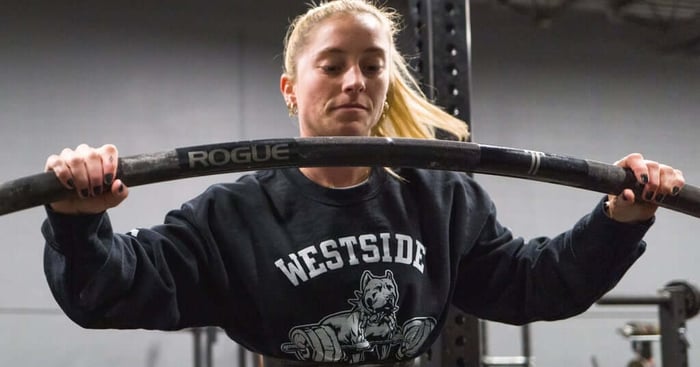
While barbell squatting is a great exercise, repeatedly using the standard squat bar week after week for multiple sets and reps is a recipe for shoulder and biceps pain.
Rotating Accommodating Resistance
The final aspect of dynamic effort squat programming is the rotation of accommodating resistance. Accommodating resistance allows for variable resistance throughout the movement, depending on the joint angle. At least advantageous joint angles, athletes will experience less resistance, with the resistance increasing as advantageous joint angles are achieved.
Chains are pure accommodating resistance. However, bands not only provide accommodating resistance but also an overspeed eccentric effect. Considering the “live” tension of the bands, there will be an increase in kinetic energy during the eccentric portion of the movement. This results in greater potential energy on the box and increased force output when moving off the box.
At Westside, our standard approach is to alternate between bands and chains wave to wave. However, we leave this up to the coach or the athlete’s discretion. Some athletes respond positively to frequent band use, while others may struggle with the overspeed eccentric aspect and need to stick with chains more often.
For those new to accommodating resistance, it is best to start with chains, as they do not cause an overspeed eccentric effect. This results in less eccentric force output needed to decelerate onto the box. Using bands right off the bat can cause athletes new to the box squat to crash into the box, leading to injury.
For more information regarding the use of the Conjugate Method when training athletes, check out our Conjugate for Athletes series.