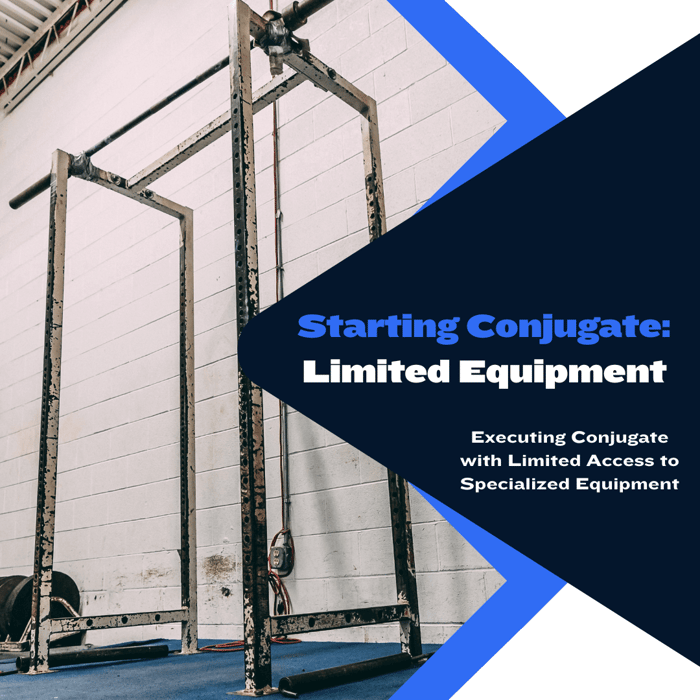
A common misconception regarding the use of the Conjugate Method is that an athlete must have access to a gym similar to Westside to execute training properly. While having access to training tools such as specialty bars, accommodating resistance, and specialty machines is great, we can implement an effective Conjugate training program at nearly any gym with a barbell and a squat rack.
What makes Conjugate so effective is the simultaneous use of three strength training methodologies: the maximal, dynamic, and repeated effort methods. While specialized training tools will, of course, enhance programming options, they are not what decides the outcomes of a Conjugate Method training program.
Ultimately, it is the programming logic and quality of execution that determines the effectiveness of Conjugate training. You may have access to a gym set up exactly like Westside, but if you lack a proper understanding of the methods and effort, your training program and outcomes will be subpar. This is why we stress the importance of combining personal education and training experience.
Below, we will outline how to set up effective Conjugate Method training using standard gym barbells and equipment.
Maximal Effort Training
The standard Conjugate Method maximal effort training strategy involves training a different lower and upper body exercise variation each week, repeating these movements once every 6-8 weeks to assess progress. While specialized training equipment allows for more variation, we can certainly put together effective training variations using basic gym equipment.
During max effort lower, we will rotate through variations of three exercises: the squat, deadlift, and good morning. Here is what an 8-week rotation of maximal effort lower exercises could look like when dealing with a limited equipment situation:
Month A
Week 1 – Squat
Week 2 – Deadlift
Week 3 – Zercher Squat
Week 4 – Good Morning (3-Rep Top Set)
Month B
Week 1 – Front Squat
Week 2 – Opposite Stance Deadlift
Week 3 – Anderson Squat
Week 4 – Good Morning (5-Rep Top Set)
Once the eight weeks are up, we will recycle through these exercises and retest. After that, we can then move on to new variations. Here is what that would look like:
Month C
Week 1 – Squat
Week 2 – Deadlift
Week 3 – Box Squat
Week 4 – Anderson Good Morning (3-Rep Top Set)
Month D
Week 1 – Low Box Squat
Week 2 – 2" Deficit Deadlift
Week 3 – Pause Squat
Week 4 – Anderson Good Morning (5-Rep Top Set)
As you can see, we keep relevant competition lifts in the rotation during Month C. This ensures that athletes have relevant training data to measure progress throughout the next eight weeks of training accurately.
Upper body training will follow a similar strategy, just with different exercise variations. Here is how we would put together upper body maximal effort training following the same approach we employed during our maximal effort lower work:
Month A
Week 1 – Bench Press
Week 2 – Close-Grip Bench Press
Week 3 – Floor Press
Week 4 – Push Press
Month B
Week 1 – Bench Press (3-Rep Top Set)
Week 2 – Incline Bench Press
Week 3 – Close-Grip Floor Press
Week 4 – Pin Press (Two-Board Starting Position)
Again, once the eight weeks are up, we will recycle through these exercises and retest. After that, we can then move on to new variations. Here is what that would look like:
Month C
Week 1 – Bench Press
Week 2 – Close Grip Bench Press (3-Rep Top Set)
Week 3 – Strict Press
Week 4 – Incline Pin Press (Pin Set at Eye-Level)
Month D
Week 1 – Floor Press (3-Rep Top Set)
Week 2 – Wide Grip Bench Press
Week 3 – Z Press
Week 4 – Wide Grip Close Grip Bench Press
We can accomplish a wide range of exercises with just a standard barbell. This demonstrates that even without access to a gym like Westside, you can still utilize the Conjugate Method effectively for both lower and upper body maximal effort training.
Dynamic Effort Training
The dynamic effort method requires athletes to use submaximal weights while executing reps at maximal velocity. This training is designed to enhance an athlete's rate of force development, which determines how quickly they can reach peak force output. If absolute strength is the thunder, rate of force development is the lightning.
Typically, dynamic effort training features the regular use of accommodating resistance, along with exercise variations rotated after every three-week training wave. When access to equipment is limited, adjustments must be made to both the training schemes and exercise selection.
First, we must address the lack of accommodating resistance. Accommodating resistance helps to alleviate the overall fatigue caused by an exercise. This is accomplished by the unloading/reloading that occurs throughout the overall range of motion.
Considering we will be training with barbell weight only, we must lower the training percentages to account for the lack of accommodating resistance. There will be no unloading aspect, so that athletes will carry the full weight of the barbell throughout the entire range of motion. If we fail to adjust percentages, we place an athlete in a situation where excess fatigue can begin to affect exercise execution and overall training progress.
With this in mind, we typically recommend coaches and athletes reduce dynamic effort training percentages by 10-15% depending on the athlete and the circumstances. How much we reduce the training weight will totally rely on the athlete's ability to maintain the 0.8m/s average velocity we seek to achieve during dynamic effort training.
Here is what an appropriately modified three-week squat and deadlift wave would look like when training without accommodating resistance or specialty bars:
Wave A
Week 1
Squat – 12 x 2 @65%, bar weight only.
Deadlift – 6 x 2 @65%, bar weight only.
Week 2
Squat – 10 x 2 @70%, bar weight only.
Deadlift – 5 x 2 @70%, bar weight only.
Week 3
Squat – 8 x 2 @75%, bar weight only.
Deadlift – 4 x 2 @75%, bar weight only.
Wave B
Week 1
Box Squat – 12 x 2 @65%, bar weight only.
Opposite Stance Deadlift – 6 x 2 @65%, bar weight only.
Week 2
Box Squat – 10 x 2 @70%, bar weight only.
Opposite Stance Deadlift – 5 x 2 @70%, bar weight only.
Week 3
Box Squat – 8 x 2 @75%, bar weight only.
Opposite Stance Deadlift – 4 x 2 @75%, bar weight only.
Wave C
Week 1
Box Squat – 5 x 5 @60%, bar weight only.
2” Deficit Deadlift – 6 x 2 @60%, bar weight only.
Week 2
Box Squat – 5 x 5 @65%, bar weight only.
2” Deficit Deadlift – 5 x 2 @65%, bar weight only.
Week 3
Box Squat – 5 x 5 @70%, bar weight only.
2” Deficit Deadlift Deadlift – 4 x 2 @70%, bar weight only.
As you can see, the only change outside of the training percentage reduction is the lack of accommodating resistance and specialty barbells. Once this 9-week plan is complete, athletes can run through the plan again without worrying about issues caused by exercise accommodation.
Here is how we would modify upper body dynamic effort training
Wave A
Week 1
Bench Press – 9 x 3 @65%, bar weight only.
Week 2
Bench Press – 9 x 3 @70%, bar weight only.
Week 3
Bench Press – 9 x 3 @75%, bar weight only.
Wave B
Week 1
Close Grip Bench Press – 9 x 3 @65%, bar weight only.
Week 2
Close Grip Bench Press – 9 x 3 @70%, bar weight only.
Week 3
Close Grip Bench Press – 9 x 3 @75%, bar weight only.
Wave C
Week 1
Wide Grip Bench Press – 9 x 3 @65%, bar weight only.
Week 2
Wide Grip Bench Press – 9 x 3 @70%, bar weight only.
Week 3
Wide Grip Bench Press – 9 x 3 @75%, bar weight only.
As you can see, we lower the training percentages by 10% each week and adjust the grip positioning each wave. This is a simple and effective way to adjust dynamic effort upper training when access to accommodating resistance and specialty bars is limited.
Similar to our dynamic effort lower programming, we can revisit these exercises at the end of Wave C without worrying about issues related to exercise accommodation.
Repeated Effort Training
Our repeated effort work is the least affected by a limited gym setup. Unless you are training in a garage or basement where access to machines is limited, a typical gym setup will have everything you need to execute repeated effort work. This work consists of basic bodybuilding-style exercises that can be performed at most public gyms.
While we won't be able to perform exercises such as Reverse Hypers, Inverse Curls, belt squats, or treadsled walks, we can still execute a multitude of exercises that will both improve the strength and physical composition of the athlete.
Here are three weeks of accessory exercise schemes that can be accomplished at any standard gym:
Week 1
ME Lower:
Hack Squat – 4 x 8-10
Romanian Deadlift – 3 x 8-10
Kettlebell Swing – 3 x 12-15
GHD Sit-Up – 4 x AMRAP
ME Upper:
Dumbbell Bench Press – 4 x 8-10
Lat Pulldown – 4 x 10-12
Rolling DB Tricep Extension – 4 x 10-12
Chest-Supported Row – 3 x 10-12
Hammer Curl – 4 x 10-12
DE Lower:
Goblet Squat – 4 x 10-12
Weighted GHD Back Raise – 4 x 12-15
GHD Sit-Up – 4 x AMRAP
DE Upper:
Standing Dumbbell Overhead Press – 4 x 8-10
Barbell Row – 4 x 8-10
Williams Extension – 4 x 10-12
Pull-Up – 3 x AMRAP
Hammer Curl – 4 x 10-12
Week 2
ME Lower:
Front Squat – 4 x 3-5
Good Morning – 3 x 10-12
Leg Extension – 3 x 12-15
Standing Abs – 4 x 12-15
ME Upper:
Incline Dumbbell Bench Press – 4 x 8-10
Supinated Lat Pulldown – 4 x 10-12
Rolling DB Tricep Extension – 4 x 10-12
One-Arm Dumbbell Row – 3 x 10-12
Dumbbell Bicep Curl – 4 x 10-12
DE Lower:
Goblet Cossack Squat – 4 x 10-12
Kettlebell Swing – 4 x 12-15
GHD Sit-Up – 4 x AMRAP
DE Upper:
Dumbbell Floor Press – 4 x 8-10
Pendlay Row – 4 x 8-10
Williams Extension – 4 x 10-12
V Bar Pulldown – 3 x 12-15
Dumbbell Bicep Curl – 4 x 10-12
Week 3
ME Lower:
Single Leg Leg Press – 4 x 10-12
Dumbbell Lunge – 3 x 10-12
Hamstring Curl – 3 x 12-15
Hanging Leg Lift – 4 x 12-15
ME Upper:
Strict Press – 4 x 5-8
Seal Row – 4 x 8-10
Rolling DB Tricep Extension – 4 x 10-12
Face Pull – 3 x 10-12
Zottman Curl – 4 x 10-12
DE Lower:
Bulgarian Split Squat – 4 x 10-12
Russian Twist – 4 x 15-20
Hanging Leg Raise – 4 x AMRAP
DE Upper:
Incline Bench Press – 4 x 8-10
Chest-Supported Dumbbell Row – 4 x 10-12
Dumbbell Skullcrusher – 4 x 10-12
Single-Arm Pulldown – 3 x 12-15
Hammer Curl – 4 x 10-12
In this scheme, we are regularly rotating accessory exercises over the course of three weeks. This provides the most significant level of variation and is typically most suitable for intermediate and advanced athletes. If we were working with beginners, we could feature the same scheme for up to three weeks before adding in new exercises.
Typically, beginners benefit from this approach, as it gives them a chance to build competency in the selected exercises, leading to improved training quality by the third week. For intermediate and advanced lifters, introducing more variation can help increase strength and coordination by providing new stimuli each training day of the week.
Regardless of whether you are a beginner or highly advanced, what matters most is the effort you put into accessory work. We want to ensure we are training with challenging weights, not just going through the motions. This is key to making progress within the Conjugate System.
No Specialty Equipment, No Problem
In the text above, we have demonstrated how easily a Conjugate Method training plan can be constructed without the use of specialized equipment. While these tools can enhance training, they are not a requirement to utilize our training methods. As long as an athlete has access to a barbell and a squat rack, a Conjugate-based training program can be executed.
It is essential to maintain a sense of perspective. Lou's initial training group had limited access to equipment, yet still made massive gains. At the end of the day, mindset and discipline matter much more than having access to every specialty bar and piece of equipment under the sun.
If you are interested in more information regarding Conjugate Method programming, check out the WSBB Blog. Additionally, consider the Conjugate Club, where you can find our Back to Basics training plan, designed for individuals with limited access to specialized gym equipment.