The combined dynamic effort training day is a modification to the standard Westside Barbell Conjugate Method training schedule used when working with conventional sports athletes. Combining dynamic effort training into a single training day allows athletes to focus on practice, skill development, or recovery on the other four days of the week.
At Westside, we have found that three barbell-focused training days per week is most optimal when training athletes with rigorous practice schedules.
The combined dynamic effort day was developed by Westside Barbell’s Tom Barry in the 2010s when working with professional athletes. These athletes deal with demanding practice and skill-development sessions weekly, which call for modifications to their barbell training. The implementation of the combined dynamic effort day resulted in greater performance improvements and optimal fatigue management for busy athletes.
Today, we continue to implement the combined dynamic effort day with great success. At Westside, our athletes make gains in absolute strength, explosive power, speed, conditioning, and overall physical composition each week. Not only do our athletes make significant gains, butour injury rate is also extremely low.
Our athletes show up to workouts in proper condition and in an optimal state of recovery. The combined dynamic effort day, along with the three-day athlete training schedule, is the key to developing this level of preparedness.
Below, we will go over the basic combined dynamic effort template and discuss a few things we focus on when executing this training day.
How to Program Combined Dynamic Effort
As the name suggests, the combined dynamic effort calls for athletes to perform all three dynamic effort main exercises, along with accessory work, in a single training session. While this may sound like a lot of work, and it no doubt can be, it all depends on how the coach programs the session.
At Westside, we primarily work with collegiate and professional athletes. Considering this, our typical training volume accrued on a combined dynamic effort day is relatively high. However, it is essential to understand that this training day can be tailored to fit all athletes, regardless of sport or physical preparedness level.
With this in mind, we will now go over the basic training strategy we use with our athletes on a combined dynamic effort training day, along with a scaled-down version for beginner or intermediate-level athletes.
Westside Barbell Combined Dynamic Effort Training Day
Squat Main Exercise:
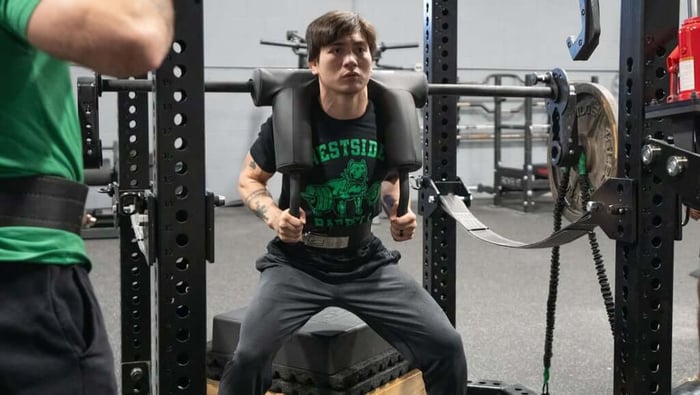
Box Squat vs. Bands – 12 x 2 @70% (45% bar weight + 25% AR)
Squat Accessories:
Single Leg Leg Press – 3 x 10-12
Dumbbell Lunge – 2 x 10-12
Reverse Hyper – 3 x 12-15
Deadlift Main Exercise:
Deadlift vs. Bands – 6 x 2 @70% (45% bar weight + 25% AR)
Deadlift Accessories:
Pendlay Row – 2 x 10-12
Hip Thrust – 2 x 10-12
GHD Sit-Up – 3 x 12-15
Bench Press Main Exercise:
Bench Press vs. Bands – 9 x 3 @70% (45% bar weight + 25% AR)
Bench Press Accessories:
Dumbbell Floor Press – 2 x 10-12
Rolling Dumbbell Tricep Extension – 2 x 12-15
Hammer Curl – 2 x 12-15
Beginner/Intermediate Combined Dynamic Effort
Squat Main Exercise:
Box Squat vs. Bands – 12 x 2 @70% (45% bar weight + 25% AR)
Squat Accessories:
Single Leg Leg Press – 2 x 10-12
Reverse Hyper – 2 x 12-15
Deadlift Main Exercise:
Deadlift vs. Bands – 6 x 2 @70% (45% bar weight + 25% AR)
Deadlift Accessories:
Pendlay Row – 2 x 10-12
GHD Sit-Up – 3 x 12-15
Bench Press Main Exercise:
Bench Press vs. Bands – 9 x 3 @70% (45% bar weight + 25% AR)
Bench Press Accessories:
Rolling Dumbbell Tricep Extension – 2 x 12-15
Hammer Curl – 2 x 12-15
Training Strategies
The programming examples displayed above represent two approaches to executing a combined dynamic effort training day. The Westside Barbell example is what we would expect a high-level collegiate or professional athlete to tolerate. The scaled-down version is what we would expect to use when working with athletes new to barbell training.
This is why we consider athlete evaluation to be the most critical aspect of the training process. If an athlete is correctly evaluated, the training plan will be scaled to meet them where they are and take them to the next level of sports performance. If an athlete is incorrectly evaluated, they risk exposure to intolerable training volume and intensity, leading to overuse injuries and program failure.
As you can see with the Westside approach, we carry quite a bit of volume during our combined dynamic effort day. However, this is the appropriate volume to produce the training responses we seek. Our athletes are highly trained and conditioned, so this level of volume is necessary to attain optimal adaptations.
We also place significant emphasis on training density with our athletes. So, not only is the volume high, butthe density is high also, leading to our combined dynamic effort days placing a significant work capacity demand on our athletes.
A high level of training density is a simple way for our athletes to continue to develop their work capacity and overall physical conditioning. While this will limit accessory exercise training weights to some degree, the trade-off in terms of improved conditioning is worth it. Plus, we can focus on pushing accessory exercise intensity on max effort training days.
When working with beginners or intermediate-level athletes, we cut the training volume by quite a bit. This is due to the need to focus on the strict execution of the main lifts with beginners and intermediates. However, during the accessory work, we will still emphasize training density.
There may also be times when it is necessary to scale the training down even further. This could mean that only the main exercises are executed. As work capacity and conditioning improve, accessory exercises can be added one by one.
Keeping Training on Track
The combined dynamic effort training day will only be as productive as the coach’s ability to regulate the training. This means ensuring athletes are executing lifts at a strict level, and that training weights are appropriate and tolerable. We want strict reps executed at optimal velocity (.8 m/s average), and we want athletes to recover properly from the workout.
If a coach notices that athletes are unable to maintain the recommended average velocity, we recommend immediately adjusting the main exercise training percentages. Our standard approach is to lower training intensity by 5% each week of the training wave, with up to a 10-15% reduction sometimes necessary for beginners.
If an athlete needs to reduce dynamic effort training intensity by more than 15%, we recommend focusing on repeated effort work without accommodating resistance, using a compensatory acceleration approach.
As long as athletes execute reps with strict form and maintain proper barbell velocity, training will be successful, and athletes will make progress. If the combined dynamic effort work is mismanaged, progress will slow, max effort days will suffer, and sports performance can be negatively affected.
No two athletes are the same, and no two training situations are the same. Coaches must understand fundamental strength and conditioning science and be able to adjust training on the fly to ensure it remains effective for all athletes.
While the Conjugate Method is the most effective way to strengthen and condition an athlete for any sport, it is only as effective as the coach who administers the training plan.