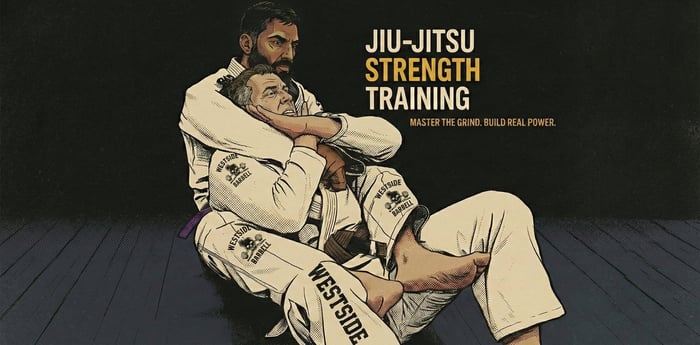
If you want usable strength, durability, and better mat performance—without beating up your body—this is how Westside adapts the Conjugate System for BJJ athletes.
Who This Is For
This is for BJJ athletes of any belt who want strength that shows up in live rounds—more control, more output, fewer breakdowns. You train Jiu-Jitsu 2–3 times per week, and between work, family, and life you don’t have hours to spend in the gym. You want a plan that fits around the mats, not a bodybuilding split that leaves you sore, stiff, and more injury-prone.
- You want usable strength: hips, trunk, grip, upper back, and posterior chain.
- You want durability: stronger tendons/ligaments and fewer nagging issues from the grind of rolling.
- You may have little to no weight training experience and need a smart on-ramp.
What Westside Barbell Is (and Why It Matters for Combat Athletes)
Westside Barbell is the world-renowned powerlifting gym founded by Louie Simmons. Westside became known for producing exceptionally strong athletes using a system that rotates exercises, builds multiple strength qualities at once, and prioritizes long-term progress without grinding the same lifts into the ground.
That matters for Jiu-Jitsu because your sport is already high-frequency, high-skill, and high-stress. The best strength plan for BJJ is one that improves power, strength endurance, and resilience without stealing recovery from the mats.
Louie Simmons built Westside around the idea that you don’t get strong by doing the same thing forever—you get strong by training multiple qualities and rotating the means so you keep progressing.
What the Conjugate System Is (Simple Version)
The Conjugate System trains multiple strength qualities in the same training week. Instead of chasing one “phase” at a time, you develop: max strength, speed/force production, and strength endurance/hypertrophy—while using accessory work to build the muscles that keep you healthy and hard to move.
For BJJ athletes training 2–3x/week, Conjugate is powerful because it’s flexible: you can keep your strength work effective while adjusting volume and exercise choices based on how hard sparring has been.
The Three Methods (What They Mean for BJJ)
- Repetition Method: submaximal sets for muscle, tendon integrity, and work capacity (great for beginners and for staying durable during heavy rolling).
- Dynamic Effort: moving moderate loads fast to develop rate of force—useful for scrambles, shots, bridging, and explosive transitions.
- Max Effort: building absolute strength (when you’re ready) to make every position stronger—stronger hips, stronger back, stronger base.
How Beginners Should Start: Earn the Right to Go Heavy
If you’re new to weight training, don’t rush into maximal lifting. Start by building the body first—this is where the repetition method shines. You’ll learn movement patterns, strengthen connective tissue, and build the base that makes heavier training productive (and safer) later on.
A smart progression is: Repetition Method first (to build the engine and armor), then layer in more intense work as technique and recovery improve. This approach supports the number-one priority for BJJ athletes: staying on the mat consistently.
How to Make Conjugate Fit a 2–3x/Week BJJ Schedule
The goal is to add strength without adding fatigue that ruins training quality on the mats. For most recreational and competitive grapplers rolling 2–3x/week, 2 strength sessions per week is the sweet spot.
A Practical Weekly Template
- Day 1 (Lower emphasis): posterior chain + trunk + single-leg + hamstring work
- Day 2 (Upper emphasis): upper back + pressing + grip + shoulder health
The exact exercise selection and dosage matters—especially for BJJ, where elbows, shoulders, neck, and lower back take a beating. If you want a ready-to-use plan built around these realities, use Westside’s dedicated program: Westside Barbell Jiu-Jitsu Strength Training (online programming). It’s designed to help you apply Conjugate principles in a way that supports mat time instead of competing with it.
Why This Works: Strong Where It Counts in Grappling
Jiu-Jitsu isn’t a single-effort sport. You need repeated outputs—grips, squeezes, bridges, isometrics, scrambles—over and over. Conjugate is effective because it doesn’t gamble everything on one quality. You build multiple qualities year-round, and you rotate exercises to keep progress moving while managing wear and tear.
- Durability first: targeted accessory work builds the tissues that keep you training.
- Force production: speed-strength work supports explosive movement without maxing out constantly.
- Strength that transfers: a stronger posterior chain and trunk improve base, posture, and finishes.
Pro-Level Input, Built for Real Life
Westside’s approach isn’t theory—it’s decades of results. And today, Westside coach Tom works with some of the best Jiu-Jitsu athletes in the world, including Dante Leon, Ademir Barreto, and Max Hanson. The same training principles that build elite strength can be scaled to the hobbyist who just wants to roll hard and stay healthy.
If you want to skip the guesswork and follow a structured plan that fits BJJ 2–3x/week, start here: get Westside Barbell Jiu-Jitsu Strength Training online programming. It’s a practical way to apply the Conjugate System with the right balance of intensity, accessory work, and progression for grapplers.
Actionable Next Steps (Keep It Simple)
- Prioritize consistency over intensity: strength should support BJJ, not replace it.
- If you’re new, start with repetition work: build muscle and movement skill before heavy max effort work.
- Train what keeps you rolling: posterior chain, trunk, upper back, grip, and joint health.
- Use a plan that matches your schedule: if you’re rolling 2–3x/week, run a strength plan that respects recovery.
If you want a complete plan that already does this math for you, use Westside Barbell Jiu-Jitsu Strength Training and apply the system immediately with sessions built to complement your mat time.
Transparency note: You’re reading a Nitro AI article. Nitro is our proprietary system built from Louie Simmons’ books and articles, plus Westside Barbell’s internal education, training data, and recent posts. We use it to answer frequently asked questions we haven’t covered yet. Every Nitro AI article is reviewed by a Westside staff member before it goes live.
The Conjugate System isn’t about doing more—it’s about training smarter. Build the engine, protect your body, and develop strength qualities that show up in every position. For a ready-to-use path built for grapplers, start with Westside Barbell Jiu-Jitsu Strength Training online programming.