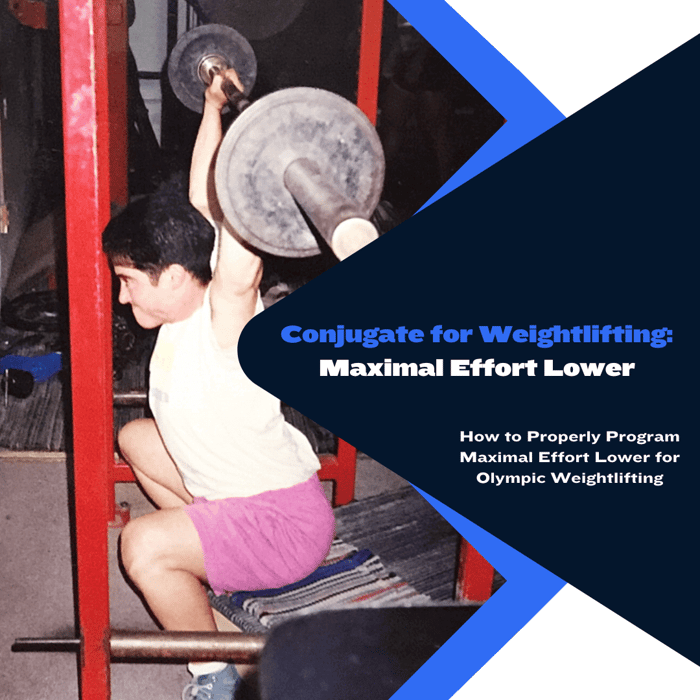
The maximal effort method is a strength training approach used to develop absolute strength. This training focuses on high-intensity work, with athletes training at 90%+ to recruit the largest motor units. While this training is taxing, it is tolerable on a weekly basis, provided the athlete is in shape.
At Westside, we perform two maximal effort lifts per week: one for the lower body and one for the upper body. These movements include a mix of competition-specific movements and special exercises intended to introduce productive training stimulus and develop specific aspects of the competition lifts. Through maximal effort training and intelligent exercise selection, we can rapidly improve an athlete's absolute strength.
The sport of Olympic weightlifting, of course, relies on explosive power and technical proficiency. However, this does not mean that the continuous development of absolute strength is unimportant. As a matter of fact, how much a training plan focuses on the development of absolute strength will define the trajectory of the weightlifter.
While you can certainly add kilos to your lifts by becoming a bit more explosive and technically sound, the real gains in performance will be made by specifically focusing on the development of absolute strength. In addition to gains in absolute strength, we can also improve our explosive power, as absolute-strength-focused training also enhances the rate of force development.
Below, we will discuss the basics of programming a maximal effort lower training day for Olympic weightlifting.
The Main Exercise
Each maximal effort lower workout will feature a main exercise. This will be either a competition specific movement or an exercise variation intended to improve specific aspects of the competition lifts. When training an Olympic weightlifter, our primary goal is to improve an athlete’s ability to execute the snatch and clean and jerk, so the exercise selection will reflect that.
It is important to note that athletes can achieve significant progress with special exercises. In the Olympic weightlifting and powerlifting communities, there is often a strong emphasis on exercise specificity. This narrow focus often results in insufficient variation in primary exercises and can compromise training outcomes.
You will notice that the more an athlete or coach resists the use of special exercises in the name of competition specificity, the more they will preach that expectations should be tempered and that a 5lb PR per year in the competition lifts is acceptable. At Westside, we try to organize training so that athletes PR by 5lbs once per month, not once per year.
Using special exercises not only allows us to improve specific aspects of the competition lifts, but it also helps avoid accommodation and expand the athlete’s capabilities. When working with Olympic weightlifters, our goal is to use our maximal effort lower training not only to improve the competition lifts but also to specifically improve the squat and pull aspects of the lifts.
Here is what a month of maximal effort lower training could look like for an Olympic weightlifter:
Maximal Effort Lower Training Schedule
Month A
Week 1 – Snatch
Week 2 – Front Squat
Week 3 – Clean and Jerk
Week 4 – Clean High Pull
As you can see, month A includes both competition movements and two special exercises. Here is what the second month will look like:
Month B
Week 1 – Power Snatch
Week 2 – Overhead Squat
Week 3 – Hang Clean
Week 4 – 2” Deficit Deadlift
In month B, we focus more on special exercises and less on competition-specific training. It is important to note that this is just an example.
Ultimately, our month B exercise selections would be influenced by the evaluation of the competition lifts in month A and what aspect of the competition lifts we believe an athlete should focus on to improve their overall performance.
We will execute this main exercise plan using an ABAB pattern, which can be used for 8 weeks or up to 24 weeks before changing the special exercise selections. When we change the exercise selections, they will depend on the athlete and the training evaluation.
The Primary Accessory Exercise
As I mentioned above, a common criticism of the Conjugate Method is that the use of special exercises that lack competition specificity will negatively impact the athlete’s ability to execute competition-specific lifts with a high level of technical proficiency. However, by using an intelligent primary accessory exercise programming strategy, we can ensure athletes build and maintain competition-specific movement skills.
Looking at our maximal effort main exercise selections for months A and B, we can begin selecting exercises for our primary accessory work to ensure competition lift skills continue to improve and athletes remain technically proficient.
Here is an example of what would be considered appropriate primary accessory exercise programming following our previously mentioned maximal effort main exercise schedule:
Month A
Week 1 – Front Squat, 4 x 3-5 reps per set, heaviest weight possible while completing all sets/reps.
Week 2 – Snatch, 6 x 2, 75-80%.
Week 3 – Hang Clean, 6 x 2, 75-80%.
Week 4 – High Bar Squat, 4 x 5-8 reps per set, heaviest weight possible while completing all sets/reps.
Month B
Week 1 – Front Squat Box Squat, 4 x 3-5 reps per set, heaviest weight possible while completing all sets/reps.
Week 2 – Snatch, 6 x 2, 75-80%.
Week 3 – Clean and Jerk, 6 x 2, 75-80%.
Week 4 – Snatch High Pull, 4 x 3-5 reps per set, heaviest weight possible while completing all sets/reps.
As you can see, we can include a mix of competition-specific and special exercises when performing our primary accessory work. This prevents skill loss and helps ensure athletes remain confident in their ability to perform competition lifts to a high standard.
It is also important to note that not only will the competition lifts be included as main and primary accessory lifts, but we will also execute competition-specific lifts weekly as part of our dynamic effort lower training. More on that in an upcoming article.
Secondary Accessory Exercises
At Westside, our secondary accessory exercise programming focuses on multi- and single-joint movements to improve the strength and capabilities of the individual muscles and muscle groups most responsible for success in competition-specific movements. This work is focused not only on strengthening the athlete but also on improving work capacity and physical composition.
While the main and primary accessory exercises of a powerlifter and weightlifter will differ, much of the secondary accessory work will be similar. This is because while the competition lift motor patterns are a bit different, the muscles and muscle groups involved in the lifts are largely the same.
Just as a powerlifter needs a strong lower body to squat, a weightlifter needs a strong lower body to execute the squat aspect of the competition lifts. Just as a powerlifter needs strong arms and shoulders to bench press, a weightlifter needs strong arms and shoulders to execute the overhead aspects of the competition lifts. Additionally, both athletes must have strong backs and trunks.
So, while some of the secondary accessory exercise selections will differ, you will notice that many of the same exercises we would use as accessory work for a powerlifter can also be used for an Olympic weightlifter.
Here is an example of a few secondary accessory exercise selections we would make when finishing up our maximal effort lower training as an Olympic weightlifter:
Exercise A
Barbell Good Morning – 4 x 10-12
Exercise B
Glute Ham Raise – 4 x AMRAP
Exercise C
Reverse Hyper – 4 x 12-15
Exercise D
GHD Sit-Up – 4 x AMRAP
Secondary accessory programming centers on high-volume work for muscle groups crucial to competition lifts.
While this list of secondary accessory exercises is a bit posterior-chain focused, we could easily substitute the good morning exercise for anterior-focused work such as front squats, Bulgarian split squats, or even leg press, with the stance modified to bias towards the anterior leg.
Ultimately, the primary and secondary accessory exercise selections we make will depend on the athlete and their strength training needs.
For more information about applying the Conjugate Method to Olympic weightlifting, check out the WSBB Blog.