The Conjugate Method is a strength and conditioning training system that can be adapted to practically any sport. Often, folks with a limited understanding of the Westside Barbell Conjugate System believe our methods only apply to geared lifting. If you truly know the Conjugate Method, you know this is not the case.
While our methods have certainly been successful in the world of geared powerlifting, they have also been used to train raw powerlifters, conventional sports athletes, and Olympic weightlifters.
The Conjugate Method allows coaches and athletes to develop multiple strengths and athletic traits simultaneously, resulting in rapid progression and reduced detraining. This is because we do not employ hyper-specific training phases, which allows us to continuously develop these strengths and traits while avoiding detraining.
Depending on the sport, we can construct an intelligent training plan that manipulates the use of maximal, dynamic, and repeated effort methods to elicit the training adaptations needed to improve sport performance.
The sport of Olympic weightlifting requires athletes to move a heavy barbell as fast as possible, generating enough momentum to get into position to carry out the lift successfully. However, just because this sport emphasizes explosive power, athletes must also continue to develop absolute strength to raise their performance “ceiling”.
If the goal is to rapidly improve explosive power while also increasing absolute strength, look no further than the Conjugate Method. Below, we will discuss the basic programming strategy we use when working with Olympic weightlifters.
The Maximal Effort Method
The maximal effort method is a training method that requires athletes to train at or above 90% of their 1rm. This method is executed twice each week to improve absolute strength in the lower and upper body. At Westside, we use a mix of sport-relevant movements and special exercises to improve absolute strength, which we refer to as builders and testers.
A builder is an exercise that may not be highly sport-specific, but can improve strengths or qualities that carry over to sport-specific movement. Testers are sport-specific movements that allow us to accurately gauge progress and check the efficacy of our builder movement selections.
When working with weightlifters, we will, of course, include the competition lifts, while also using special exercises to improve performance during the different phases of those lifts.
Here is an example of an A and B group of maximal effort lower and upper exercise selections we could employ when training an Olympic weightlifter:
Lower Month A
Week 1 – Snatch
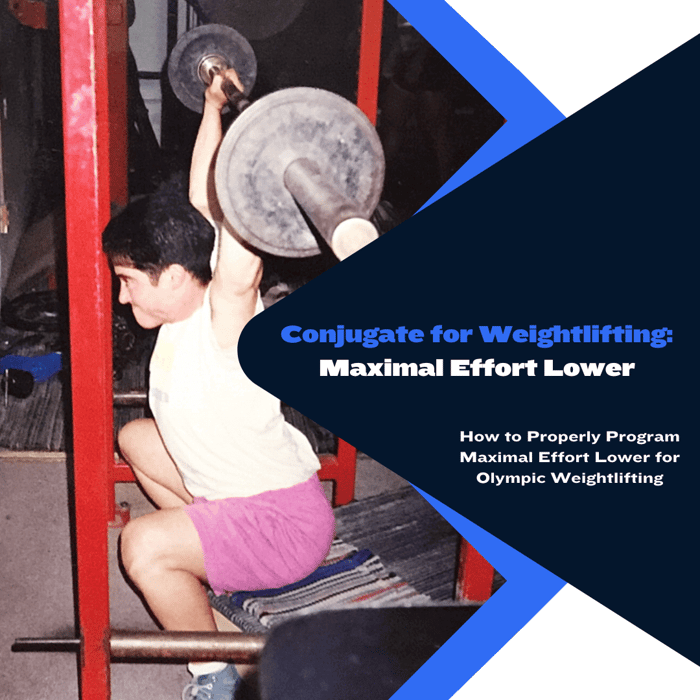
Week 2 – Overhead Squat
Week 3 – Clean and Jerk
Week 4 – High Bar Squat
Lower Month B
Week 1 – Tall Snatch
Week 2 – Front Squat
Week 3 – Power Clean
Week 4 – 2” Deficit Deadlift
Upper Month A
Week 1 – Power Jerk
Week 2 – Strict Press
Week 3 – Close-Grip Bench Press
Week 4 – Z Press
Upper Month B
Week 1 – Behind the Neck Jerk
Week 2 – Hang Clean and Press
Week 3 – Push Press
Week 4 – Hang Clean and Jerk
As you can see, our lower work will include the competition-specific lifts, along with additional exercise variations intended to improve the pull and squat aspects of those lifts. Meanwhile, our upper-body exercise selections focus on improving jerk and press strength.
If we are dealing with a beginner, we can, of course, reduce the amount of variation and include competition-specific lifts more frequently. That is the great thing about the Conjugate Method: we can construct a program that meets the needs of all athletes, regardless of experience or ability.
The Dynamic Effort Method
While the maximal effort method is focused on building absolute strength (it also improves rate of force development), the dynamic effort method allows us to specifically focus on rate of force development. The combination of maximal and dynamic effort work allows athletes to make great improvements in explosive power, which is critical to the sport of Olympic weightlifting.
While our maximal effort exercise selections are mostly weightlifting-specific, our dynamic effort work will include a mix of box squats and Olympic lifts. While the box squat is not a sport-specific lift, it is a valuable tool to develop rapid knee and hip extension, which is critical in nearly all sports.
While our maximal effort movements will change weekly, our dynamic effort work will follow a three-week wave training structure. This means we will perform the same exercise variations for three weeks, increasing training intensity and decreasing training volume from week one to three.
The three-week wave allows athletes to train at optimal levels of volume and intensity, while also helping to mitigate excess fatigue that could interrupt training.
Dynamic effort training also provides us with the opportunity to focus on improving performance in the competition-specific lifts. Typical WSBB dynamic effort calls for deadlifts to be performed immediately following the box squat. However, when working with Olympic weightlifters, we can replace the deadlift work with the competition-specific lifts.
This means that instead of executing deadlifts, we will perform the snatch or the clean and jerk.
Here is how a three-week wave could be structured when working with an Olympic weightlifter:
Dynamic Effort Lower
Week 1
Box Squat – 12 x 2 @65% (40% + 25% AR)
Clean and Jerk – 8 x 2 @70% bar weight only
Week 2
Box Squat – 10 x 2 @70% (45% + 25% AR)
Clean and Jerk – 6 x 2 @75% bar weight only
Week 3
Box Squat – 8 x 2@75% (50% + 25% AR)
Clean and Jerk – 5 x 2 @80% bar weight only
Eliminating the deadlift from our dynamic effort lower work allows athletes to work at a lower intensity while accruing meaningful volume and improving their technical execution.
Including the competition-specific lifts in our dynamic effort lower training is one of the ways we can continue improving strength and technique in the competition lifts, no matter our maximal effort training schedule. This helps to prevent skill loss or unfamiliarity with the competition lifts.
The Repeated Effort Method
When training Olympic weightlifters, we use repeated effort work to target specific muscles and muscle groups that contribute to strength and success in the competition lifts. As the name implies, we do this by performing multi- and single-joint exercises for multiple reps and sets. This work is performed on every training day, done immediately after the main exercise.
Our approach to repeated effort work for weightlifters will be the same as in any other sport: we want to strengthen the muscle groups that contribute to competition lift success, enhance work capacity, and improve overall physical composition. Additionally, we can use this work to target specific muscular or positional weaknesses we identify during maximal or dynamic effort training.
Here is what an upper-body repeated effort day could look like for an Olympic weightlifter:
Primary Accessory Exercise
Press in Snatch – 4 x 5-8 (while this is a special exercise, we can also perform the competition-specific movements as primary accessory exercises to improve strength and technique)
Secondary Accessory Exercises
Pendlay Row – 4 x 8-10
Dumbbell Push Press – 3 x 10-12
Upright Row – 3 x 8-10
Rolling DB Tricep Extension – 3 x 12-15
As you can see, we are using exercise variations to target critical muscle groups, helping athletes better execute jerk- and press-based exercises. This work will not only help improve competition lift performance but also improve exercise performance across all other main exercise variations.
One Method, Many Approaches
The basic programming strategy described above only scratches the surface of how we can manipulate the Conjugate Method to improve an Olympic weightlifter's sport performance. If we are working with a specific athlete, the exercise selections for maximal, dynamic, and repeated effort training could change. However, no matter the athlete or the situation, the overall strategy would remain the same.
The Conjugate Method is the most optimal strength training method because it never puts the coach or athlete in a corner they can’t escape from. If a coach or athlete knows our method well enough, there is always a path forward to continue progressing. The only limitation to this training method is the mind of the coach or athlete wielding it.
Our training style allows athletes to continuously improve absolute strength and explosive power while also enhancing work capacity and physical composition. A properly trained Conjugate-based athlete will show up to competition strong, explosive, technically proficient, and fit.
Keep an eye out for a new Conjugate Weightlifting program dropping soon in the Conjugate Club.