Table of Contents
The typical Westside Barbell training week calls for two upper-body training days per week, a maximal and dynamic effort workout. This training covers two important aspects of powerlifting: improving absolute strength and rate of force development. When executed properly, these two training days work together synergistically to make athletes both stronger and more explosive.
While this approach is most effective, there are times when athletes may need a break from either maximal or dynamic effort upper body training. This could be due to fatigue, preventing athletes from meeting the thresholds for proper maximal or dynamic effort training, or to wear and tear from constant barbell pressing.
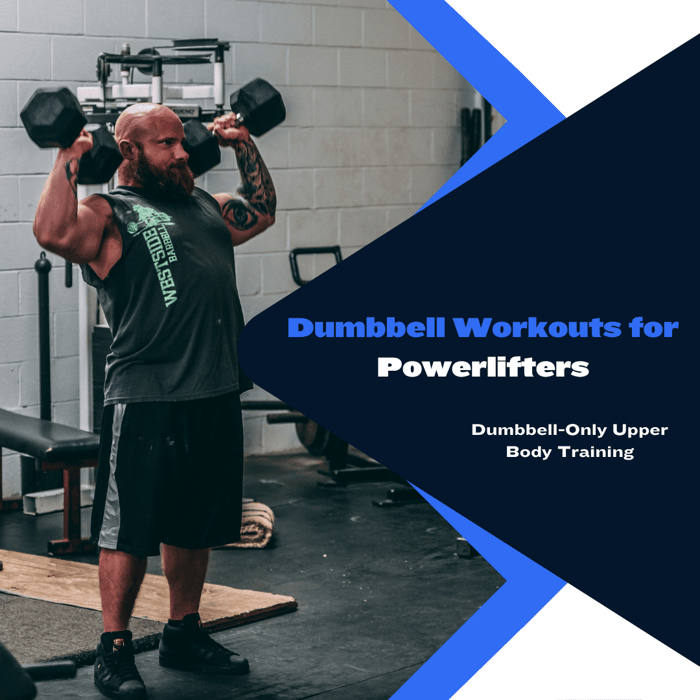
Fortunately, when using the Conjugate Training System, we always have a way to keep training productive, no matter the circumstances. When an athlete is unable to perform a maximal or dynamic effort upper-body exercise, we can replace the training day with a heavy or repeated effort dumbbell workout.
In this article, we will discuss heavy, repeated effort upper dumbbell workouts, including how to program them.
Heavy Effort Dumbbell Workout
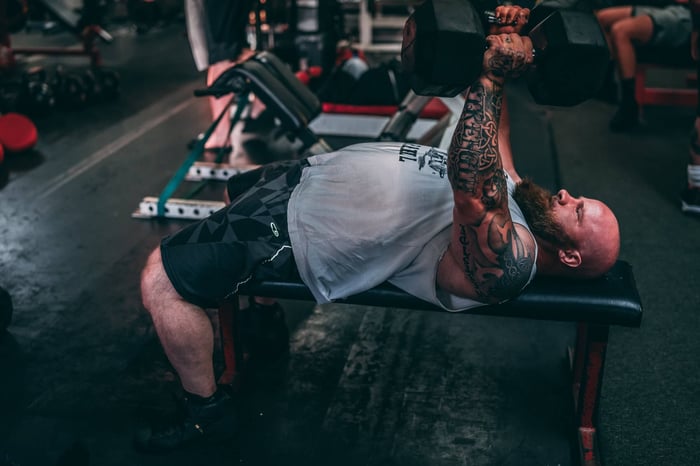
The repeated effort method can be used in various ways to improve specific aspects of sport performance, depending on the set and repetition scheme used for the exercise. Heavy effort dumbbell training calls for athletes to use the heaviest dumbbells possible to complete multiple sets of 3-5 repetitions.
This training is often used for beginner or intermediate-level athletes, provided they can reach effective training intensities with common dumbbells available at most gyms. If we are dealing with an experienced athlete benching 500lbs+, achieving appropriate heavy effort training intensity becomes difficult, since most gyms do not have 180lb+ dumbbell sets.
Heavy effort dumbbell work provides the beginner or intermediate-level athlete with exposure to optimal exercise intensity capable of improving absolute strength, all while avoiding an all-out maximal effort and giving athletes a week off from heavy barbell pressing to reduce the likelihood of overuse injuries.
When we implement a heavy effort dumbbell workout, we often use one of three types of presses: flat, incline, or floor press. If we are working with an athlete focused on vertical pressing strength, we will go with a standing or seated dumbbell overhead press.
Here is how we would go about programming a heavy effort dumbbell workout for a beginner or intermediate-level athlete:
Main Exercise
Dumbbell Bench Press – work up to a top set of 3 reps
Primary Accessory Exercise
Barbell Row – 4 x 5-8
Secondary Accessory Exercises
Incline Dumbbell Bench Press – 4 x 10-12
Chest-Supported Row – 3 x 10-12
Rolling DB Tricep Extension – 4 x 10-12
Hammer Curl – 4 x 10-12
As you can see, the main exercise is a dumbbell bench press, performed under heavy-effort training parameters. We are working up to a top set triple with the dumbbell press, which should have the athlete training at about 90% intensity. While not as effective as a true maximal effort, this day would still have a positive impact on upper body absolute strength.
The rest of the day follows a fairly common upper body accessory exercise training scheme. The goal here is to adequately train all muscle groups that contribute to upper-body pressing strength. If athletes have specific weaknesses, we will adjust the exercise selection to include one or two exercises that directly address the issue.
This training day would be used only as a replacement for a maximal effort exercise. If we wanted to replace a dynamic effort upper workout, we would use a repeated effort training scheme.
Repeated Effort Dumbbell Workout
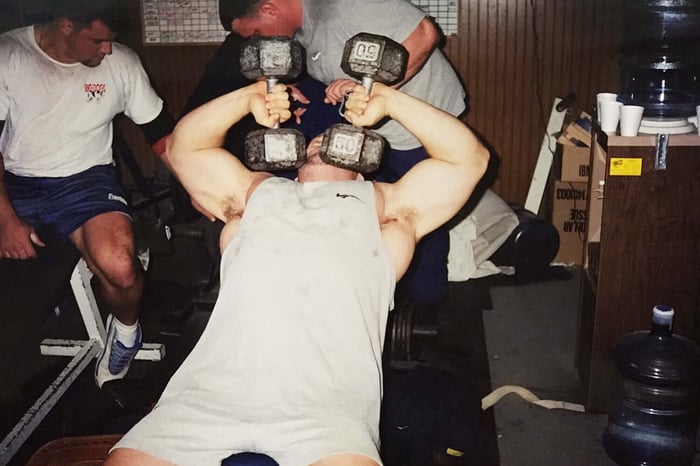
The second programming option we have when implementing a dumbbell-only workout is the repeated effort method. The repeated effort method calls for athletes to lift a challenging weight for a specific number of sets and reps, working to near or total failure. The goal of this training is to achieve optimal muscular hypertrophy and improve the work capacity of specific muscle groups.
Repeated effort dumbbell workouts can be implemented for athletes at any level. As we mentioned previously, heavy dumbbell work is difficult for advanced-level athletes to perform, as most gyms lack dumbbells heavy enough to achieve adequate training intensity.
With repeated effort training, we can adjust the set and rep scheme to match the available dumbbell weights, ensuring athletes achieve optimal training stimulus to elicit the specific adaptations we are targeting. Even with a 600lb+ raw bencher, we can adjust the rep counts to 12, 15, or even 20 per set to ensure the training is productive.
When we use a repeated effort upper dumbbell workout, we will most often perform it in place of a dynamic effort upper training day. Often, this is a good option between training waves. Once one three-week wave ends, we will execute a repeated effort dumbbell workout the following week before jumping into our next dynamic effort upper body training wave.
Here is how we would go about programming a repeated effort upper dumbbell workout:
Main Exercise
Dumbbell Floor Press – 4 x 10-12
Primary Accessory Exercise
Seal Row – 4 x 8-10
Secondary Accessory Exercises
Dumbbell Push Press – 4 x 10-12
One Arm DB Row – 3 x 10-12
Incline Williams Extension – 4 x 10-12
DB Bicep Curl – 4 x 10-12
In this workout, we begin the training day with a dumbbell floor press programmed to follow a repeated-effort training scheme. This could be an ideal approach for an athlete dealing with weak triceps. As we move on through the training day, the primary and secondary accessory exercises are programmed as usual.
Always a Way Forward
No matter how well planned or executed a training plan may be, there will ultimately be times when an audible must be called to keep training on track and productive. Whether due to fatigue or aches and pains, it is important to have strategies in mind to implement immediately.
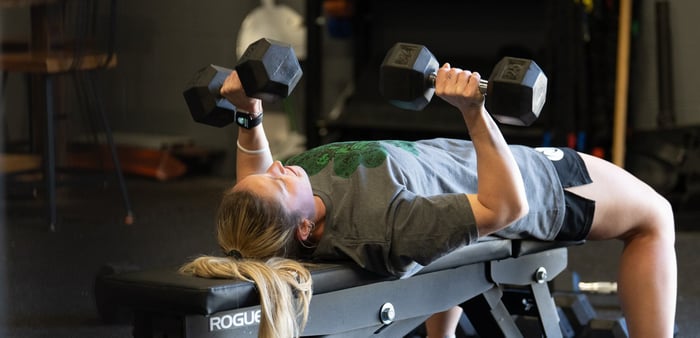
The two dumbbell workout styles discussed above are viable strategies for replacing a maximal or dynamic effort upper body workout.
There are many advantages afforded to the coach or athlete who chooses to use the Conjugate Method. Chief among them is the ability to adjust training on the fly depending on athlete feedback and current circumstances.
We are never locked into a mandatory training rotation; we can always adjust to ensure training remains optimal while keeping fatigue in check and reducing the chance of overuse or catastrophic injury.
At Westside, Lou and our training crews have used dumbbell-only workouts regularly over the years. A strategy Lou preferred was a dumbbell-only upper body workout in place of a maximal effort upper body workout once every fourth week. This helps to avoid excess upper body fatigue and gives athletes a week off from barbell pressing to alleviate pain or soreness in the wrists, elbows, and shoulders.
The next time you need an alternative to a maximal or dynamic effort upper body workout, consider the two strategies discussed above.
WSBB Books - Bench Press Manual

$11.25
$22.50
The Bench Press Manual by Louie Simmons is a comprehensive guide to mastering the bench press and achieving personal records in this critical lift. Tailored with beginners in mind, this 70-page manual provides in-depth training techniques that align with the… read more
FAQs
When should a dumbbell-only upper body workout be implemented?
We utilize a dumbbell-only workout when an athlete displays signs of excess upper body fatigue due to recent maximal efforts, or reports dealing with joint pain potentially related to barbell pressing.
Is an entire three-week wave of dumbbell-only training useful?
While this would not be our initial approach, this could be a viable option for some athletes.
Can you implement a dumbbell-only upper body workout every month?
Yes, Lou has spoken previously about the effectiveness of dumbbell-only upper body workouts in place of typical maximal effort training once every fourth week.