
Table of Contents
The word has gotten loose. Conjugate now gets stapled onto almost anything. Rotate a few exercises, throw in a speed day, call it conjugate. That is not what the word means, and it is not what the conjugate method is. If you are going to use the term, you should know what you are actually saying, and you should know where it came from.
Conjugate means joined together. Coupled. That single idea is the whole thing. In a conjugate system you develop multiple strength qualities at the same time, not one at a time in separate phases. Absolute strength, speed strength, strength endurance, work capacity. These are trained concurrently, in the same week, every week. The qualities are conjugated. Joined. That is where the name comes from, and it is the part most people skip right past.
Where the Conjugate Method Came From
Louie Simmons did not invent the raw idea, and he never claimed to. He found it in the Soviet literature and then spent forty years turning it into something a coach could actually run. Laying out the real lineage does not take anything away from Westside. It does the opposite, because the line runs straight through here.
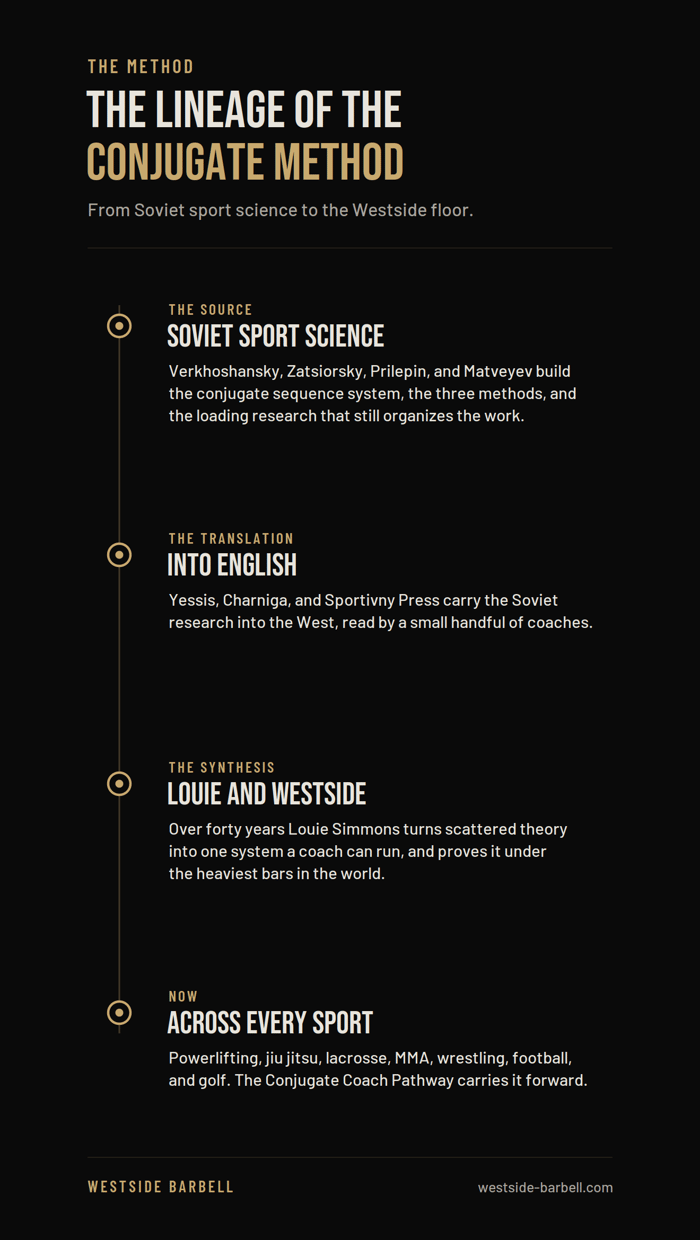
The seeds are Soviet. Through the 1960s and 70s, sport scientists like Yuri Verkhoshansky were building what they called the conjugate sequence system. In the original Russian sense, conjugate meant conjoined in sequence. You arrange your training so the adaptation from one stage becomes the foundation for the next, each phase feeding the one after it.
Verkhoshansky is also the man behind the shock method and the depth jump, and behind dynamic correspondence, the principle that a special exercise should match the force and speed demands of the movement it is meant to serve. [1, 3]
Working in the same era was Vladimir Zatsiorsky, who laid out the three methods that still organize everything we do: the maximal effort method, the dynamic effort method, and the repeated effort method. If those names sound familiar, it is because they are the spine of the system, and they came from his work. [4]
Then there is A. S. Prilepin, who studied the training records of thousands of competitive weightlifters to work out how many reps and sets actually produce at a given intensity, and how much is wasted volume. That chart is why our dynamic effort work is calculated instead of guessed. [8] Leonid Matveyev gave the world classical periodization, the phase by phase model we chose to move away from. [5]
Bondarchuk and Vorobyev added their pieces. [7, 9] None of this was secret, but almost none of it was reaching American lifters. Most of it sat in translated journals like the Soviet Sports Review, carried into English by translators like Michael Yessis and Bud Charniga, read by a small handful of coaches and ignored by nearly everyone else. [10, 11]
The theory was Soviet. The system is Westside. And the only reason most coaches have ever heard of either is Louie.How It Became A System
Here is the part the textbooks could never do on their own. Theory does not produce a world record. A system does. By the 1970s to1980's Louie already had the hard part, the part you cannot copy out of a book. A culture. A win at all costs mentality. A garage gym of powerlifters who were plenty strong. What he did not have yet was a system to house any of it. He had strong men who could not reliably get it right on the day, on the platform, when it counted.
He pulled methods from wherever he could find them, and his first real source was the original Westside Barbell Club in Culver City, California. That club is where the name comes from. In the 1960s a crew of lifters and throwers, Bill "Peanuts" West, George Frenn, and Pat Casey, the first man to squat 800 and total 2,000, were already doing the things that would come to define the method.
Box squats. Floor presses. Power rack work. Special exercises rotated to push past sticking points. They were among the first to pull those tricks into one system for competitive lifters, and they shared all of it openly in the muscle magazines of the day. A young Louie, his squat stuck at 410 and stationed overseas in the Army, found their box squat article, tried it, and never looked back. Years later he named his Columbus gym Westside Barbell in tribute to the men who set him on the path. [15]
Still, the methods were scattered and the structure was missing. Then the other half arrived. While Louie was building his culture in Ohio, the Soviets had spent decades building the science, the conjugate sequence, the loading research, the organization of training. When the translated material finally reached him, the work of Bud Charniga and the others, the two halves married. Louie at last had a system to house the culture, the programming, and the standard he already demanded. The science gave him the structure. The culture gave the structure a reason to exist.
He took the Soviet use of special exercises and wave loading, blended it with the box squats and exercise rotation he inherited from the original Westside, added the Bulgarian habit of lifting near maximal weights often, the approach Ivan Abadjiev rode to a wall of Olympic medals, and built the version the powerlifting world now knows. Rotate the max effort lift to beat accommodation. Train speed strength with submaximal bars and accommodating resistance. Attack weak points with special exercises. Keep every quality alive at once. [12, 13]
That marriage is the contribution, and it is not a small one. The science was Soviet. The earliest methods were Culver City. But the system that came out the other side, the one on the floor today, is more a reflection of Louie Simmons than of any single part it came from. He is the one who had the culture that needed a structure, went and found the structure, and spent forty years proving the whole thing under the heaviest weights in the world. Strip Louie out of the story and you do not have the modern conjugate method. You have a pile of good ideas that never became a system.
The Two Engines
Two of those methods sit at the center of the day to day. The max effort method and the dynamic effort method. Everything else exists to support them.
Max effort is how we train absolute strength. You work up to a top single on a main movement. Here is the part that matters: the movement changes every week or two. You do not back squat to a max every Monday until your hips give out. You rotate the lift. A different bar, a different stance, a box, a chain setup, a specialty movement. Rotating the exercise is what lets you train at maximal loads year round without grinding yourself into the ground. The body never gets the chance to fully accommodate, so it keeps adapting. A coach who skips the rotation and just maxes the same lift over and over is not running conjugate. He is running himself into a wall and calling it a method.
Dynamic effort is how we train speed strength, the ability to produce force fast. Submaximal weight moved with maximal intent, usually against bands or chains so the resistance accommodates through the range. The target is rate of force development, not grinding. A lifter who can only express strength slowly is not much use to a fighter or a field athlete. Dynamic effort keeps the fast end of the spectrum alive while max effort builds the top end. You are working both ends of the same problem in the same week.
Underneath those two you have the repeated effort method for hypertrophy and work capacity, and a rotating library of special exercises that attack weak points and build general physical preparedness. The special exercises are not filler accessory work. Each one has a job. You select them to fix the thing that is holding the main lifts back. Weak off the chest, the program answers it. Weak lockout, the program answers it. Nothing in the rotation is there by accident. [4, 6, 12]
What It Is Not
This is where people go wrong. The conjugate method is not variety for its own sake. Throwing random exercises at an athlete is not conjugate. It is chaos with good marketing. The rotation has logic underneath it. You rotate to beat accommodation, and you select to address weakness. Take away either of those and you do not have the method anymore. You just have a busy program that tires people out.
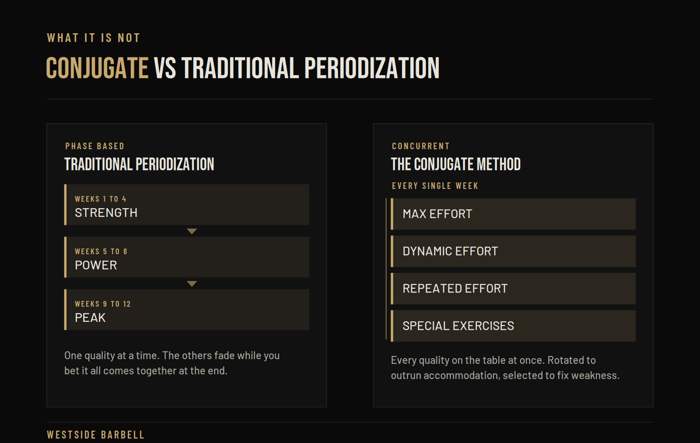
It is also not traditional periodization wearing a different shirt. In that phase based model you isolate one quality at a time. A strength phase, then a power phase, then a peak. The bet is that you can build one thing while the others fade, then stitch it all together at the end. [5] For a lot of athletes that bet does not pay. A fighter cannot afford to spend six weeks getting slow in exchange for getting strong.
A field athlete in a long season cannot park their power development and hope to find it again in the playoffs. The conjugate method keeps every quality on the table at once. You are not chasing a maximum in all of them on the same day. You are keeping each one alive while you push hardest on whatever the athlete needs most right now. That is the entire advantage, and it is exactly why the qualities are conjugated in the first place.
Yes, It Is Concurrent Training
The honest word for what the modern day conjugate method does is concurrent. In training theory, concurrent means developing several qualities in parallel, in the same week, rather than block or sequential training that builds one quality at a time and sets the others aside. That is exactly how we train. Absolute strength, speed strength, strength endurance, and work capacity all stay in play at once. So when someone calls conjugate a concurrent system, they are right. That is the truest description of it.
Some confusion comes from a different corner of the research. In exercise physiology, concurrent training usually points to one narrow case, stacking heavy endurance work on top of lifting, and that pairing can blunt strength over time. It is called the interference effect, and Hickson documented it in 1980. [16] That is not what happens here.
We are not pitting a marathon against a squat. We develop strength qualities that sit close to one another, and where any two could start to compete, we manage it the way the method always has, by rotating the emphasis and choosing which quality gets pushed hardest while the rest are kept alive.
There is a real debate worth naming, and it is not the interference effect. Block periodization makes the opposite case, that training many qualities at once spreads the stimulus too thin, and that advanced athletes are better off concentrating on one quality at a time in sequence. [17] It is a serious argument. Our answer lives in the rotation. The conjugate method is not equal effort spread evenly across everything. It concentrates hard on the priority and the weak point while it holds the rest in place. That is concentration inside a concurrent frame, and it is how you get parallel development without the dilution the block camp warns about.
There Are No Absolutes
Programming and training are not two different jobs. They are the same system seen from two angles. The plan you write and the work that actually happens on the floor feed each other constantly. Treat them as separate disciplines and you have already misunderstood how this works. [2]
Spend enough time in strength and conditioning and you watch the fads come and roll back out again. New names on old ideas, repackaged and sold as discovery. If one thing holds, it is this: there are no absolutes in strength and conditioning. Anyone who speaks in absolutes has not spent enough time under the bar to know better.
The work changes day to day and week to week, and it changes for a reason. What the athlete went through in training, what they are going through in their sport, how they moved and recovered and competed, all of it is feedback, and the feedback changes the training in front of you.
That is the part that does not fit in a tidy template. You are rotating every piece of it in real time. How you structure the dynamic, maximal, and repeated effort work. When to push volume and when to pull it back. When to hammer joint specific work and when to chase hypertrophy. How to blend all of it together for the person actually standing in front of you. And you are doing all of that while holding the thing steady, keeping the consistency and the culture right, so the gym does not become a different gym every week. A system that lets you be that malleable without falling apart is rare. That malleability is exactly why conjugate is worth what it is worth.
When someone is convinced they have reinvented the wheel, it usually means they never spent real time around Louie in person. He would change a workout on the fly, mid session, based on what he saw in front of him. He said it constantly. A chain is only as strong as its weakest link. If there is one blatant weakness staring at you, what is the point of working on anything else? Fix that. Then move to the next one. That is not a fad, and it is not a discovery. It is just how the method has always worked. [14]
Why It Holds
This is also why the conjugate method moves across sports so cleanly. The same structure that built world record powerlifters is what we run for jiu jitsu players, lacrosse athletes, wrestlers, fighters, and golfers. The proportions shift from sport to sport. A lineman needs a different balance than a guard passer, and a golfer needs something different again. But the engine does not change. You identify the demands of the sport, you train the qualities concurrently, you rotate to keep adapting, and you select to fix weaknesses. The framework does not care what sport the athlete is in. [13, 14]
We put that to the test over a full year. We took athletes from lacrosse, jiu jitsu, MMA, wrestling, and football and ran them on the same system at the same time. Not the same workout. The same system. On any given day we adjusted the exercises, the volumes, and the intensities to fit what each athlete needed and where they were in their own season. Twelve months later every one of them was stronger and harder to break, and the part that matters most, each of them performed better in their actual sport.
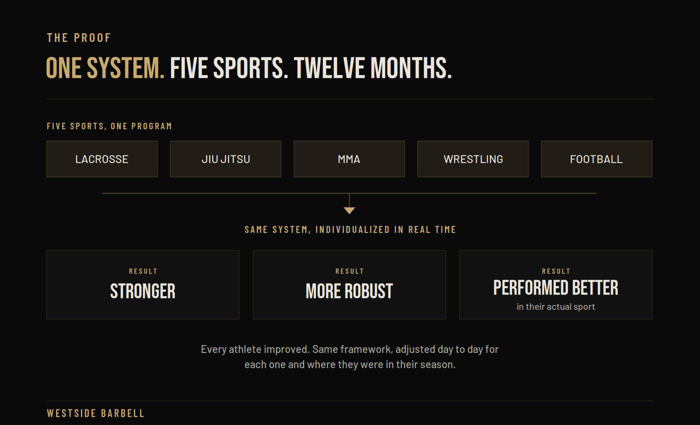
That is the whole argument in one sentence. One framework, individualized in real time, bending to whatever walks in the door that day without ever losing its shape. A rigid template cannot do that. A pile of random workouts cannot do that. A system built to be adjusted can, and that is the difference between a program and a method.
It also has to survive the real world, where we may only have an athlete three to nine hours a week. The conjugate method is flexible enough to work alongside their sport coaches and skill coaches instead of fighting them for control. That is how strength and conditioning earns its place and keeps it, at a time when plenty of programs are looking for reasons to cut it. A system that adaptable is a system that stays in the building.
And Now To Us
 The clearest proof is in our own buildings, and it is happening right now. Ally Kennedy on the lacrosse side. Dante Leon in jiu jitsu. A room full of athletes alongside them getting measurably better in their sports, season after season. Like Louie, the goal has never been complicated. Advance the actual athletes in front of us.
We run two facilities now. The original gym in Columbus is preserved exactly as Louie left it, a living record open by appointment. Our current athletes train in a second building where the work keeps moving, the method adapted for their sports and documented so other coaches can use it. You can read the whole story of both in our About page.
The lineage did not stop with Louie, and a living method does not get to stop. Advancing the conjugate method is the daily job of the staff and the coaches we work with, and it is carried forward by the next generation we are guiding through the Conjugate Coach Pathway. We are not after copies. We want interpretation.
That word matters. We want coaches who keep tinkering and exploring, who think for themselves, carve their own path, and go build their own businesses, the same way Lou made it possible for so many of us to do. He helped start more careers and more gyms than most people will ever realize. Locking the method behind one rigid way of thinking would betray the whole point of it.
We ask for one thing in return. Credit the source. Build the community up around the man and the legacy that gave all of us a conjugate in the first place. The word belongs to a method, and the method belongs to Westside. Take it anywhere you want. Just do not pretend it appeared out of nowhere. The line runs from the Soviets, through Louie, to us, and out to everyone we are teaching to carry it next. That is not a closed door. It is an open one, with a name on it.
FAQs
What is the conjugate method?The conjugate method is a strength training system that develops several physical qualities at the same time instead of one at a time. In a single week you train maximal strength, explosive speed, and muscle through the maximal effort, dynamic effort, and repetition effort methods, and you rotate the main exercises often so progress never stalls. That combination is what separates the conjugate method from programs that chase one goal per phase.
Who created the conjugate method?Louie Simmons built the conjugate method at Westside Barbell over more than four decades. He took the science coming out of Soviet sport, paired it with the hard culture of the original Westside Barbell club, and turned a loose set of ideas into a system any coach could run. The conjugate method as it exists today is his synthesis, proven first in powerlifting and then across a long list of sports.
Is the conjugate method the same as concurrent training?In today's language, yes. Concurrent training means developing multiple qualities at once, and that is exactly what the conjugate method does. The honest way to describe the conjugate method to a modern coach is concurrent training with rotating emphasis, where one quality is pushed while the others are maintained and built. The label is newer than the method, but the idea underneath is the same.
Is the conjugate method only for powerlifters?No. It was proven in powerlifting first, but the conjugate method is a system for building strength, speed, and durability in any athlete. We run the conjugate method with field athletes, fighters, and lifters on the same backbone, changing the exercises and the emphasis to fit the sport and the person in front of us. The method bends to the athlete. The athlete does not bend to the method.
How is the conjugate method different from traditional periodization?Traditional periodization trains one quality at a time in sequence, so whatever you are not working on quietly fades. The conjugate method trains everything in the same week, which removes that detraining problem and keeps an athlete ready year round. Because the conjugate method rotates exercises and emphasis instead of running long single goal phases, progress stays steady and the program adjusts to the athlete in real time.
Coaching Foundations Course | Level 1 Conjugate Pathway

$150.00
Learn How Louie Thought — Then Get Direct Access to a Westside Coach to Apply It to Your Athletes NSCA CEU APPROVED - 0.9 The philosophy, the assessment process, and the culture that built 40+ years of World Records —… read more
References
- Verkhoshansky, Y.V. Fundamentals of Special Strength-Training in Sport. Trans. A. Charniga. Sportivny Press (orig. 1977).
- Verkhoshansky, Y.V. Programming and Organization of Training. Trans. A. Charniga. Sportivny Press (orig. 1985).
- Verkhoshansky, Y.V. and Siff, M.C. Supertraining, 6th ed., 2009.
- Zatsiorsky, V.M., Kraemer, W.J. and Fry, A.C. Science and Practice of Strength Training. Human Kinetics, 1st ed. 1995, 3rd ed. 2021.
- Matveyev, L.P. Fundamentals of Sports Training. Progress Publishers, Moscow, 1981.
- Medvedyev, A.S. A System of Multi-Year Training in Weightlifting. Trans. A. Charniga. Sportivny Press.
- Vorobyev, A.N. Weightlifting: Textbook for the Institutes of Sport of the USSR. Trans. A. Charniga. Sportivny Press.
- Prilepin, A.S. Research on optimal training loads for weightlifters. Soviet sport science, 1970s, as presented in translated Soviet weightlifting literature.
- Bondarchuk, A.P. Transfer of Training in Sports. Trans. M. Yessis. Ultimate Athlete Concepts, 2007.
- Soviet Sports Review (later Fitness and Sports Review International), ed. M. Yessis. English translations of Soviet sport science.
- Charniga, A. (trans.). Soviet and Russian strength and weightlifting texts. Sportivny Press.
- Simmons, L. The Westside Barbell Book of Methods. Westside Barbell, 2007.
- Simmons, L. Special Strength Development for All Sports. Westside Barbell.
- Simmons, L. The Conjugate Method: Enhanced Through the Research of Westside Barbell. Westside Barbell, 2022.
- Yarnell, D. Forgotten Secrets of the Culver City Westside Barbell Club. 2011.
- Hickson, R.C. Interference of strength development by simultaneously training for strength and endurance. European Journal of Applied Physiology, 1980.
- Issurin, V.B. Benefits and limitations of block periodized training approaches to athletes' preparation: a review. Sports Medicine, 2016.
WSBB Books - Forgotten Secrets of The Culver City Westside Barbell

$21.95
This book offers a deep dive into the legendary origins of strength training, focusing on the stories and methods of the Culver City Westside Barbell Club and the Wild Bunch of West Virginia. If you are passionate about Old School,… read more