Table of Contents
The development of skill and technique is important in all sports. Powerlifting is no different: athletes must develop a high level of proficiency in the squat, bench press, and deadlift to succeed in competition. Failure to do so results in lackluster performance at competition, or worse, injury.
The Conjugate System is often criticized for lacking competition lift specificity. This is due to our preference for specialty bars, accommodating resistance, and exercise variation. To the uninformed coach, this training doesn’t make sense, given that we don't specifically train the squat, bench press, and deadlift to competition standards on a weekly basis.
In a previous article, I discussed misconceptions regarding the Conjugate System and explained how we are not only specific but also ultra-specific. Our training develops specific strengths and traits, targets specific weaknesses, and builds movement skills in a variety of ways that carry over to the competition lifts.
Our approach is simple; we master complexities so that the competition lifts become easier. If an athlete can consistently achieve PR lifts using specialty bars and special exercises, there is no doubt their competition lift proficiency has increased.
However, our preference for specialty bars and special exercises during main exercise training does not limit our ability to develop movement skills in the competition lifts. In this article, I will cover the ways we manipulate our programming to ensure athletes continue developing proficiency in and remain familiar with the competition lift motor patterns.
Maximal Effort Programming
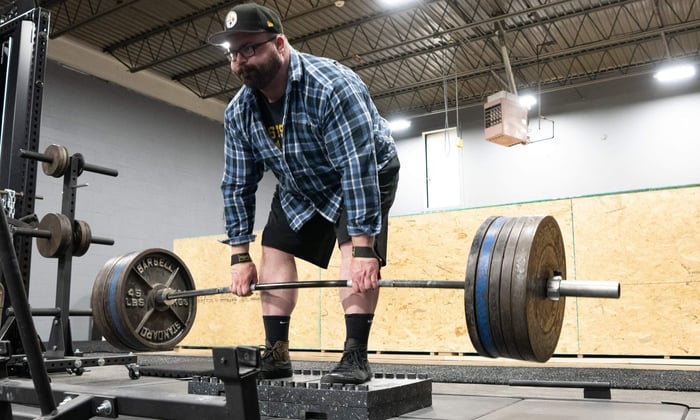
The maximal effort method is a strength training approach that develops absolute strength. This style of training requires athletes to train at high intensity (90%+), preferably working up to a top set single for a PR lift. This method is the most competition-specific, considering we are training at the same levels of intensity we will experience at competition.
During our maximal effort training, we can include both specialized and competition-specific exercises. Ideally, every other month of maximal effort training will include one exposure to a competition-specific lift.
Here is an example of how we would go about including competition-specific exercises when executing maximal effort training over the course of a month
Lower Body
Week 1: Competition Squat
Week 2: 2” Deficit Deadlift
Week 3: Giant Cambered Bar Good Morning
Week 4: Competition Deadlift
Upper Body
Week 1: Close-Grip Bench Press
Week 2: Floor Press
Week 3: Competition Bench Press
Week 4: Incline Bench Press
As you can see, it is rather easy to include the competition lifts in our maximal effort exercise rotation while also keeping exercise variations in the mix. When programming for a specific athlete, the non-competition lifts will be selected based on the athlete's weaknesses or issues with their competition lifts.
For instance, if an athlete has issues with chest collapse in the squat, we may include a maximal effort giant cambered bar squat in their exercise rotation. If an athlete has an issue with lockout in the bench press, we can include floor presses or bench press variations against band tension.
In an 8-week maximal effort programming scheme, our next four weeks would be focused on specific variations rather than the competition lifts. However, if we are close to competition or if an athlete requires it, we can continue to include the competition lifts in our exercise rotation month to month.
Ultimately, how frequently we feature the competition lifts in our maximal effort exercise rotation will depend on the individual and their overall confidence with those lifts. In my experience, advanced athletes prefer greater exercise variation, while beginner or intermediate-level athletes require frequent exposure to the competition lifts to remain confident in their skills.
The Primary Accessory Exercise
In the Conjugate System, accessory exercises play a tremendous role. You may be familiar with the Westside 80/20 rule, which dictates that 80% of our training volume will be devoted to accessory exercises, while the remaining 20% will be devoted to main exercises. Not only does our accessory work offer the opportunity to target lagging muscle groups, but it can also enhance movement skills in the competition lifts.
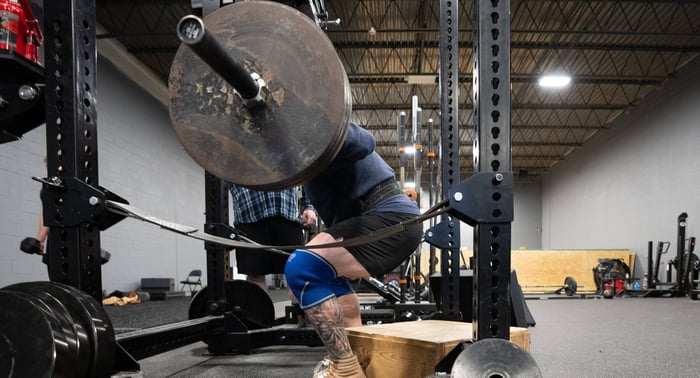
The first accessory exercise, executed immediately after the main exercise, is what is referred to as the primary accessory exercise. This exercise will be a multi-joint movement and will follow a set-and-rep scheme that allows athletes to train at intensity levels just below maximal effort.
In my opinion, this work is the sweet spot where absolute strength can still be enhanced while providing athletes with the opportunity to develop technique at intensity levels somewhat close to those experienced in competition. When executing a primary accessory exercise, we typically aim to work between 70% and 85% of our 1RM, depending on the set and rep scheme.
If our goal is to enhance technique or remain familiar with the competition lifts, we will choose competition-specific movements as our primary accessory exercise. To show how we go about doing so, we will refer back to our maximal effort lower programming scheme from the previous section.
Lower Body
Week 1: Competition Squat
Week 2: 2” Deficit Deadlift
Week 3: Giant Cambered Bar Good Morning
Week 4: Competition Deadlift
As you can see, in this month we have two competition-specific lifts, and two exercise variations. If our goal is to include competition-specific movements more frequently, we will program competition-specific primary accessory exercises in weeks featuring exercise variation.
Here is how that would look:
Lower Body
Week 1
Main Exercise:
Competition Squat – work up to a top set single.
Primary Accessory Exercise:
Competition Deadlift – 5 x 3 @75-80%
Week 2
Main Exercise:
2” Deficit Deadlift – work up to a top set single
Primary Accessory Exercise:
Competition Squat – 5 x 3 @75-80%
Week 3
Main Exercise:
Giant Cambered Bar Good Morning – work up to a top set of 3 reps.
Primary Accessory Exercise:
Competition Deadlift – 4 x 5 @70-75%
Week 4
Main Exercise:
Competition Deadlift – work up to a top set single.
Primary Accessory Exercise:
Competition Squat – 4 x 5 @ 70-75%
As you can see, we are now including a competition-specific movement in each week of our training via the primary accessory exercise. While these lifts are not performed at the intensity levels experienced in competition, they are still executed at levels that will adequately improve strength and motor pattern competency.
We can also follow a similar strategy for our upper body work. In this case, instead of alternating between the squat and deadlift, we will alternate between the standard and close-grip bench press.
Is this approach necessary for all athletes? No. However, if you are dealing with an athlete who lacks confidence in their competition-specific movement skills or who just prefers to include them more regularly, this approach will provide great results.
Following this programming scheme will allow athletes to execute competition-specific barbell movements on a weekly basis while adhering to the structure of a Conjugate Method training plan. So, the next time you hear a coach or athlete criticize Conjugate for a lack of competition lift specificity, just know that they have no idea what they are talking about, nor do they know how to properly construct a Conjugate-based training plan.
Think Outside the Box
While our training methods are commonly referred to as the Conjugate Method, it is better described as the Conjugate Training System. In this system, we have three primary strength training methods: the maximal, dynamic, and repeated effort methods. Using these methods, we can construct what appears to be a near-infinite number of training plans.
However, the quality of Conjugate-based training will always depend on the coach designing the programming and their level of understanding of foundational strength and conditioning science. Too often, critics focus on the methods rather than on the coach designing the training plan.
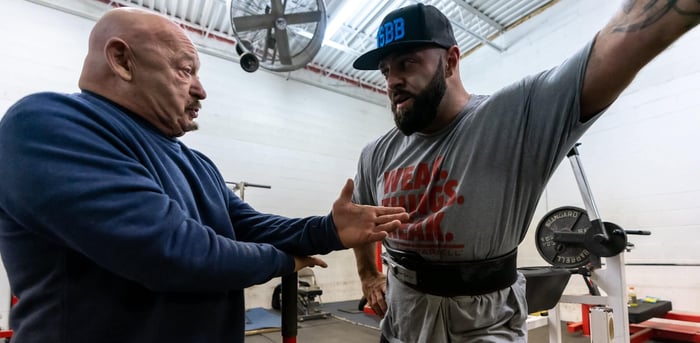
At Westside, Lou achieved tremendous success using the Conjugate Training System to develop geared and raw powerlifters, as well as athletes from many different sporting backgrounds. Why? Because Lou always thought outside of the box.
Lou’s deep understanding of strength and conditioning science, coupled with his knowledge and experience using the Conjugate Method, enabled him to adapt the methods to deliver results for any athlete, regardless of sport or situation. No matter the circumstances, he always found a path forward for the athletes he worked with in the Conjugate Training System.
The Westside Barbell approach to training leaves no stone unturned. We develop all aspects of strength and athleticism, specifically focusing on the strengths and traits an athlete needs to be competitive within their sport.
So, the next time you hear someone criticize the Conjugate Method for a lack of competition-specificity for the sport of powerlifting, feel free to send them this article.
Squat and Deadlift Manual — Louie Simmons

$10.00
$20.00
Take your squat and deadlift training to the next level with The Squat and Deadlift Manual, a 173-page guide packed with scientifically-backed methods and practical tips to enhance your performance in two of the most fundamental lifts. This book is… read more