Table of Contents
The Conjugate Method develops multiple strengths and athletic traits simultaneously through the use of three primary strength training methods; the maximal, dynamic, and repeated effort methods. This allows us to bring about specific training adaptations depending on the athlete we are working with. Through the use of these three training methods, we can essentially design training plans that leave no necessary strength or motor pattern untrained.
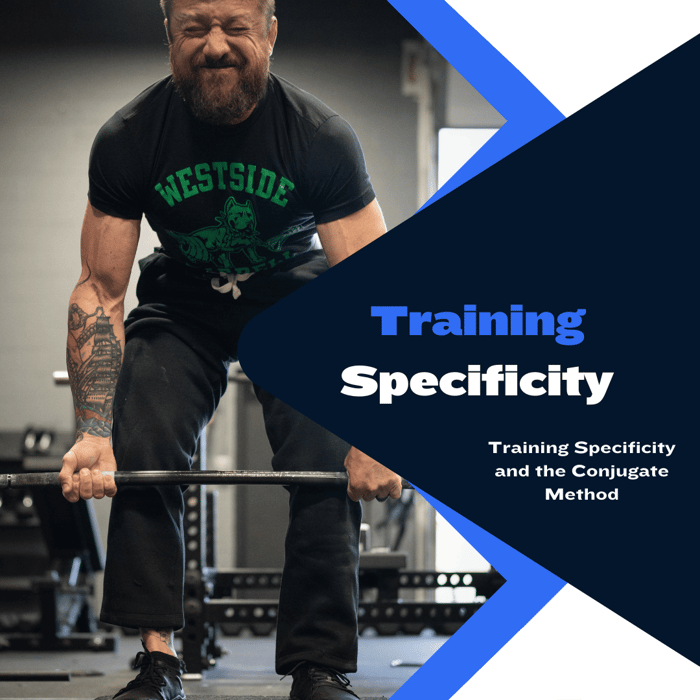
Oddly enough, one of the main arguments made against the Conjugate Method is that our approach to training lacks specificity. This argument often comes from coaches and athletes involved in the sport of powerlifting, a sport where Conjugate has excelled in now for many years.
Why do coaches and athletes make this argument? It’s simple, they have no clue when it comes to Conjugate Method training theory or application. To these folks, Conjugate just means bands and chains, specialty bars, and partial range of motion lifts. They fail to see the utility of the methods, and incorrectly judge what they do not understand.
As anyone who has properly implemented a Conjugate-style program can attest to, there is no other approach that beats Conjugate in terms of efficiency and effectiveness. What most linear programs hope to achieve in a year, we can achieve in a quarter or even sooner. We are not bound to phases, and we have the ability to manipulate training implements to amplify training effects and outcomes.
In this article, we will discuss specificity within the Conjugate System, and show how the argument that Conjugate lacks sports-specificity for powerlifting is foolish.
Conjugate Method: Ultra-Specific
If you talk to the average powerlifting coach, they believe that you must constantly utilize the motor patterns, bars, racks, and setups that will be featured in competition. In the mind of these individuals, any training that defies these rules is useless and sets an athlete up to lose sports-specific skills and traits. However, this is completely untrue.
In the Conjugate System, we use all sorts of barbells and training tools to improve performance. For instance, let's go over our approach to developing the competition barbell squat. At Westside, our approach to developing the squat is multifaceted. We can choose to develop the squat using the maximal, dynamic, and repeated effort methods.
Our maximal effort squat training focuses on improving absolute strength and is the most competition specific out of all of our squat training. This is because we are actually training the barbell squat motor pattern at a level of intensity that is competition-relevant. This typically occurs once every three weeks, or once every other week depending on how often a good morning variation is used in our maximal effort lower exercise rotation.
So, once every other or every third week, we will perform a barbell squat for a top set single within intensity ranges that reflect what the athlete will experience in competition. Compare that to alternative approaches, where an athlete may only train the squat pattern during a specific high-intensity phase for a short period of time. In terms of exposure to competition-relevant intensity, the Conjugate athlete will be far more experienced and familiar than the athlete training in phases.
Next, we have our dynamic effort lower training. This training occurs weekly, focuses on improving rate of force development using submaximal weights moved at maximal velocity, and follows a three-week wave loading pattern. The three-week wave is percentage based, and allows us to control volume and intensity to ensure athletes can train at velocities that improve explosive power whilst keeping fatigue in check.
At Westside, we execute our dynamic effort squat training using the box squat and accommodating resistance. This aspect of our training garners the most criticism, considering athletes will not squat to a box nor with accommodating resistance in competition.
What these critics are missing is that we are not specifically developing squat technique. We are specifically improving an athlete’s rate of force development using the box to break up the eccentric/concentric chain (static and relaxed-overcome-by-dynamic work) while using resistance bands to increase kinetic energy and promote acceleration throughout the entire motor pattern.
Is this motor pattern exactly comparable to the competition barbell squat? No. Will this training have a tremendous impact on an athlete’s ability to generate force and accelerate through the entire competition squat pattern? Absolutely.
Then we have the repeated effort method at our disposal. The repeated effort method is most often used during accessory exercise training, which is the training executed following the main exercise of the workout. This training also uses submaximal weights, without the emphasis on maximal velocity.
At Westside, our first accessory exercise of the day is referred to as the primary accessory exercise. This exercise is a multi-joint movement typically performed at higher intensity (75-85%), for multiple sets and reps.
The primary accessory exercise slot allows us to program competition-relevant movements (comp barbell squat, bench, deadlift) to accrue volume and remain familiar with these movements when specialty bars are being used during the maximal or dynamic effort main exercises. So, if we are dealing with an athlete that wants to maintain familiarity with the competition-relevant lift, we can program the lift as a primary accessory exercise to accrue volume within meaningful ranges of intensity.
This is essentially the same type of work linear-based lifters will do as their main work, we just prioritize absolute strength development with our main work then maintain familiarity with competition barbells as needed through our primary accessory work. Of course, competition-relevant lifts are always rotated in our maximal effort exercise selection; this repeated effort work just helps to accrue volume and dial in technique even further.
It is also important to note that as we approach competition (8 weeks out or less), we will increase the use of competition-relevant exercises in our maximal effort main exercise selections.
To sum it all up, when we train the squat we focus on the improvement of absolute strength (maximal effort), the improvement of rate of force development (dynamic effort), and the improvement of motor skill and muscular development (repeated effort). Additionally, we do this on a weekly basis, unlike those who follow phases that only focus on the development of these traits for short periods of time. I ask the reader, which method develops the squat more specifically?
An Argument for the Use of Specialty Barbells
The use of specialty barbells are one of the key aspects of our training that those opposed to Conjugate like to attack. They will say that since the barbell is not the same as the barbell that will be used in competition, it is essentially useless. This couldn’t be further from the truth.
The two specialty squat barbells we use the most are the giant cambered bar, and the safety squat bar.
The giant cambered bar places the weight closer to midline, and oscillates as an athlete moves through the squat pattern. This barbell forces an athlete to brace to control the oscillation, and places great emphasis on the posterior chain. Athletes with experience using the giant cambered bar will develop a stronger posterior chain, improve their bracing mechanics, and will have the strength to resist excess spinal flexion in the competition barbell squat.
The safety squat bar places the barbell in an exaggerated high bar position, placing great emphasis on the lower body anterior chain, the mid and upper back, and the trunk. This barbell also forces athletes to focus on bracing and upright torso positioning considering the exaggerated high bar position of the barbell.
So, through the use of these two barbells, we are able to place greater emphasis on the anterior and posterior chains, improve bracing mechanics, and develop the ability to maintain optimal torso positioning during maximal effort squats. All while still training the same motor pattern as we would if we were to use a standard competition barbell.
Now, it is important to note that we do not use these barbells every time we squat. Do we execute max effort competition barbell squats? Of course we do.
We use specialty bars to bring about specific adaptations that allow us to improve our sport-specific skillset and avoid accommodation. Plus, any time we use these barbells we can always program competition barbell squats as a primary accessory to ensure we remain familiar with the demands of that specific barbell.
As long as the coach has a sound understanding of the Conjugate System there is no reason specialty barbells should negatively impact sport-specific movement skills. The use of specialty barbells should enhance sport-specific movement skills.
Influencers Say the Darndest Things
Spend enough time on the internet, and you will undoubtedly hear some foolish takes when it comes to strength and conditioning training. Often, coaches who specialize in offering their “take” on matters do so as a means of driving engagement and hopefully converting followers into clients. The end goal is to charge $300 a month to constantly move the goal posts and tell athletes they have all sorts of dysfunctions that can only be solved by continuing to pay for coaching.
Criticism of the Conjugate Method almost always comes from individuals who have no experience using the methods. I have yet to find a coach who has used Conjugate and has a solid understanding of foundational strength and conditioning science that believes the Conjugate Method is a suboptimal approach.
How could Conjugate ever be suboptimal when it literally gives the coach every weapon needed at their disposal to elicit sport-specific training adaptations rapidly? The only thing that causes Conjugate to be suboptimal or ineffective is the coach or athlete’s lack of understanding regarding proper implementation and execution.
A well organized Conjugate-based training plan will bring about rapid results, and will accelerate the development of sport-specific skills and athletic traits. As I have said many times, a properly implemented Conjugate plan will beat any other training approach in terms of effectiveness and efficiency every time.