
Table of Contents
A key benefit of Conjugate Method training is our ability to tailor our approach to achieve specific training outcomes based on the needs of the individual we are working with. If we notice a particularly weak aspect of a movement or muscle group, we can immediately modify training to specifically address the issue. This allows our athletes to continue making progress and avoid overuse injuries caused by improperly executed motor patterns due to weak muscle groups.
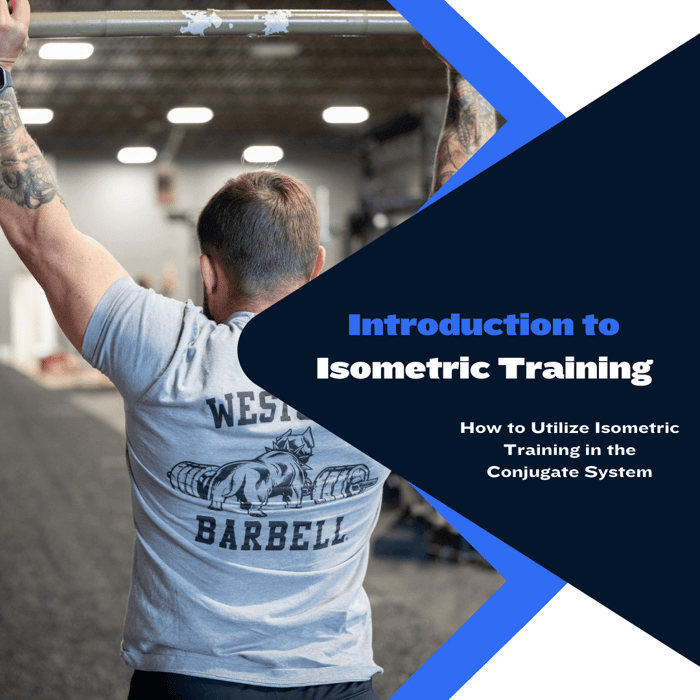
One option we have at our disposal to help athletes solve issues with force output at specific joint angles is isometric training. Isometric training is a form of strength training that allows athletes to target force production at specific joint angles, resulting in muscular contraction without changes in joint angle or muscle length.
This differs from typical movements that feature eccentric and concentric phases, which are referred to as dynamic resistance training exercises.
At Westside, we have used isometric training for many years. Whether we are training strength or conventional sports athletes, isometric training provides a meaningful stimulus to address weaknesses within a specific motor pattern. The use of isometric training has helped our athletes improve their maximal effort performance in the squat, bench press, and deadlift.
In this article, we will discuss how to effectively use isometric training within a Conjugate Method-based training plan.
Yielding and Overcoming Isometrics
The first step to using isometric exercise effectively is to understand the two types. Yielding isometrics are a form of isometric exercise that focuses on maintaining position and force production to prevent the applied resistance from moving the athlete above or below the targeted joint angle. A few examples of yielding isometric exercises include planks, split squats, and belt squat skater’s pose.
The goal of these exercises is simple: establish position at the specific joint angle we are targeting and hold it for a set time. These positions are held for various lengths of time, ranging from 15 seconds to over a minute. Again, the goal here is to maintain optimal positioning and resist external forces that would move the athlete out of the targeted position.
When executing yielding isometric exercises, we can perform 3-6 total sets for time.
Overcoming isometrics involves pushing or pulling against an immovable object, such as rack pins. The objective of this form of isometric training is to reach peak force output at a specific joint angle, then maintain it for 3-5 seconds. We will typically execute 1 rep per set, performing 3-5 total sets, depending on the athlete and their level of strength and fitness.
At Westside, we favor overcoming isometrics for our strength athletes, and a mix of both yielding and overcoming isometrics when working with conventional sports athletes. Of course, strength athletes can use yielding isometrics successfully, but isometric work with them is often better spent on addressing weak points in maximal effort competition lifts.
Find Your Weak Point
One of the most common issues faced when beginning isometric training is figuring out which joint angle an athlete should target to improve performance in the competition lifts. Fortunately, within the Westside Barbell Conjugate System, we have a method that is perfect for this task - maximal effort training.
As the name implies, maximal effort training calls on an athlete to exert as much force as possible to lift the heaviest weight on a given training day (lower/upper). This training will provide the feedback needed to ensure isometric training is correctly targeting the joint angles where the lifter is currently struggling most.
The correct joint angle to train isometrics is often revealed during a missed maximal effort repetition, which essentially turns into a yielding isometric unless complete failure occurs. While we do not want to purposely miss maximal effort lifts, it is inevitable that a missed rep will occur at some point.
Once we have this information, we can begin executing overcoming isometric work with the pins set to ensure we are targeting the correct joint angle.
Programming Isometric Training
When using the Conjugate System, we have a few ways to execute isometric training. If we are using yielding isometrics, this work will typically be performed during our repeated effort-based accessory work. For instance, we can go with a split squat yielding isometric for 3-4 sets for a specific amount of time with a specific weight, or we can go with something like planks for 3-4 sets, holding the position for as long as possible each set.
When performing yielding isometrics across multiple sets, we typically rest for about 1 minute between sets.
Overcoming isometrics must be programmed a bit differently, considering the stress and demand associated with this form of exercise. Considering we are seeking to reach peak force output during these movements, we want to perform overcoming isometrics before or immediately after our main exercise of the day.
In my experience, I have had better outcomes when overcoming isometrics are performed as a primary accessory exercise rather than before a maximal effort movement. I want to ensure I have as much energy on deck as possible for my main exercise, so performing demanding isometric work before it can be counterproductive.
As a primary accessory exercise, I can still achieve optimal force output without reducing my performance capabilities during the main exercise.
There could be an argument that performing isometric work before maximal effort training can improve performance. However, there is no denying that true maximal effort overcoming isometric exercises will sap energy and reduce main dynamic resistance exercise performance to some degree, depending on the athlete's fitness.
When performing overcoming isometrics, we typically execute 3-5 sets, one rep per set, with each set lasting 3-5 seconds. We could execute up to 3 reps per set, but in my opinion, 1 rep per set is optimal. Our rest time between sets will be 1-3 minutes, depending on the athlete we are working with.
Minimum Effective Dose
A key aspect of isometric training is determining the optimal amount of exposure based on the athlete's needs and fitness level. If this work is programmed and executed incorrectly, it will result in excessive fatigue that will begin to limit other aspects of training, specifically maximal effort performance.
While isometric training is very effective, we typically want to keep it regulated to the minimum effective dose.
The goal is to find the threshold at which exposure to isometric training begins to translate into progress in competition lifts, and then gradually adjust from there. We do not want to immediately go overboard with isometric training, forcing an athlete to train beyond their ability and tolerance.
If isometric training is poorly programmed and regulated, it will disrupt the training process. Athletes may experience excessive fatigue, risking slowing or halting their progress.
While both yielding and overcoming isometric training are valuable, they can be incredibly taxing. We want to ensure we program the exercises sensibly from the start and incrementally increase the demand on the athlete over time as strength and fitness improve. However, when programmed correctly, isometric training is an effective way to eliminate sticking points and improve overall performance in squat, press, and deadlift movements.
FAQs
What do isometrics do
Answer here