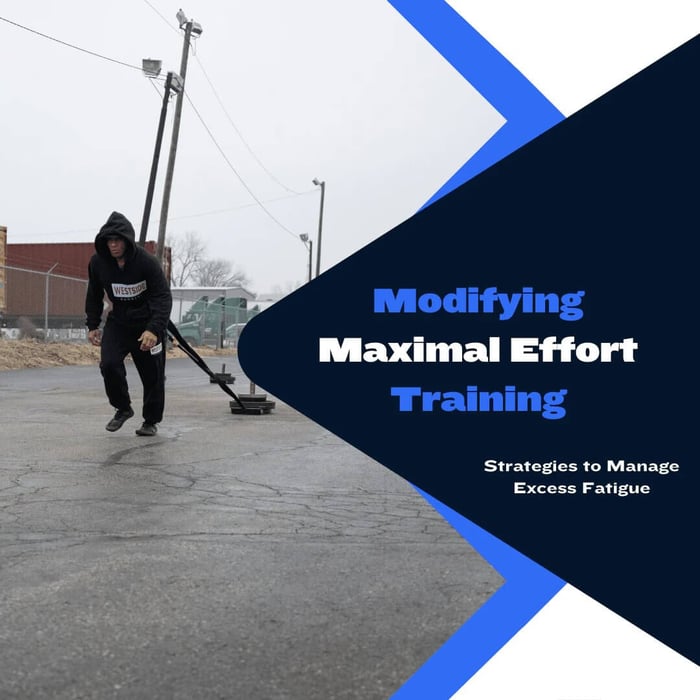
The maximal-effort method is one of the three primary strength-training methods used in the Conjugate Training System. This method focuses on the development of absolute strength, which refers to the peak force an athlete can produce. The maximal effort method is performed twice weekly, with half of our weekly schedule dedicated to lower- and upper-body maximal effort training.
At Westside, we have long understood the importance of consistent maximal effort training. This approach to training is not a phase, but a necessary aspect of consistent athletic development. As we expose athletes to high-intensity training (90%+), we not only improve absolute and relative strength but also help improve bone and tissue density through frequent maximal-effort lifts.
Unfortunately, some folks misunderstand maximal-effort training and question an athlete's ability to survive week-to-week maximal-effort lifts. These individuals confuse training maxes with competition maxes, where athletes specifically peak and rest to lift the heaviest weight on competition day.
Our maximal-effort training is performed without a peak and does not reach the same overall intensity as a competition lift. Because of this, training maximal efforts do not have the same recovery implications as a full-on competition maximal effort. The demands are different both physically and mentally.
However, while maximal-effort training is sustainable, there are times when PR lifts stagnate, and recovery is suboptimal. In this case, we must slightly modify training to ensure we do not reach a recovery deficit that impacts the sustainability of the training plan.
In this article, we will discuss a few ways to modify maximal effort training to reduce excess fatigue and improve PR lift frequency.
Heavy Effort Training
The first option we would consider when modifying our maximal-effort training would be to institute heavy-effort training. Heavy-effort training refers to training executed at 90% or below, generally between 80% and 90%, depending on the prescribed rep count. When we perform heavy efforts, we will typically work up to one top set around 85-90% for 3-5 total repetitions.
The reason heavy-effort training is the first option is that it is most similar to maximal-effort training. While the overall intensity is reduced, a heavy-effort set of three or five reps is still demanding and will still improve absolute strength. Just not to the degree of a true maximal effort single.
For this reason, our first approach to maximal-effort modification would be to transition to heavy efforts until any fatigue-related issues are resolved. However, it is important to note that heavy-effort training is only a viable option for those dealing with light or moderate fatigue and should not be used when an athlete needs a complete deload.
Here is what a heavy effort main exercise would look like:
Lower Body
Box Squat – work up to a top set of five reps, leave a set in the tank.
Upper Body
Bench Press – work up to a top set of three reps, leave a set in the tank.
Repeated Effort Training
The next option is to use repeated-effort main exercises in place of maximal-effort training. This is often the best route for athletes with recovery-related issues, as we can program the training across a wide range of volume and intensity. The idea here is to still work above 70%, with 85% being the limit.
When we implement a main exercise with repeated effort, we will always go with a multi-joint exercise. This movement will be a variation of the squat, bench press, or deadlift, depending on whether we are training the lower or upper body. Typically, we will go with 5 x 5, 5 x 3, or 5 x 1 between 70-85% training intensity.
Here are some programming ideas:
Squat-Focused
SSB Low Box Squat – 5 x 5 @70%
The goal here is to specifically address the hip flexors and quads, with an atypical setup. Considering this, we will go with a higher volume, with intensity set to 70%.
Bench Press-Focused
Close Grip Bench Press – 5 x 3 @75-80%
This is an easy way to emphasize the triceps. With this set and rep prescription, we would aim to perform three sets at 75% and two sets at 80%. If we are dealing with an experienced lifter, we could go with two sets at 75%, and three at 80%.
Deadlift-Focused
Deadlift vs. Minibands – 5 x 1 @85%
In this case, we are using accommodating resistance to reduce stress and fatigue while training at a slightly higher intensity. While this work is intended to be a repeated-effort effort, we aim to achieve barbell velocity similar to that in dynamic effort training.
Total Deload
While the first two options are generally recommended for most athletes dealing with recovery or PR frequency issues, there are times when athletes are so fatigued that a complete deload is necessary. When this occurs, we will still execute repeated effort work, but program in a way more similar to a bodybuilding-style approach.
The goal will be to use a combination of multi- and single-joint exercises to achieve optimal muscular hypertrophy while avoiding intensities that could exacerbate current fatigue.
Here is how we would go about programming this day:
Main Exercise
Incline Barbell Bench Press – 4 x 5-8 @60-65%
Primary Accessory Exercise
Barbell Row – 4 x 8-10
Secondary Accessory Exercises
Rolling DB Tricep Extension – 3 x 10-12
Supinated Grip Lat Pulldown – 3 x 10-12
Overhead Tricep Rope Extension – 3 x 12-15
Hammer Curl – 3 x 12-15
Our main exercise will use a percentage range to ensure intensity levels are kept in check. However, the rest of the training will be performed with the heaviest weight we can use while still capable of performing all sets and reps with strict technique.
While this training is a deload, we do not want to reduce our training weights so low that we are merely going through the motions. If the intensity during this training day is too much, consider taking a few days off from training and reevaluating your programming approach.
Extra Rest Day
There are times when the day-to-day work and life schedule, or mismanaged training, create a situation in which no modification to training will be effective in solving the problem. In this case, athletes will need to take an extra rest day. As much as we believe in trying to modify training to still get something done, there are circumstances where total rest is warranted.
As an athlete, if you notice extreme decreases in workout performance, sleep issues, decreased appetite, an elevated heart rate, or generally feel like crap each workout, an extra rest day for a week or two may be the best option for you.
There are some reading this that will believe they are too dedicated or tough to take a day off and just rest. However, in my experience, it is much better to take a day or two off than to be forced to take weeks off when an injury occurs. The first rule of finding yourself in deep shit is to get rid of the shovel that helped you dig your way there.
When we take extra rest days, we want to make sure we are making the most of this time. We want to have our nutrition and hydration dialed in, set ourselves up for the best sleep we can, and try to get a few extra naps in if possible.
As mentioned, this is always our last option. However, if you train long enough, there is no doubt you will eventually run into a situation where it is the only reasonable option.