Table of Contents
The dynamic effort method is one of the three primary strength training methods used in the Conjugate Training System. This training method calls for using submaximal weights lifted at maximal velocity. The dynamic effort method is a method for specifically improving an athlete’s rate of force development, a key component of sports performance.
The rate of force development dictates how quickly an athlete can reach peak force output, which results in what most would refer to as an athlete’s “explosiveness”. At Westside, we execute dynamic effort training twice per week, with one session focused on the lower body and the other focused on the upper body.
This training also contributes to our overall weekly training volume, providing powerlifters with 16-24 repetitions of a sport-relevant motor pattern.
Often, when the Conjugate Method is discussed online, the first aspect of the training that is criticized is the dynamic effort method. You will have “experts” making all sorts of baseless claims, such as that raw lifters do not require dynamic effort training or that bands and chains alter the resistance curve in a way that only benefits geared powerlifters.
In this article, I will discuss why dynamic effort training works for all powerlifters, regardless of their chosen discipline.
Why We Use Dynamic Effort
If we were to remove the factor of training fatigue, the most effective way for powerlifters to develop strength would be to train maximal effort during every session. This training results in improvements in both absolute strength and rate of force development (as well as inter- and intra-muscular coordination, tissue density, and bone density), which are critical aspects of athletic performance.
Unfortunately, as we know, this approach could not be maintained for very long and would eventually result in injury. At Westside, we have found that two maximal efforts weekly, one for the lower body and one for the upper body, result in adequate improvement in absolute strength while avoiding excess fatigue.
However, two training days per week aren’t enough, so what can we do on the other days? Dynamic effort work. As I mentioned above, dynamic effort training focuses on improving an athlete’s rate of force development, while maximal effort improves absolute strength and also rate of force development.
Essentially, maximal effort training kills two birds with one stone but cannot be sustained if implemented continuously. Therefore, dynamic effort training is introduced as a means of managing fatigue by using submaximal training weights, while adding a velocity parameter to specifically target improvements in rate of force development.
Dynamic effort work is merely a downshift from maximal effort work that allows us to specifically address a meaningful aspect of sport performance. It should also be noted that dynamic effort work will still positively impact absolute strength. Given the overall training volume, as athletes fatigue throughout a workout, increased levels of motor unit recruitment will be necessary to perform all sets and reps with proper technique and at proper velocity.
When we train maximal effort, absolute strength is in the driver’s seat, and rate of force development is in the passenger seat. When we train dynamic effort, rate of force development training is in the driver’s seat, while absolute strength, work capacity, and hypertrophy training (via cumulative metabolic stress) are in the car for the ride.
The Use of Accommodating Resistance
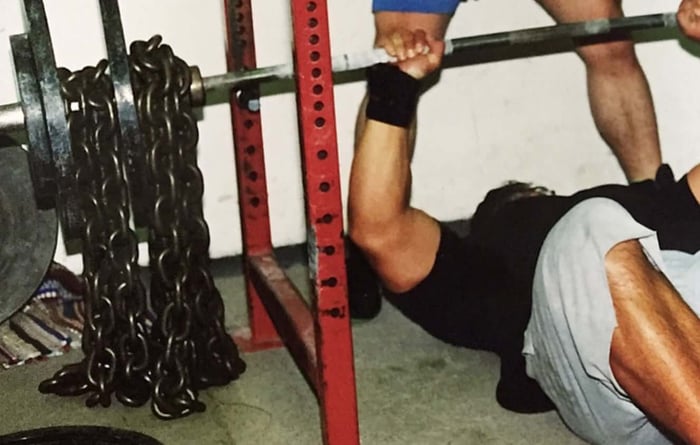
At Westside, the dynamic effort method utilizes accommodating resistance during our main exercises. Accommodating resistance refers to training tools that alter the resistance curve of an exercise. This means that instead of the force output demand being greatest at the most disadvantageous joint angles, force output demand increases as advantageous joint angles are achieved.
This is why you often hear critics say that dynamic effort work only develops lockout strength and is therefore only good for geared lifters, since their gear creates a similar resistance curve. However, this is untrue for a few reasons.
First, accommodating resistance increases the demand on eccentric force outputs, particularly when using bands. The use of resistance bands introduces overspeed eccentrics, increasing the kinetic energy generated during the eccentric phase of the lift.
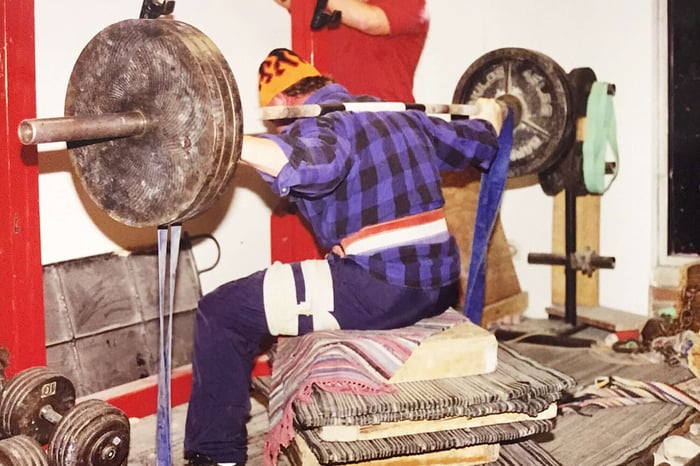
This training effect emphasizes eccentric force output to decelerate the barbell and execute the motor pattern at an acceptable velocity whilst maintaining control of technique. Add an exercise like a box squat, which requires precise movement to be executed properly, and the demands for eccentric force output and deceleration only increase. This helps improve adductor strength and tissue tolerance, which are important aspects of raw squatting.
The box also allows us to achieve a relaxed-overcome-by-dynamic contraction, which is incredibly effective for improving rate of force development.
Another benefit of accommodating resistance is that both bands and chains promote acceleration. Typically, when only barbell weight is used, deceleration occurs as advantageous joint angles are reached. Accommodating resistance requires athletes to continue accelerating past what would typically be needed to achieve the lift with barbell weight alone, improving their ability to execute the powerlifts in a more explosive manner.
Replacing Dynamic Effort with Repeated Effort
One thing you will see some coaches suggest is that dynamic effort work must be replaced with repeated effort work, especially for a raw powerlifter. These coaches often believe they are having a eureka moment, when in reality, this approach has been used at Westside for many years.
While dynamic effort training is most commonly used, we do at times replace it with a wave of repeated effort training. This is primarily done for one of two reasons: the athlete has become fatigued and cannot properly execute dynamic effort, or the athlete needs to increase their muscle mass.
When we perform repeated effort work, we no longer have to worry about maintaining a specific barbell velocity. Therefore, we can slightly increase the training intensity and volume, resulting in improved strength and muscle mass. The only issue is that we are not improving the rate of force development to the extent we could, and athletes are not afforded the deceleration/acceleration benefits provided by accommodating resistance.
Of course, maximal and dynamic efforts will always improve absolute strength and rate of force development to the greatest extent, but repeated effort work can also positively impact an individual's strength, explosive power, and overall muscle mass. Beneficial, no doubt, just not at the magnitude of proper maximal or dynamic effort training.
Replacing dynamic effort with repeated effort training can be a reasonable strategy when introducing the Conjugate Method to a beginner. Beginners can typically handle repeated effort work without difficulty and quickly adapt to the demands of maximal effort. However, until absolute strength and coordination improve, beginners often struggle to properly execute dynamic effort training.
So, we will implement repeated effort waves first, then begin adding compensatory acceleration. Once athletes demonstrate proficiency in executing movements with compensatory acceleration, we can properly introduce dynamic effort training.
While there is no exact weight an athlete must be able to lift to execute dynamic effort, an athlete must reach a certain level of strength and coordination before they’re able to execute dynamic effort work in a manner that would be considered productive. This is why coaches and athletes must be honest in their evaluations and reasonably escalate training.
Westside for Raw Powerlifting
You will often see people talking online about the Westside Barbell Conjugate Method for raw powerlifting. These individuals typically fall into two camps: those who believe the methods are completely ineffective, and those who think the methods must be heavily modified to work. Both are incorrect.
The Westside Barbell Conjugate Method, as stated in the Westside Barbell Book of Methods, will work for raw powerlifting. There is a myth that the Book of Methods is only useful for geared lifting, which is entirely untrue.
The Book of Methods represents the foundational knowledge of the Westside Barbell Conjugate Method, and the WSBB Basic Template provides the traditional weekly training schedule. However, within the confines of the system, we can develop a tremendous amount of training plans without deviating from what would be considered proper Conjugate Method training.
There is a saying that unless you’re at Westside, you’re not training Westside. This is because Lou was always manipulating the methods to deliver the greatest results for his athletes. However, he was always doing so within the confines of the Conjugate Method training philosophy as described in the Westside Barbell Book of Methods.
The ability to wield the methods depends on the coach's knowledge. Lou, a master of strength and conditioning, could always find a way to deliver optimal results for any athlete he worked with, all without completely overhauling our system. We continue to do so to this day.
Worried about box squats ruining your competition squat technique? Regularly feature competition-squat variations during maximal effort sessions, and program barbell squats as a primary accessory exercise for 3-5 sets x 3-5 reps at 70-85%.
Think you need to pause your speed bench to be a better raw bencher? Think again: the ballistic nature of the speed bench press not only improves reversal strength but also increases tissue tolerance for maximal efforts. If you need to improve your bench press pause, do so during maximal or repeated effort upper body exercises.
Dynamic effort training isn’t some method Lou threw in the mix for the hell of it. It is a crucial aspect of the Conjugate Training System and should be used so long as the athletes being trained can properly execute the sets and reps.
Westside Barbell Book of Methods — Louie Simmons

$50.00
What this book is The Westside Barbell Book of Methods is Louie Simmons' lifetime of work in 319 pages. It is the master text on the Conjugate Method and the training system Louie built at Westside Barbell over four decades.… read more
FAQs
How can I maintain competition squat proficiency when executing dynamic effort training?
You can utilize competition-squat variations during maximal effort sessions, and program barbell squats as a primary accessory exercise for 3-5 sets x 3-5 reps at 70-85%.
Should beginner-level powerlifters utilize dynamic effort?
Replacing dynamic effort with repeated effort training can be a reasonable strategy when introducing the Conjugate Method to a beginner. Beginners can typically handle repeated effort work without difficulty and quickly adapt to the demands of maximal effort. However, until absolute strength and coordination improve, beginners often struggle to properly execute dynamic effort training.
What is accommodating resistance?
Accommodating resistance refers to training tools that alter the resistance curve of an exercise. This means that instead of the force output demand being greatest at the most disadvantageous joint angles, force output demand increases as advantageous joint angles are achieved.