Table of Contents
Year after year, you see raw powerlifting training change from the linear-based SBD approach to a more Conjugate-based training strategy. Some may scoff at this, but I recall a time when specialty bars, accommodating resistance, and accessory exercises were often disregarded by a significant portion of the powerlifting community.
If you look at the training of many great lifters today, you begin to see a slow but sure conversion to the Conjugate Method. Today, you see many powerlifters using specialty bars, accommodating resistance, and special exercises to improve performance. These individuals adopt and use these tools, yet will still deny the effectiveness of Conjugate Method training.
One of the chief arguments is that none of the world's best powerlifters use Conjugate. While they may not profess to use our methods, one look at their training shows Lou’s influence. While these individuals may not have fully adopted the methods yet, it is clear that, in their quest to improve performance, powerlifters are seeking methods and strategies beyond the conventional SBD framework.
I often wonder if this slow crawl toward Conjugate will make these individuals believe they have discovered something new. Often, the human ego leads folks to believe they’re being innovative when in reality they are merely stealing or borrowing ideas from minds far greater than their own.
One thing that I find entertaining is coaches who use Conjugate, or aspects of it, but say they are editing or fixing the methods for the raw powerlifter. I see them talk about their new strategies, new ideas, and I immediately think to myself, “I’ve seen that at Westside before”.
When it comes to the Conjugate Method, there is nothing new under the sun. It took these coaches over a decade to figure out that specialty bars, accommodating resistance, and special exercises work. Let's see if they begin to understand and implement dynamic effort work over the next decade.
However, I am sure these "innovators" will say they had to “fix” dynamic effort work for the raw powerlifting community. The ego of the social media-focused coach knows no bounds.
Here is some advice to help the raw powerlifting community as they continue their slow adoption of the Conjugate Method.
Conjugate Lacks Competition Lift Specificity
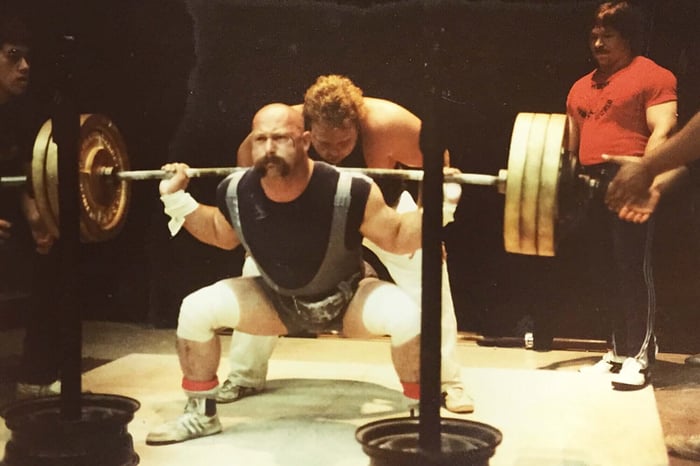
One of the main criticisms our methods receive from the raw powerlifting world is that the consistent use of exercise variations erodes competition lift skill. While this may seem logical to the uninitiated, the truth is our training is more competition-specific than the average raw powerlifting program.
It’s true: at Westside, we prefer to use a wide range of exercise variations for both our main and accessory exercises. However, we still execute the basic motor patterns of the squat, bench press, and deadlift on a weekly basis. Sure, these movements may include a specialty barbell or accommodating resistance, but we are still executing the motor pattern.
It is my opinion that the use of specialty bars and exercise variation enhances competition lift skill, not inhibits it.
Let’s take the squat, for example. At Westside, we will use the giant cambered bar to place greater emphasis on the posterior chain and challenge trunk stability and bracing as the barbell oscillates. We will also use the safety squat bar, which places the barbell in an exaggerated high-bar position, challenging the lower-body anterior chain and thoracic and cervical posture.
In our experience, as performance improves with these two barbells, the competition squat improves as well. Keep in mind that we will still include the competition squat in our max effort exercise rotation at least once every 4-6 weeks (more frequently if necessary).
I find our approach to training to be more competition-specific than the average powerlifting program. Sure, we may use specialty barbells. However, we train at or above 90% every week. While I agree familiarity with competition-specific barbells is important (especially for beginners), I would argue that the most important aspect of powerlifting skill development is becoming familiar and comfortable with training intensity.
Many powerlifting programs only raise training intensity to competition-relevant levels within the last six weeks of a training cycle. At Westside, we train maximal effort twice per week, year-round. Our approach is truly competition-specific, as I cannot remember the last time a powerlifting competition called for an athlete to squat five sets of triples at 80%.
If an athlete is new to powerlifting and lacks confidence due to infrequent use of a competition-specific barbell, we will have the athlete execute reps using competition-specific barbells as a primary accessory exercise. This work would be similar to what the average powerlifter would do for a main exercise, as we will have the individual execute 3-5 sets of 3-5 reps around 70-85%, depending on the selected set and rep scheme.
We achieve an optimal training stimulus to increase absolute strength during our main exercise, and we refine competition lift technique using competition-specific barbells during our primary accessory exercise. In my opinion, this is the most sensible approach a powerlifter can take when seeking to check all the boxes relevant to competition.
In competition, it will never matter how technically proficient you are at 60-85% intensity. All that matters is your ability to exhibit proper technique at competition-relevant intensity, which is 90%+. Some say we lack competition specificity; I would argue our training is more competition-specific than any other approach.
Consistent exposure to competition-relevant levels of intensity matters far more than what barbell you choose to squat with.
Speed Work Doesn’t Work
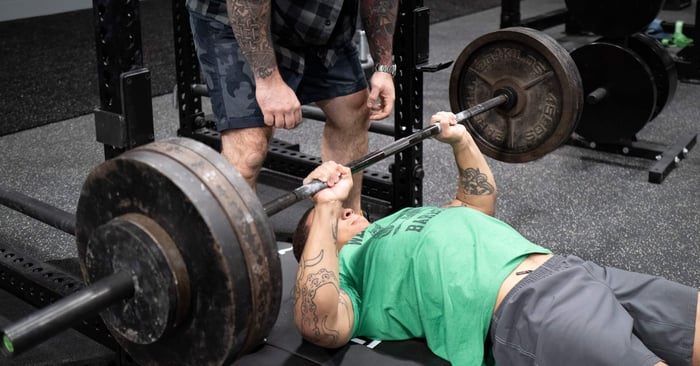
I recently wrote an article titled “Why Dynamic Effort Training Works” to help clarify why we utilize dynamic effort training at Westside Barbell. In this article, I mention how maximal effort is the most effective method for the raw powerlifter. However, as we know, training at maximal effort every training session is an unsustainable approach.
Maximal effort training increases absolute strength and improves an athlete’s rate of force development. Considering we cannot train this method every session, dynamic effort training represents a downshift in intensity, with specific execution caveats added, focusing on improving the rate of force development.
It’s a simple and reasonable approach: we train at maximal intensity to specifically address absolute strength, and at submaximal intensity with maximal velocity to specifically address the rate of force development.
Additionally, the use of resistance bands during dynamic effort training introduces overspeed eccentrics. This refers to the band tension increasing the kinetic energy during the eccentric portion of the lift. Not only will this work make an athlete stronger and more explosive, but it also improves tissue tolerance and reactive strength.
Dynamic effort training is the next best thing to maximal effort training. If we can’t specifically focus on absolute strength development every session, we can at least focus on improving the rate of force development.
You will have raw powerlifting “experts” say that, for a raw powerlifter to use Conjugate, dynamic effort training must be removed in favor of repeated effort training. While we do occasionally use repeated effort work in place of dynamic effort work at Westside, totally removing dynamic effort work in favor of repeated effort work is foolish.
As we discussed in the previous section, we can perform multi-joint repeated effort work during our primary accessory exercise. Why limit the athlete’s ability to develop specific aspects of sport performance? In my opinion, many coaches want to disregard dynamic effort training because they do not fully understand it and cannot effectively teach it.
The only time where it can make sense to momentarily eliminate dynamic effort work from the training plan is when working with complete beginners. Due to a lack of strength and coordination, beginners often struggle to properly (and safely) execute dynamic effort barbell movements. In this case, we will implement repeated effort work as a means of building a base level of strength and competency before moving on to the more advanced dynamic-effort approach.
I have also heard absolute BS, such as using bands too often will allow you to learn to “cheat” or “beat the bands”. If anything, frequent use of bands can beat the lifter, leading them to need to transition to chains for a wave or two to alleviate fatigue from consistent resistance band use.
The resistance bands promote acceleration, requiring athletes to produce force for an extended period of time compared to a lift executed with standard plate weight. Additionally, the overspeed eccentric aspect of the bands forces athletes to exert greater levels of eccentric force to decelerate and properly execute a box squat or bench press.
You will also find coaches who say that raw powerlifters should only use chains. Their excuse is often related to stability, and the assumption that training with bands provides a lifter with added stability. If bands are only used during dynamic effort training, this should not be a concern.
The only time athletes can become dependent on bands to exhibit sound technique is when bands are used too frequently. This means the athlete is using bands during maximal effort work or does not alternate between bands and chains during dynamic effort training.
Typically, we recommend a 2:1 ratio of band-to-chain training waves. Meaning, after two waves of bands, we will run a wave of chains. We can alternate wave to wave, but in my opinion, bands are superior to chains.
It is important to note that bands provide accommodating resistance AND overspeed eccentrics, while chains merely provide accommodating resistance.
Instead of arguing against dynamic effort training, the online raw powerlifting experts should seek to understand the method. If you want to reduce the risk of soft tissue injuries and become a more explosive lifter, dynamic effort training is your answer.
Reconfiguring Box Squat Technique
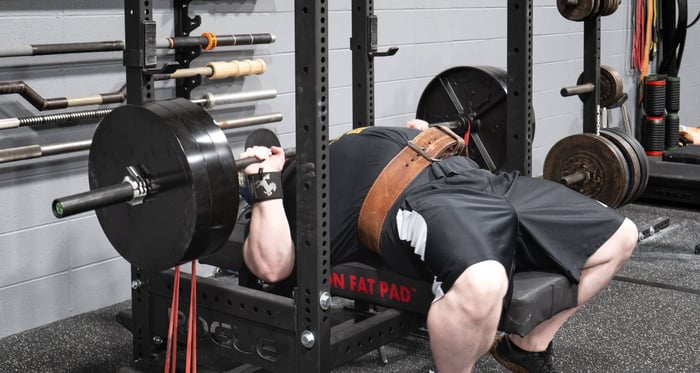
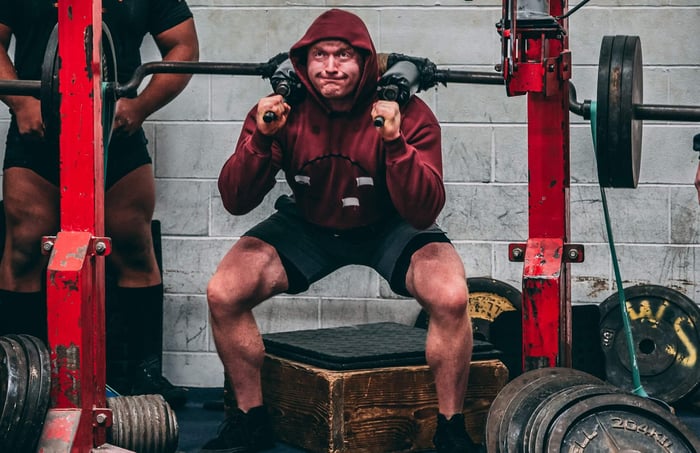
The final aspect of our training that is commonly misunderstood by the raw powerlifting community is the purpose and execution of the box squat. One common misconception is that the way Westside Barbell teaches the box squat is related to the sport of geared powerlifting.
This argument focuses on the relaxed-overcome-by-dynamic phase of the box squat, which the uninitiated “experts” believe is specific to the way the geared powerlifter squats in briefs or a suit. This is absolutely not the case. At Westside, we execute the box squat as taught by Louie Simmons, whether we are working with geared powerlifters, raw powerlifters, or conventional sports athletes.
The entire reason for using the box is to allow for the relaxed-overcome-by-dynamic effect to take place. This breaks the eccentric/concentric chain, limiting the benefit of elastic energy and resulting in a higher rate of force development. The static and relaxed-overcome-by-dynamic have a significant impact on starting strength as well.
Similar to overspeed eccentrics, proper box squat technique also emphasizes deceleration. Appropriate execution of a box squat requires the athlete to control their descent to the box to achieve the relaxed-overcome-by-dynamic work. This deceleration work is another layer of tissue preparation and helps athletes improve eccentric force output.
You will see raw powerlifting coaches say that if box squats are used, they should be modified to only hold a brief static position on the box or performed touch-and-go. Both of these modifications render the box completely useless.
As I mentioned, we use the box for one primary reason: to enable the athlete to achieve relaxed-overcome-by-dynamic work. The static positioning modification makes no sense; a pause squat would be more appropriate. However, the most nonsensical use of the box is as a depth marker during touch-and-go reps.
The box squat is a tool that allows us to achieve specific work that pays dividends for all athletes. Within the Conjugate Training System, we have numerous ways to train the competition squat. We can perform the competition-style squat as a maximal effort variation, or use it as a primary accessory exercise at moderate to high intensity.
Knowing this, there is no reason to avoid proper box squats for the sake of specificity. The box squat is an exercise that elicits specific adaptations that can only be achieved with the appropriate use of a box.
The Blessing and Curse of Social Media
The world of social media allows people to share experiences, ideas, and communicate. This has been both a benefit and a detriment to the world of powerlifting. In the world of powerlifting social media, beware of the communal narcissists.
These individuals present themselves as helpful authorities seeking to provide insight and knowledge to their followers. In reality, these individuals are often driven by ego and the dopamine rush of a viral post. They’ll say their goal is to help and educate, but the real goal is likes, shares, and follows.
With the need to post every day (or for some, damn near every hour), these folks will eventually say some goofy stuff. It becomes a game of saying things to garner attention, not to help or educate.
You see this in the world of Conjugate, where coaches create confusion or post information that conflicts with Lou’s teachings. Oddly enough, many of these individuals have never discussed training with Lou or stepped foot inside Westside Barbell. Even then, being a member or visiting the gym does not render one an expert on the Conjugate Training System.
Lou’s work is complete and does not need to be edited by charlatans seeking their next podcast invite. Truthfully, what leads these individuals to edit the methods is their lack of understanding of the methods. They must change what they cannot understand or teach.
It’s a tale as old as time, oversimplifying or altering something for the sake of being able to profess expertise. Just because the methods aren’t making sense to you doesn’t mean the methods don’t make sense. If you lack understanding, seek knowledge, and improve.
The Conjugate Method is like the AK47. You can add a new optic and/or upgraded furniture, but the reason the rifle works is the mechanisms within it. You can absolutely customize Conjugate for each athlete, but the foundational aspects of the methods should not be altered.
WSBB Vinyl Sticker - Red Conjugate Club Circle

$2.50
Let everyone know that you are part of the Conjugate Club with this red Conjugate Club Circle sticker. The Conjugate Club is world class online resource for those who are looking to take their programing to the next level. Designed… read more