
Table of Contents
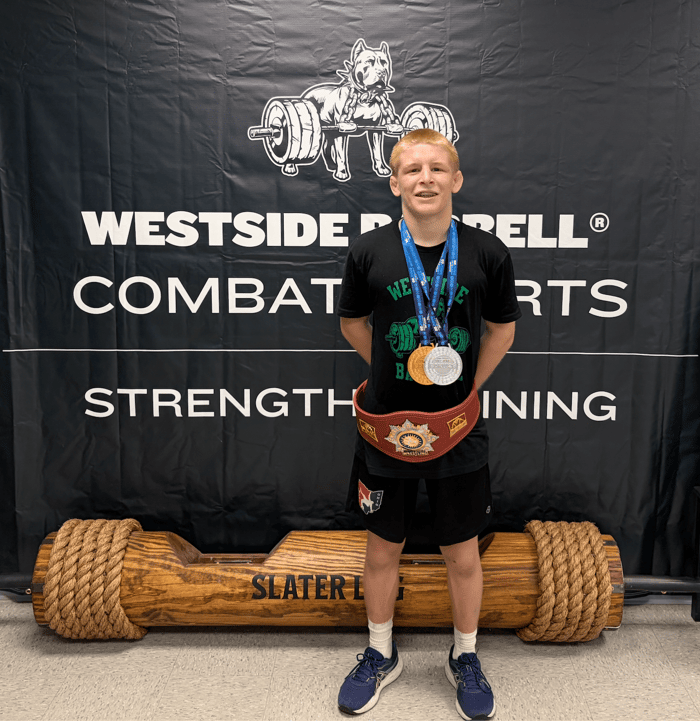
16 years old, Rylen Wax represented Team USA at 45 kilograms in both Greco-Roman and freestyle at the 2026 U17 World Championships. He returned home this week as the Greco-Roman world champion and a Freestyle silver medalist.
Those results followed victories in both styles at the 2026 U.S. Open and U17 Pan-American Championships. Rylen’s wrestling ability earned him those opportunities. Our responsibility at Westside Barbell was to build the physical qualities needed to support his technical preparation and demanding competition schedule.
Since joining the Westside Wrestling Strength Program, Rylen’s training has focused on developing absolute strength, posterior-chain strength, and work capacity without adding unnecessary fatigue or interfering with his wrestling practices.
Where Rylen Started and What He Needed
Rylen began training at Westside late in 2025. He was already competing at a high level and had a strong foundation, but he had not been in a training environment like Westside before.
Our initial training sessions and assessments showed that Rylen needed to improve absolute strength, posterior-chain strength and work capacity while remaining within the 45-kilogram weight class. We also had to account for the amount of wrestling he was already doing each week.
Each style requires the athlete to produce force from difficult positions, control an opponent, maintain balance, and repeat explosive efforts throughout a match. Our goal was to improve those qualities without creating fatigue that the weight room impeded his wrestling development.
Building the Program Around Wrestling
We organized Rylen’s training around technical Max Effort work, combined Dynamic-Effort sessions, targeted accessory exercises, and general physical preparation.
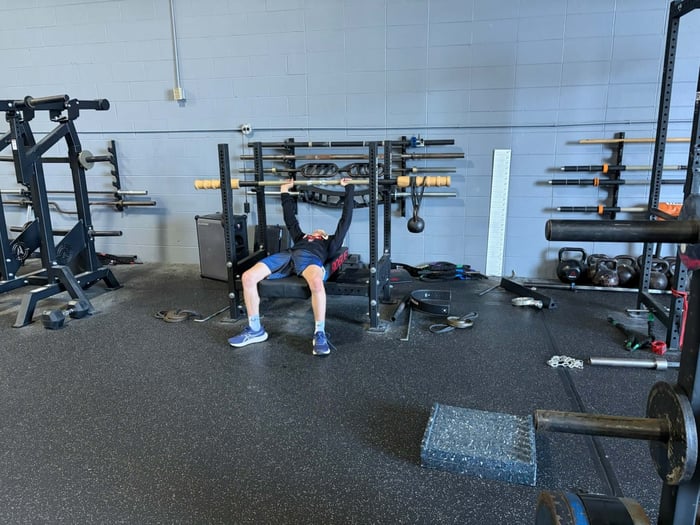
Rylen uses Max Effort exercises to improve his ability to produce force. We rotate exercise variations to develop strength without repeatedly stressing the same movement pattern. The objective is to establish a technically sound maximum for the day without allowing the pursuit of a gym number to interfere with wrestling practice.
The combined Dynamic Effort sessions focus on producing force quickly. We expect Rylen to move each repetition with greater intent while maintaining consistent bar speed throughout the session.
Rylen demonstrated this understanding when another wrestler said the box squat was too light and wanted to add weight. Rylen told him that if he wanted to make the exercise harder, he needed to move the bar faster. That interaction showed that Rylen understood the purpose of the session: developing speed rather than seeing who could load the most weight.
We select accessory exercises according to the weaknesses observed during training and wrestling, including his posterior chain, hip and shoulder capacity, and grip strength.
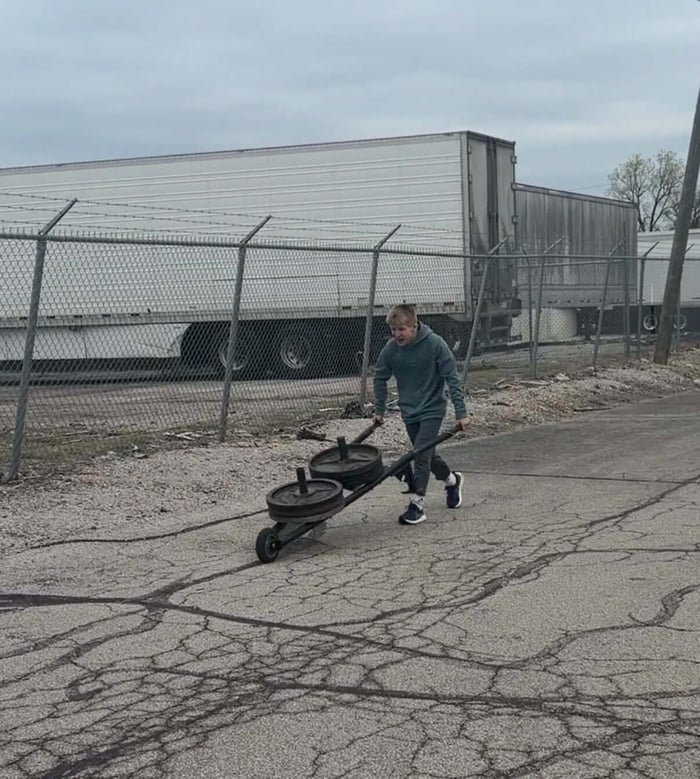
PSA sled sprints, sandbag carries, overhead carries, and the War Wagon develop general physical preparedness and repeated-effort capacity without relying only on additional barbell volume.
Managing Training and Athlete Feedback
The weight room has to support Rylen’s wrestling schedule rather than compete with it. We adjust his weekly workload according to wrestling practices, tournaments, travel, and how he is responding to training.
Bar speed, exercise technique, rest periods, and Rylen’s feedback help determine whether the prescribed workload is appropriate. When Rylen recovers well, we can increase the training demand. When wrestling volume is high or an exercise does not feel right, we adjust the exercise, volume, or intensity before it affects practice or competition.
Rylen understands that heavier does not automatically mean better. When the objective is speed, he focuses on moving the prescribed weight faster. When the objective is strength, he is willing to push heavier weights.
Like most competitive athletes, Rylen sometimes wants to add weight or continue pushing. When we show him the bar speed, explain the training decision, or tell him that the objective for the day is different, he follows the plan. This feedback process allows us to coach the athlete in front of us instead of forcing him into a predetermined program.
Measuring Rylen’s Progress
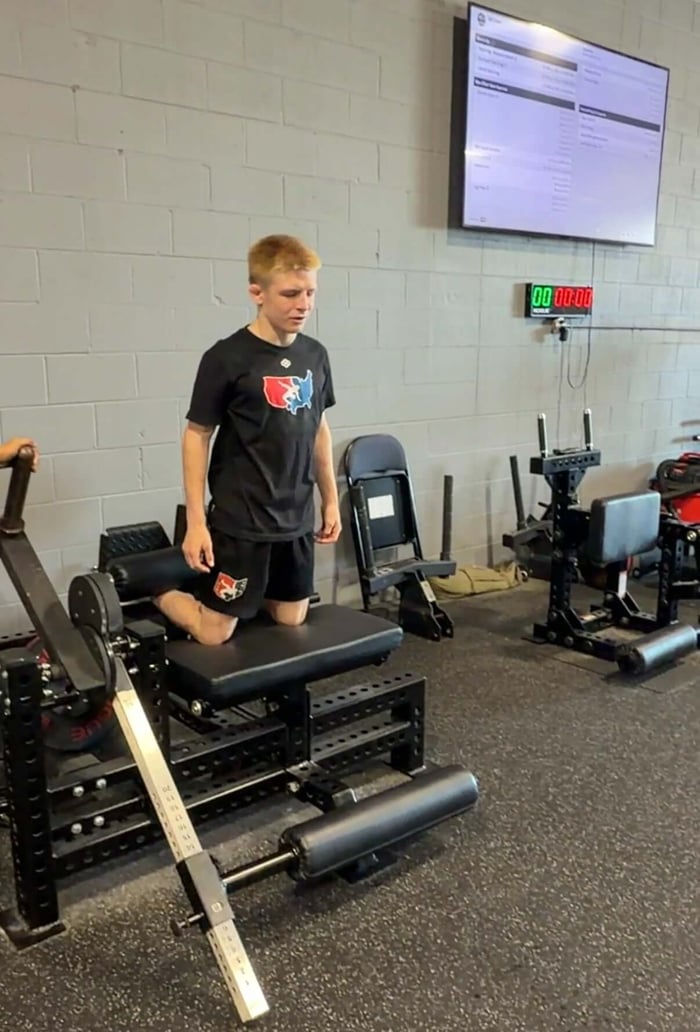
The data shows that Rylen’s greatest improvement has been in his hamstring strength. During his initial testing on the inverse curl, he required 70 lbs of assistance to complete the movement. He can now perform the inverse curl with no assistance and without using the chest pad.
This matters for wrestling because stronger hamstrings help a wrestler maintain hip position, finish takedowns and throws, resist an opponent's pressure and control the body during rapid changes of direction.
Rylen has also made significant improvements in his work capacity. His early sessions included approximately 18,400 pounds of volume, but he has since completed sessions totaling 148,000 pounds of volume while maintaining a bodyweight appropriate for the 45-kilogram weight class.
Beyond his top numbers, he maintains bar speed later in sessions, handles greater accessory volume, recovers faster between stations, and holds better positions under fatigue.
These changes are important because wrestling does not require an athlete to produce force once under perfect conditions. A wrestler must produce force repeatedly, from different positions, while responding to an opponent.
Strength Training That Supports Wrestling
Our goal at Westside is not to turn wrestlers into powerlifters. We use barbells, specialty equipment, sleds, sandbags, and carries to develop maximum strength, explosive strength, grip endurance, work capacity, and other qualities that can transfer to wrestling. We judge the program by whether the athlete becomes stronger, faster, and better prepared for practice and competition, as well as by feedback from his sport coaches, not by how tired he looks when the workout ends.
Supporting World-Level Preparation
Strength and conditioning did not create Rylen’s wrestling skill. His technical development, wrestling coaches, training partners, competition experience, and years of consistent work earned him his place on Team USA.
The role of his Westside training was to support that foundation. By identifying his physical needs, selecting exercises according to those needs, and adjusting the workload around his wrestling schedule, we helped him develop without taking away from the work that mattered most.
Rylen’s 2026 season included U.S. Open titles in Greco-Roman and freestyle, Pan-American titles in both styles, a U17 Greco-Roman world championship, and a U17 freestyle world silver medal.
Those results do not prove that one exercise or training method caused his success. They demonstrate what can happen when high-level wrestling preparation from his coaches is supported by an organized strength and conditioning program that adapts to the athlete.
Coachability and the Training Environment
Rylen understands each session’s objective, communicates honestly, and holds himself to the same standard he expects from his training partners. During a difficult conditioning circuit, he finished before several teammates but continued walking beside them and encouraging them until the group finished. His willingness to be coached and push others strengthens the training environment.
The Westside Wrestling Strength Program
The Westside Wrestling Strength Program is designed to create measurable physical improvements that support performance on the mat without reducing the quality of technical preparation.
We organize Max Effort training, Dynamic Effort work, targeted accessories, and general physical preparation around each wrestler’s individual needs and schedule. Rylen’s development shows the value of combining high-level wrestling instruction with a specific strength and conditioning plan that we continually evaluate and adjust. If you want to learn how to apply the Westside Conjugate System for wrestlers, email me at mac@westside-barbell.com or jump into the pathway to learn how we establish culture, coach, program, and adjust the system for athletes in real time.