
Table of Contents
To build a truly successful strength program using the Maximal Effort (ME) Method, you need to lay down a solid foundation of education before your athletes ever touch a barbell. Wrestling already places a heavy demand on the athlete before they ever walk into the weight room. Because of that, training high school wrestlers requires a unique approach.
Before a high school wrestler ever works up to a heavy attempt, the coach needs to understand three things:
How recovered the athlete is
How aggressive they are with weight selection
What the lift is telling you
Using the Max Effort Method within the weekly feedback loop lets the coach track strength levels from week to week. It proves whether the chosen special exercises are actually working, and it serves as a real-time assessment tool to see if a current weakness is improving or if a new one has shown up.
Autoregulation
Some wrestlers train and compete year-round. They move from the folkstyle season straight into Freestyle/Greco and might also train with multiple club teams as a way to become more technically skilled. As a strength coach, you must keep a close eye on the individual's readiness as this may cause you to adjust the plan.
You might have the perfect strength and conditioning program written on paper, but reality often gets in the way. Imagine an athlete goes to a club practice where light drilling suddenly turns into live matches. Then, the coach hands out hundreds of push-ups and wall-to-wall sprints as a punishment because the room lacked energy or the wrestlers weren’t being aggressive enough. That intense sprinting conditioning as a punishment can easily add up to 500,000+ pounds of sprint volume quickly. With no consideration for the extra stress it just placed on the athlete's body, this will negatively affect the athlete’s ability to recover.
Planned sprints have a place when they are programmed with a purpose. Punishment sprints are different because they add stress without measuring volume, recovery, or the athlete’s readiness for the next session. When they are used as punishment without structure it increases systemic stress, structural stress, psychological stress, nervous system fatigue and muscular fatigue all in one session.
It is not the athlete's fault that they are exhausted, but they cannot out-recover that kind of spike in volume, especially if that practice ended at 9 PM and they are walking into your weight room at 6:30 AM the next morning.
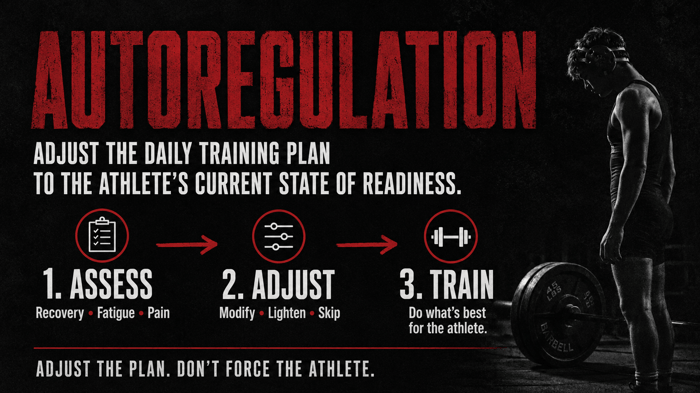
This is where autoregulation comes in. A good strength coach adjusts the daily plan based on the athlete’s current state of readiness. Don’t make the mistake of following the training plan as if it is set in stone. As a strength coach, you should be able to adjust the daily training to the athlete rather than forcing the athlete to fit your plan. If a wrestler is completely drained from a brutal mat session, the Max Effort lift for that day needs to be modified, lightened, or skipped entirely.
The same applies when an athlete comes in and is banged up or has tweaked something at practice. If the athlete comes in with a beat up shoulder then a good substitute could be a belt squat instead of a straight bar back squat. At the end of the day, you have a responsibility to do what’s best for the athlete you have in front of you.
Fearless Attempts (But Don't Get Greedy)
The Max Effort Method is incredible for high school wrestlers because they are already some of the most determined, fearless athletes you will ever meet. They aren't afraid of hard work or pushing their bodies. However, their biggest mistake is usually getting too competitive in the wrong lifting metric in a group. This can lead the wrestler to attempt a weight they are not prepared for. When training in a group with different body sizes and weight classes, clearly someone will outlift another teammate. The goal here is to match or surpass the PRs, not the total weight lifted.
Common Mistakes to Avoid
Here are some common mistakes wrestlers and coaches should avoid when using the Max Effort Method:
Failed Lifts: When using the Max Effort Method, we want to avoid failing lifts. Missing lifts should not become normal. A failed attempt taxes the nervous system, can hurt confidence, and usually shows that the athlete or coach got greedy with the jump. When an athlete learns how to set achievable goals a 5 lbs PR becomes more than just a small jump. They break a PR by 5 lbs, move on, and attack their accessories with intent. That teaches them goal setting, builds confidence through consistent weekly PRs and buy-in to a program teaching them to win week by week.
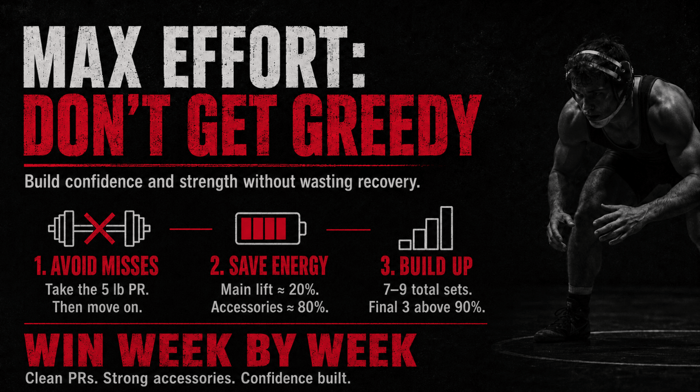
Wasted Energy: If a wrestler spends every ounce of energy grinding out one ugly rep on the main lift, their accessory work will suffer. For the Max Effort Method to work, the main lift should make up roughly 20% of total volume, with accessory work making up the other 80%. The accessory exercises are what actually build the main movement, decrease weaknesses, strengthen muscles that matter and help to mitigate injuries.
Skipping Working Sets: The goal is not to break a record in 3 sets. You want to build up over 7-9 total sets with the last three being above 90%. Those working-up sets matter. They are not just added volume; they prepare the athlete’s body and nervous system for the heaviest load of the day. A wrestler may try to jump up too fast because they think they are conserving energy, but skipping sets usually has the opposite effect. The athlete misses the chance to dial in technique, build tension, feel the groove of the lift, and mentally prepare for the top attempt.
Lowered Speed Percentages: If a max effort lift turns into a multi-second, grinding struggle, it can negatively impact their Dynamic Effort (speed) work later in the week. Dynamic Effort work requires speed. If the bar velocity drops, the percentages need to be adjusted. For example, if on week two speed squats at 55% bar weight +25% accommodating resistance move too slow, the load is too heavy for that athlete on that day. Lower the bar weight by 5-10% so the bar speed matches the specific adaptation you are trying to achieve.
When training wrestlers, the weight room should enhance their physical abilities. Remember the ultimate goal of the weight room is to build a dominant wrestler on the mat, not just a high number on a chalkboard. A solid, technical PR builds a confident athlete who knows how to strain without breaking.
The Weekly Feedback Loop
Max Effort training isn’t just about lifting heavy weights; it acts as a live, weekly report card for the coach. By rotating a new heavy exercise every single week, you create a feedback loop. Instead of waiting until the end of the season to test your athletes, this method acts as a real-time assessment tool.
This weekly feedback loop answers three major questions:
How strong is the athlete right now? Because wrestling weight classes and training loads change constantly, you need to know their true strength levels in real-time. This method tells you how strong the athlete is on any given week.
Are the accessory exercises working? Your accessory exercises are supposed to drive your main lifts up. If a wrestler’s Max Effort sumo deadlift or box squat PR goes up, it proves that the specific hamstring, glute, and lower back exercises you chose are actually doing their job.
What is the new weakness? When an athlete approaches a maximum load, their form will always break down at their weakest link unless it’s a technical issue. If their knees shoot forward off the box or their upper back rounds, the barbell has just exposed their weakness. This tells the coach exactly what muscle group needs to be targeted with accessory work next.
Max Effort training can be one of the most valuable tools for a high school wrestler and the coaching staff, but only when it is coached correctly. The goal is to teach the athlete how to strain, expose weaknesses, build confidence, and carry that strength back to the mat.
If you want to learn how to apply the Westside Conjugate System for wrestlers, email me at mac@westside-barbell.com or jump into the pathway to learn how we establish culture, coach, program, and adjust the system for athletes in real time.