
Table of Contents
The dynamic effort method is one of the three primary strength training methods used within the Westside Barbell Conjugate Training System. This training method features submaximal weights lifted at maximal velocity. The goal of this training is to enhance an athlete's rate of force development, which dictates the time it takes for the athlete to reach peak force output.
This work develops an athlete’s ability to be explosive in their lifts and sporting movements. Dynamic effort training works synergistically with maximal effort training. If an athlete were a race car, dynamic effort work develops the transmission that puts the power to the wheels, while maximal effort work builds the engine that produces the horsepower.
However, the dynamic effort work places a bit more demand on the athlete than maximal effort. Considering the velocity these movements are performed at, an athlete must have the strength, coordination, and work capacity to ensure dynamic effort reps are strictly executed set to set.
In this article, we will discuss the most reasonable approach to introducing dynamic effort training to the beginner-level athlete. We refer to this approach as the “crawl, walk, run” strategy.
The Crawl Phase
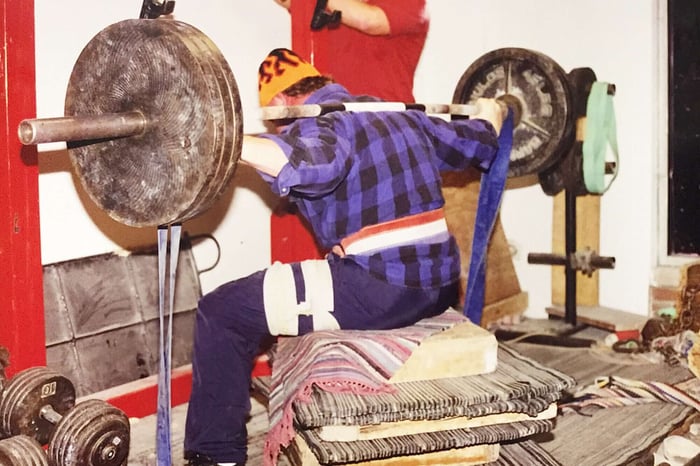
Once beginner-level athletes have established baseline strength and coordination, and have exhibited the ability to properly execute the big three lifts (squat, bench press, and deadlift), we can begin to increase the velocity at which these lifts are performed. This is where compensatory acceleration training enters the equation.
Compensatory acceleration training is an approach to barbell training made popular by Dr. Fred Hatfield. The idea is simple: athletes will lift submaximal weights as fast as possible, without the use of accommodating resistance. This means no bands or chains will be attached to the barbell.
As many of you know, our dynamic effort work follows a three-week wave format. During the crawl phase, our dynamic effort training wave will utilize 50% intensity in week one, 55% in week two, and 60% in week three. This work will be performed with barbell weight only, with a focus on moving as fast as possible while maintaining strict technique.
Considering this will be the first time athletes are moving a loaded barbell at maximal velocity, we will have to cut the volume slightly. For instance, our standard squat wave utilizes a 12 x 2 scheme in week one, a 10 x 2 scheme in week two, and an 8 x 2 scheme in week three. During the crawl phase, we will cut two sets per week, following a 10 x 2 / 8 x 2 / 6 x 2 three-week wave format.
Our focus during the crawl phase is to familiarize the athlete with higher velocity movement. We want to ensure the athlete understands the intent needed to make this work effective, while building the work capacity needed to escalate to the walk phase.
The Walk Phase
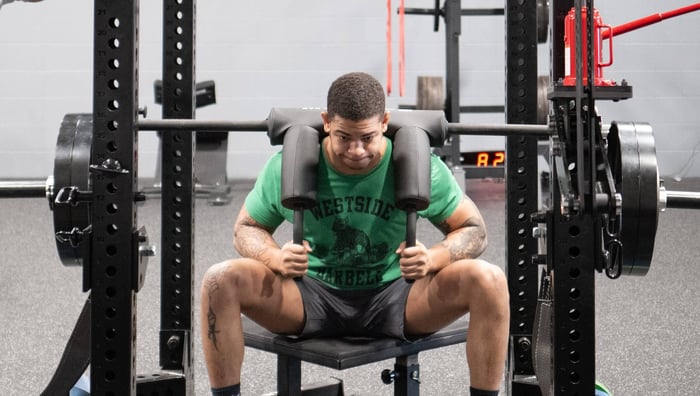
After 2-3 successful “crawl” training waves, we will evaluate the athlete’s capabilities. If the athlete has consistently exhibited proper technique and possesses the work capacity to complete all sets and reps strictly, we can then move on to the walk phase. This is where we introduce accommodating resistance into the mix.
During the walk phase, we will opt to use only one form of accommodating resistance: chain weight. Chains are the best option to introduce accommodating resistance to beginners, as they accommodate resistance without an overspeed eccentric effect. The overspeed eccentric effect occurs with the use of resistance bands, which increases kinetic energy during the eccentric phase of a lift, placing greater demand on deceleration.
If we introduce overspeed eccentrics too early, we risk significant breakdowns in technique and the possibility of excess wear and tear on the athlete. Resistance bands can be physically demanding, especially to an athlete with less than six months of barbell training time under their belt.
When we add the chain into the mix, we will also escalate the weekly training intensity. During the walk phase, we will go from a 50%, 55%, 60% wave to a 60%, 65%, 70% wave. The chains will make up 20% of the training weight, with the remaining training weight being made up in bar weight.
It is important to ensure the chains are properly attached to the barbell. Ideally, when the athlete is at lockout, we want 2-3 links total in constant contact with the ground. If too many links are left on the ground, the chain weight applied to the barbell is altered, and we are not getting a true 20% of accommodating resistance added to the barbell.
With the chains added, the technical demands of the lift increase. Chains challenge stability and technique, allowing the walk phase to enhance the athlete's technical capabilities while properly preparing them for the increased demand during the “run” phase.
The Run Phase
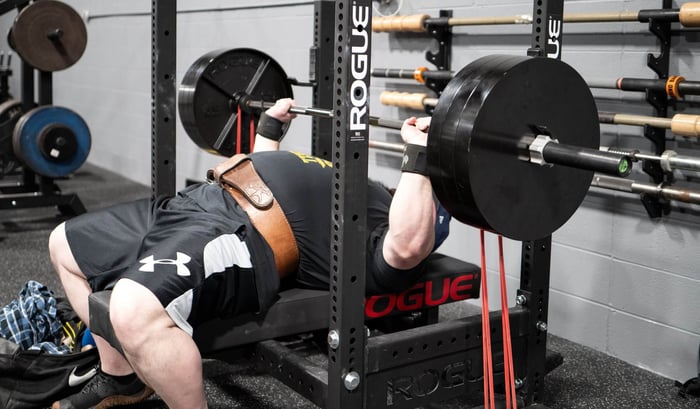
Once the beginner-level athlete has successfully worked through multiple waves of dynamic effort work with chains, we will then introduce resistance bands. As I mentioned previously, resistance bands are a form of accommodating resistance, but also feature a specific benefit that chains cannot match: overspeed eccentrics.
When resistance bands are connected to a barbell, the overspeed eccentric effect increases the kinetic energy of the eccentric phase. This demands that the athlete exert a greater level of eccentric force to decelerate the barbell and maintain proper positioning and technique. Resistance bands place significant demand on the athlete, which is why we recommend beginners work through the crawl and walk phase before utilizing them.
The use of resistance bands will enhance an athlete’s reversal strength and starting strength, and will promote acceleration through the entirety of the lift. With a standard barbell and plate weight, acceleration only occurs for so long, then the athlete “coasts” once enough force is produced to overcome the applied resistance.
With resistance bands, athletes must accelerate for an extended period, which pays dividends on the field, court, mat, or powerlifting platform.
When working with an athlete new to resistance band training, it is important to monitor their tolerance to the training. Often, bands can be a bit fatiguing for inexperienced athletes. Because of this, athletes will likely need to alternate between bands and chains wave to wave.
However, once athletes can tolerate bands without incurring excess fatigue, we want to maintain a 2 to 1 ratio of band to chain use when executing dynamic effort waves. This is because resistance bands essentially kill two birds with one stone (accommodating resistance and overspeed eccentrics), while chains only accommodate resistance.
Once athletes have reached the run phase and have displayed the ability to tolerate and recover from the training in a reasonable amount of time, they can now begin following typical Conjugate Method dynamic effort training schemes with no adjustments made due to their experience level.
Work Through the Process
As a coach or athlete, it is important to understand the necessity of the crawl, walk, run approach. Within the Conjugate Training System, many believe maximal effort work is the most taxing. In reality, dynamic effort training is the most demanding from both a physical and mental perspective.
When executing maximal effort, we will work up to the heaviest weight we can lift that day, and end the exercise just before an egregious breakdown in technique takes place. This typically results in the athlete performing 7-9 total sets (mostly singles) before moving on to accessory work.
With dynamic effort training, we are not only dealing with increased training volume, but we also have to ensure our velocity, technique, and training density are dialed in. This training requires athletes to remain dialed in for up to 24-27 total reps, at intensity levels between 70-85%.
Dynamic effort training requires athletes to be strong, focused, and have the work capacity to successfully meet the parameters of the training set after set. This is why we use the crawl, walk, run approach. We do not want to throw a beginner in the deep end and expect them to swim; we want to escalate training reasonably to avoid injury and ensure reps are properly executed.
Following the advice above will allow for dynamic effort training to be successfully introduced, while ensuring athletes have the time to develop the intent, technical proficiency, and work capacity needed to execute standard dynamic effort work properly.
Do not rush the process. Take the time to work through the levels, and your dynamic effort training will be productive.
Westside Downloadable Seminars- Dynamic Effort Method™

$5.00
Learn how to increase force production, maintain or increase volume, and make individuals both stronger and faster! The Dynamic Effort Method™ is sometimes referred to as speed work, and while some may dismiss its importance, it is a crucial part… read more