Table of Contents
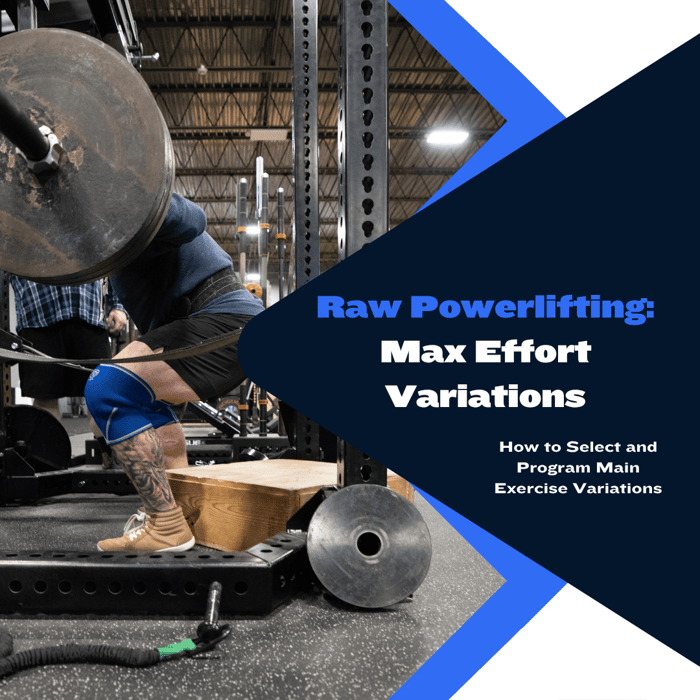
The use of max effort main exercise variations during maximal effort is commonly associated with the Westside Barbell Conjugate System. At Westside, we use main exercise variations to avoid accommodation and target specific joint angles and muscle groups. In our experience, this approach to training results in athletes building the strength and competency to consistently achieve PR lifts throughout each year.
In the world of raw powerlifting, the need for or efficacy of exercise variations has been consistently called into question. Some believe that specificity is King, and to become the best powerlifter you can be, you must focus strictly on the competition standard squat, bench press, and deadlift.
Others do not fully buy into the “no need for exercise variation” argument and include some exercise variety in their training plans. However, these individuals limit the use of main exercise variations to the offseason, focusing on competition specificity once they are 12-16 weeks out from competition.
At Westside, we use exercise variations for our main and accessory exercises year-round, regardless of the competition schedule. It is our belief that the athlete who becomes highly proficient across a broad spectrum of exercises becomes as strong as they can genetically be.
By consistently challenging the athlete to adapt to new stimuli week after week, our rate of progress will surpass that of athletes following other exercise programming styles. You’ll hear some coaches say athletes with a high training age should be happy with a 5lb PR per year.
At Westside, our athletes make at least a 5lb PR each month, regardless of training age.
Introducing Max Effort Exercise Variations
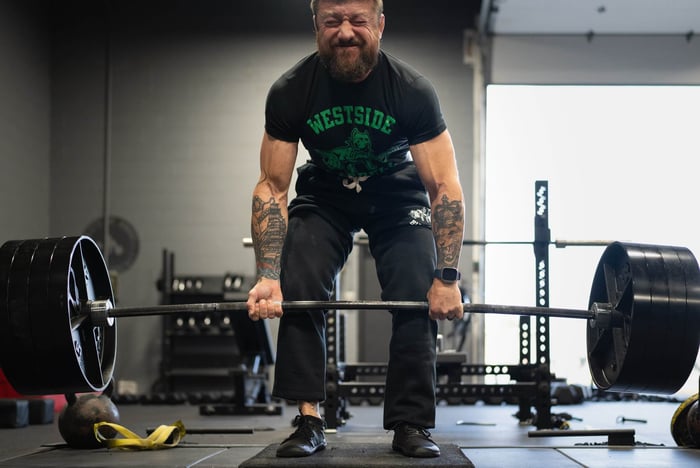
A common question we receive is when and how to introduce exercise variations. The answer to these questions will always depend on the athlete's training experience. Simply put, an athlete new to barbell training will need less variation, while more experienced athletes will immediately begin using exercise variations.
When working with beginners, we want to ensure we build strength and basic movement skills using what would be considered the foundational powerlifts. This means using the standard squat, bench press, and deadlift to build initial strength and coordination before beginning to include more complex movement.
The idea here is simple: get the greatest amount of adaptation out of the least amount of exercise variation.
Contrary to popular belief, we can absolutely use the Conjugate Method with an absolute beginner. However, we must ensure that we scale the training in a way that allows the athlete to “level up” appropriately.
As a beginner, the rate at which accommodation affects training will be a bit slower than that of an experienced athlete. This means beginners can make gains using the same main exercises for at least 10-12 weeks before adding base-level variations (box squats, good mornings, block deadlifts, etc.). However, while the movements will remain the same for the first 10-12 weeks, we will vary the rep ranges, working at 1-, 3-, or 5-rep sets.
If we are dealing with an intermediate or advanced-level athlete converting to the Conjugate Method, we can begin using exercise variation immediately. Considering these athletes have been training and have improved in absolute strength and coordination, we can expect them to benefit immediately from new stimuli.
The only hurdles are understanding the point of each variation and becoming proficient in its execution. However, once these athletes understand the why and the how, they will immediately begin to benefit from using main exercise variations.
Programming Max Effort Exercise Variations
Once an athlete has decided to begin incorporating max effort exercise variations into their training, the next question is: how many variations should be used per month? When using the Conjugate Method, we have two maximal effort days and two dynamic effort days. Typically, our maximal effort variations will change week to week, while our dynamic effort variations remain in place over the course of a three-week training wave before being adjusted.
The standard Westside Barbell Conjugate Method approach calls for four exercise variations per month for both the lower- and upper-body maximal effort workouts. However, the amount of variation used per month can be modified based on the athlete’s preference or level of confidence.
There are athletes who begin to lose confidence if they do not perform the competition lifts at least once, if not twice, per month. Additionally, when we begin adding variation into the mix for an experienced beginner, we want to regulate the amount of variation used to ensure they do not lose competency in the standard barbell lifts.
Here is how we can program maximal effort exercise variations for beginners or experienced athletes new to Conjugate-style training.
Max Effort Training Schedule
Week 1:
Max Effort Lower – Squat
Max Effort Upper – Bench Press
Week 2:
Max Effort Lower – Giant Cambered Bar Good Morning
Max Effort Upper – Close Grip Bench Press
Week 3:
Max Effort Lower – Deadlift
Max Effort Upper – Bench Press
Week 4:
Max Effort Lower – Box Squat
Max Effort Upper – Floor Press
As you can see, we focus on competition-specific training twice per month, while the other two weeks include exercise variations intended to improve competition lift strength and skill. This would be an optimal, maximal effort lower-body training schedule for an experienced athlete new to Conjugate, or a beginner-level athlete looking to escalate their training approach.
An athlete with Conjugate Method training experience will follow a more traditional Westside Barbell maximal effort training schedule. Here’s an example.
Max Effort Training Schedule
Week 1:
Max Effort Lower – Squat
Max Effort Upper – Bench Press
Week 2:
Max Effort Lower – Giant Cambered Bar Good Morning
Max Effort Upper – Close Grip Bench Press
Week 3:
Max Effort Lower – 2” Deficit Deadlift
Max Effort Upper – Bench Press vs. Chains
Week 4:
Max Effort Lower – Box Squat
Max Effort Upper – Floor Press
The standard maximal effort programming will utilize greater exercise variation, resulting in consistent gains in strength, skill, and coordination. While the onramp plan for beginners or the Conjugate Method converts is a good starting point, this schedule represents what would be considered optimal maximal effort exercise programming.
At Westside, our approach is to follow an ABAB pattern of exercise variations. This means that in month one we will execute the “A” series of exercises, and then in month two we move on to the “B” series of exercises. We will do this over the course of four months, with the numbers achieved in months 1 and 2 serving as the baseline PR numbers we aim to beat in months 3 and 4.
Once we have completed the ABAB pattern, we will select new exercises for each month and execute the training following the same approach.
It’s Not About Weaknesses
A common misconception about main exercise variations is that they should be chosen based on an athlete's weaknesses. As a matter of fact, one of the biggest misconceptions about our training style is that most of our programming focuses on targeting weaknesses.
In reality, specific targeting of weaknesses occurs only after an individual has demonstrated the weakness consistently over 4-8 weeks.
Often, an athlete will display a weakness once or twice in training, leading to a complete overhaul of the training program. However, the likely cause of this is fatigue, not a significantly weak muscle or muscle group. So, before we adjust training and begin focusing specifically on an identified weakness, we want to make sure we have enough evidence to rule out systemic or local fatigue as the cause.
At Westside, we use exercise variations to target specific joint angles, emphasize the anterior or posterior chain, and improve posture and positioning. For instance, the pin 3 rack pull allows us to challenge specific joint angles in the deadlift, the SSB squat allows us to place emphasis on the thoracic and cervical spine, as well as the trunk and lower body anterior chain, and the good morning helps to improve posture and position during maximal effort squats and deadlifts.
The overall idea is to build a more confident and complete athlete by training above and beyond the demands of the competition-specific lift. If an athlete has mastered the barbell squat and a variety of squat variations, it can be assumed that this athlete is a more skilled squatter than an athlete who can only demonstrate strength and competency in the competition-specific lift.
Now, some may say, “jack of all trades, master of none,” however, in our experience, the best becomes better once they begin to master variations beyond the standard competition lifts.
While there are times where identified weaknesses lead to specific variations being included, this is not the only aspect of training we are concerned with.
Tracking and Estimating Progress
When using max effort exercise variations, it is important to understand how to track progress across all variations and estimate progress in the competition-specific movements. As I mentioned above, we will implement variations in an ABAB pattern over four months, allowing us to test and retest each variation. “A” variations will be tested in months 1 and 3, while “B” variations will be tested in months 2 and 4.
Once this is complete, we will adjust the exercise selection and repeat the pattern.
We can also use progress in exercise variations to estimate progress in competition-specific lifts. However, which lifts we use to draw conclusions will depend on the athlete we are working with.
For instance, an athlete who consistently misses their bench press off of their chest can look to an exercise such as the dead press to estimate potential competition bench press progress. If a lifter has notorious lockout issues, we can consider variations such as the floor press or the banded bench press to gauge progress on competition lifts.
Of course, if athletes are consistently hitting PR lifts in all non-competition variations, we can also assume progress in the competition lifts is being made.
Over time, coaches and athletes will begin to identify both main and accessory exercises that serve as indicators of progress in competition lifts. However, it is important to note that this will take time to establish. If an athlete has only been training Conjugate for 16 weeks, we won’t have enough training data to accurately measure progress based on a matrix of exercises.
So, we not only want to test our competition lifts at different points in our maximal effort training, but we also want to ensure our exercise selection is specific to the athlete so that we can accurately estimate progress in the competition lifts based on progress in main and accessory exercises.
Again, getting to the point where we can accurately select variations to correlate with progress in competition lifts takes time. Beginners or intermediates should select basic exercise variations, see what they respond best to, identify correlations, and adjust their exercise selection as needed going forward.
Westside Downloadable Seminars- Maximal Effort Method™

$5.00
Learn how to increase Absolute Strength and discover why the Maximum Effort Method is the most crucial aspect of strength training. In this seminar, Louie Simmons explains the principles behind pushing your limits in the weight room and how the… read more