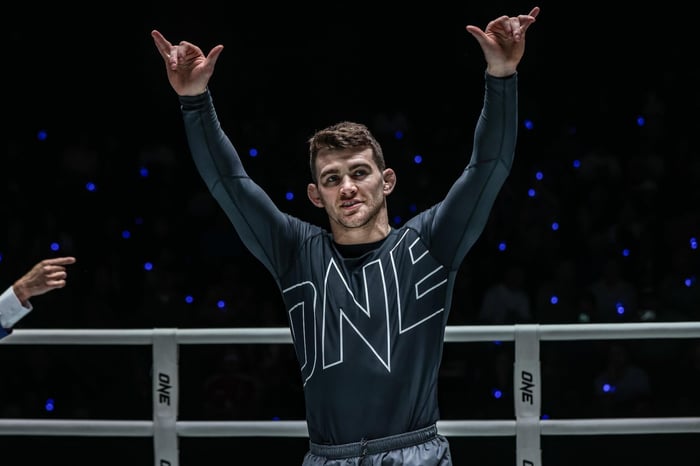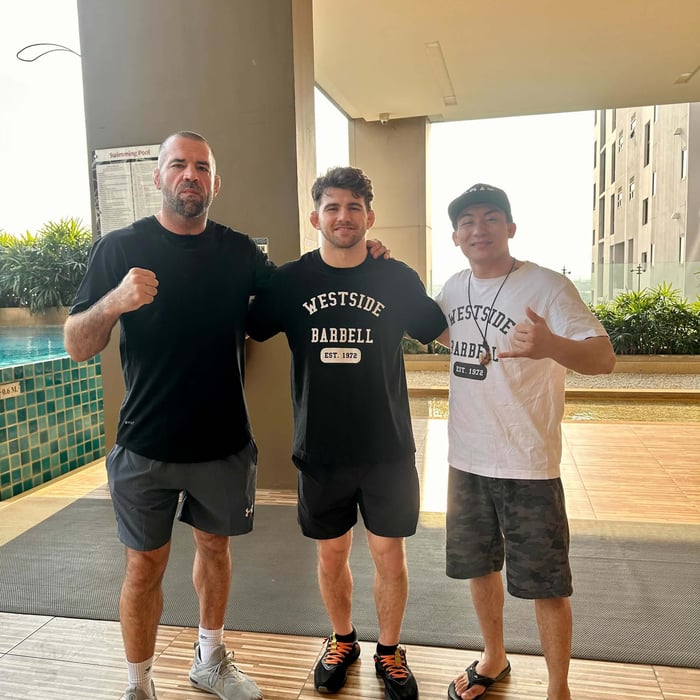
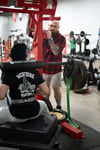
Joshua Perreira knocked out Gilbert Nakatani with a spinning backfist 38 seconds into the first round at ONE Fight Night 42 in Bangkok on April 10. One fight later on the same card, Dante Leon took a unanimous decision over Kenta Iwamoto in welterweight submission grappling. Josh is an MMA fighter coming off a torn ACL and over a year on the sidelines. Dante is a two time IBJJF No Gi World Champion chasing a ONE Championship world title in grappling. Both train at Westside through the conjugate method.
Table of Contents
Joshua Perreira: The Comeback
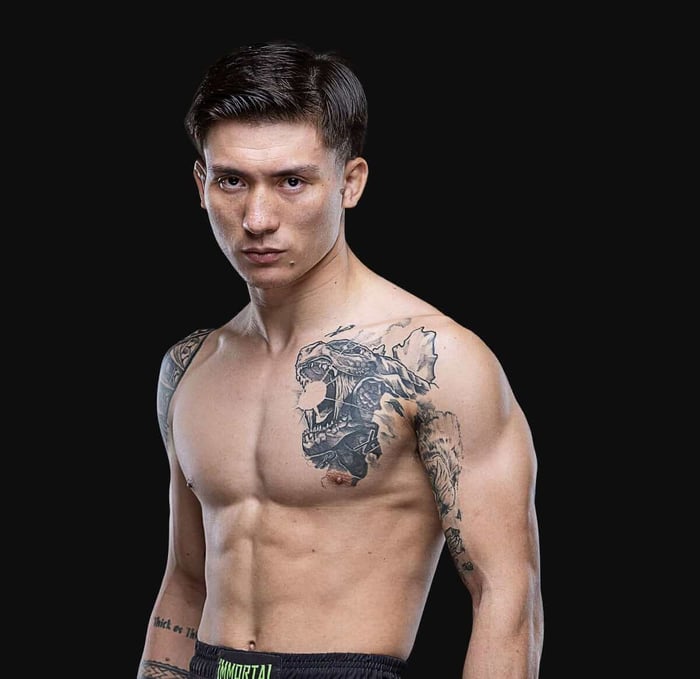
In March 2025, Josh tore his ACL and suffered meniscus damage on both sides of his knee during his ONE Championship debut against Banma Duoji. That fight was later ruled a no contest, but the injury was real and significant. Complete ACL tear. Two surgeries. The first to reconstruct the ligament and repair the meniscus. The second to remove a scar tissue cyst that was preventing his knee from bending past a certain point. For over a year, Josh could not compete.
We got involved immediately. As soon as Josh was back from the injury, we sat down and started formatting a plan. The first thing I did was call Dr. Shawn Bailey at The Armory, who we work with for exercise physiology and physical therapy.
From there we established a feedback loop with their physical therapist Sarah Bishop so that as soon as Josh had surgery, we had a direct line between physical therapy and strength training at Westside. That feedback loop was the foundation of the entire recovery. It allowed us to know the timeline, range of motion windows, and intensity thresholds we could train within at any given point.
As soon as inflammation went down, we got to work. Light movement. Range of motion. And most importantly, training everything that was healthy. Upper body dynamic effort and accessory work started right away.
Training did not stop. We did taper down on max effort lifts early on so the central nervous system could direct energy toward recovery, but after about four weeks we reintroduced max effort upper body work. No leg drive, nothing coming from the lower body, but we were still training the central nervous system and keeping his upper body in shape.
When Josh could bear weight and walk, sleds entered the program. Ultra lightweight, long distances, moving in all directions. Band extensions, asymmetric holds using bodyweight, belt squat box squats with limited range of motion to gauge depth and progress.
As we acquired more range of motion, we put more force into the area, building load bearing capacity in conjunction with what Sarah was doing in physical therapy. We tried not to overlap with her work. We trained generally around it.
The injury also gave us an opportunity. When an athlete is out of competition, you can get into a series of smaller, more frequent accessory work that competition schedules normally do not allow. We were able to develop Josh more specifically during this time than we could have during a normal training cycle. His physical literacy went up.
When you suffer a serious injury, your feedback loop with your own body and how it moves starts to sharpen. You stop taking it for granted. You understand your own biomechanics better, give better feedback, and learn when to push and when to hold back.
What was remarkable is that in the last three months leading up to this fight, Josh broke personal records on all lifts that were established before the injury.
But I want to be clear about something. A lot of strength coaches take credit for athletic results, and I think that is the wrong way to look at it. My philosophy is that the goal of strength and conditioning is to give the athlete the best opportunity to develop and showcase their skills.
It is the athlete who refines that and takes what is given and runs with it. The strength and conditioning process, via the conjugate method, that we put Josh through was one part of the overall system that helped his recovery. At the end of the day, in sports like MMA, it is the athlete in the ring, not us. Josh's level of commitment, consistency, and mental attitude toward using this setback to come back better is what made the difference.
A spinning backfist knockout in 38 seconds on the biggest stage in the world after a year on the sidelines. That is Josh Perreira, and we are fortunate for the trust he places in this process.
Dante Leon: The Professional Standard

Dante is the role model for what a professional jiu jitsu athlete should look like. He approaches everything with a systematic outlook and leaves no stone unturned. Nutritionists, physical therapists, strength and conditioning, skill development, teaching, coaching, always learning.
He gives valuable feedback and trusts the process. The vast majority of systems we use have been laid down by the greats. All we are doing is trying to refine and advance them in a correct setting. When you have strong feedback loops with your athletes, you can dial in training, and that gives someone like Dante maximum access to his skill.
For this camp specifically, the biggest factors were that Dante did not have to cut weight and we could push work capacity and training density higher than normal. We were able to put on sport specific mass in areas that develop his game and not lose any of it to weight management stress.
To give some context on what the conjugate method actually looked like going into this fight, here is a snapshot of a typical training week during Dante's adaptation phase.
D. Leon, conjugate method training phase, Week 4-
| Day / Session | Key Movements |
|---|---|
| Day 1Cardio, Pump, Posture | High intensity bike intervals, TRX plank to pike, contralateral deadbugs, barbell curls, supine tricep extensions, straight arm cable pulldowns |
| Day 2DE Full Body | Box squat 10x2 @ 55%, bench press with chains 9x3 @ 55%, sumo deadlift from 2 block with bands 8x2 @ 55%, sprints, sled drags |
| Day 3Posture, Plyos, Hypertrophy | Plyo push ups (single response + continuous), med ball rotational throws, staggered stance RDL 3:1:3 tempo, SSB good mornings 3:1:3 tempo, heel elevated goblet squats 3:1:3 tempo |
| Day 4ME Lower | Front squat to 97.5% + record attempt, back attack machine, adductor dominant leg press, jump shrug from hang snatch, reverse hypers |
| Day 5Posture & Plyos | DB squat jumps 4x5, band hamstring curls 3x100, banded good mornings, banded deadbugs, external rotation work |
| Day 6ME Upper | Floor press to 97.5% + record attempt, strict DB tricep extensions, DB bench @ 100s, pullover and press, shoulder raise complex |
That is six training days covering dynamic effort lower and upper body with accommodating resistance, max effort days for both lower and upper, dedicated hypertrophy, plyometrics, high volume postural and accessory work, and sport specific conditioning layered throughout. The conjugate method allows you to address all of these qualities concurrently without overloading any single one.
It is also worth noting that even within the conjugate framework, we will periodically utilize tools and frameworks such as tempos to introduce new stimulus for a specific purpose. The hypertrophy work on Day 3, staggered stance RDLs, SSB good mornings, and heel elevated goblet squats, all done with a 3:1:3 tempo, is a good example. We are using time under tension to drive hypertrophy in targeted areas while controlling the movement quality.
That is not a departure from the conjugate method. That is the system doing what it is designed to do: absorbing the right tool for the right problem at the right time. The system has defined methods, but how we manipulate them is based on context. The exercises themselves are tools to deliver force, and they change based on what the athlete needs at that point in their development.
The graph below shows Dante's monthly training volume in total pounds lifted from September 2025 through March 2026 leading into this fight. This is a general overview of volume to give an idea of how we manipulate it across the training cycle.
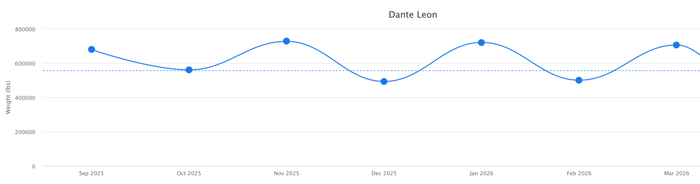
When volume is high, the emphasis and distribution of those methods shifts accordingly. When it pulls back, it shifts again. That is how you manage fatigue, drive adaptation, and keep the athlete developing without running them into the ground. It is also worth noting that this volume increases during warmer months when we are able to push sled drags and outdoor based strength endurance exercises harder. Environment shapes the program. The conjugate method accounts for that.
Now, about the weight cutting conversation.
If you have the skill and you have the strength and conditioning to walk in just under the required weight class, you are not pulling back on nutrition, you have no stress from the cut, and you are able to train harder leading up to a big event than you would if you were depleting yourself. That stress on your body disappears. You walk in with maximum access to your energy, your strength, and all the skill acquisition you have invested in.
That is what we did with Dante for this camp. The result was a dominant decision win over Kenta Iwamoto, a three time ADCC Asia and Oceania Trials champion with world class credentials. Dante controlled the match, swept from X guard, attacked the Achilles, hunted a triangle in the closing minutes, and was never in real danger. He is now in a clear position for another shot at Tye Ruotolo and the ONE Welterweight Submission Grappling World Title.
The System and the Culture
An MMA fighter recovering from a torn ACL and a submission grappler pushing for a world title do not train the same way. But they train through the same system. That is the point.
When we educate people on the conjugate method through our training, we are introducing them to thinking in systems. The principles, the methods of max effort, dynamic effort, repeated effort, accommodating resistance, special exercises, all of that can be adopted and used within whatever context and setting you operate in. That is the power of it. It is not a rigid template. It is a framework that allows you to solve problems in real time.
But what you can only get at Westside is Westside. That is a reflection of the cultural values we place within the system. The responsibilities, the level of consistency, the expectations we place on our athletes. How hard they train here is difficult to convey through text.
All are welcome to come visit or try to jump in with them, but this environment is not for those who are not willing to give everything to be the best in the world. There is a legacy attached to what we do, and we want to ensure our athletes still abide by the principles of what a Westside athlete should be.
This should be the same for anyone who uses conjugate method principles within their own training. Your system should carry your own culture. It should be based on the equipment you have, the athletes you work with, the environment you operate in. That is what makes this such a great system. It allows for personality, principles, and context to make it uniquely yours while still being systematic enough that you can justify how you train.
Louie told me when I first got to Westside that there are two ways to train: correctly and incorrectly. As time goes by and our industry continues to shift and change, that starts to make even more sense. Training correctly means your athletes are getting stronger, faster, more robust, and most importantly they are able to get better in the sport they are in. Training incorrectly means the strength training is not converting to the sport.
They are not getting stronger or faster and they are highly prone to injury. Once you are on the correct side, everyone is fighting over efficacy. But there is no room for absolutism because in strength and conditioning, there are no absolutes. Context and circumstances change on a daily basis.
Our goal is to problem solve in real time. The Conjugate Method allows you maximum adaptability and the ability to solve problems as they come will give you an advantage over one that is so strict, so absolute, so rigid that it cannot adapt.
If you want to get deeper into the context of how we train and into the nuances, our Level 1 course is the best way in.
Coaching Foundations Course | Level 1 Conjugate Pathway

$150.00
Learn How Louie Thought — Then Get Direct Access to a Westside Coach to Apply It to Your Athletes NSCA CEU APPROVED - 0.9 The philosophy, the assessment process, and the culture that built 40+ years of World Records —… read more
That is where we can talk about the specifics of how we approach strength and conditioning within the conjugate method.
A system that allows you maximum adaptability and the ability to solve problems as they come will always have an advantage over one that is so strict, so absolute, so rigid that it cannot adapt. Josh and Dante proved that on the same night, on the same card, from two very different starting points. The conjugate method is a way of training
FAQs
What is the conjugate method and how is it used for combat sports athletes?
The conjugate method is a training system that develops multiple physical qualities concurrently rather than in isolated phases. At Westside Barbell, we apply it to combat sports athletes by training max effort strength, dynamic effort speed work, and repeated effort volume within the same training week. The exercises are treated as tools to deliver force and change based on what the athlete needs. The methods stay consistent but how we manipulate them is based on context, the sport, the athlete's injury history, competition schedule, and development stage.
Can the conjugate method be used for injury rehabilitation?
Yes. The conjugate method allows you to train around an injury while still developing the athlete. When Joshua Perreira tore his ACL, we immediately established a feedback loop with his physical therapy team and began training all healthy areas of his body through dynamic effort and accessory work. We tapered max effort lifts early to direct central nervous system energy toward recovery, then reintroduced them progressively. The system's flexibility allowed us to adjust intensity, exercise selection, and volume on a daily basis as his range of motion and load bearing capacity improved. He broke personal records on all lifts before returning to competition.
How does Westside Barbell train jiu jitsu and MMA athletes differently using the same system?
The principles and methods are the same. The application changes based on the demands of each sport and the individual athlete. For a grappler like Dante Leon, the focus for this camp was sport specific hypertrophy without weight cutting, pushing work capacity and training density through a six day protocol that included wave periodized volume, tempo based hypertrophy, and high volume accessory work. For an MMA fighter like Joshua Perreira, the priority was rebuilding from injury and restoring explosive power. Both trained through the conjugate method at Westside, but the exercise selection, volume distribution, and emphasis were tailored to what each athlete needed at that point in their career.