Table of Contents
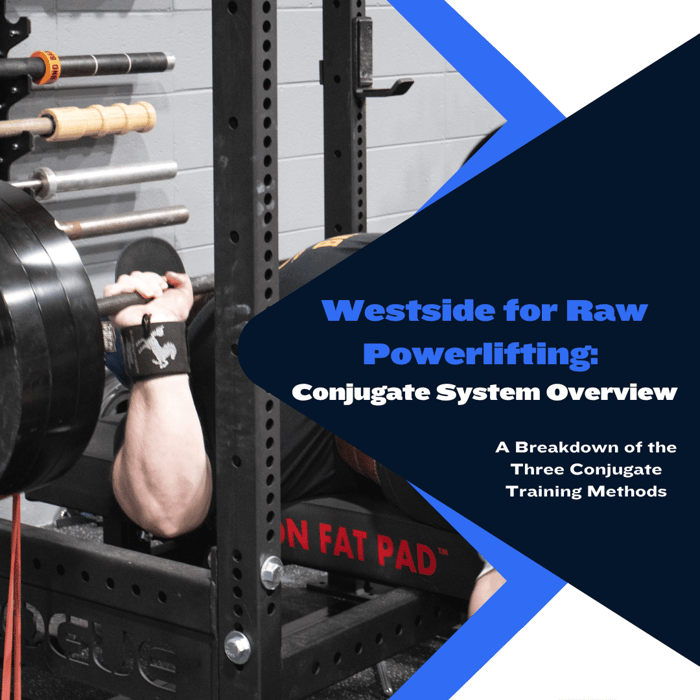
Over the past decade, there has been much debate in the powerlifting world about whether the Westside Barbell Conjugate System works for the raw powerlifter. I find this to be an odd argument, considering the Conjugate Method has not only historically proven to develop all the capacities needed to succeed in raw powerlifting, but has also been applied to many conventional sports.
As far as I know, conventional sports athletes do not wear multi-ply briefs, bench shirts, squat suits, or deadlift suits when competing.
The “Does Westside work for raw?” argument is typically used by coaches who want to alter the system or add their own two cents to a system they most likely have a limited understanding of. As the saying goes, you’re not training Westside unless you’re at Westside. So, does an individual who has never trained at the gym have the ability to comment on the system's use cases?
The truth is, the Westside Barbell Conjugate System absolutely works for raw lifters. It all depends on the individual constructing the training plan and their knowledge and experience.
If you know anything about Westside, you know that the development of “raw” strength has always been a focus. Lou did not allow lifters to live in their gear. He understood that the key to accelerating success in the geared world depends on the lifter developing raw strength. This was especially true with the powerlifting gear available in the 80s and 90s, as it did not offer the support that today’s gear does.
Take a guy like George Halbert, for instance. If you know powerlifting, you know George is one of the greatest bench pressers in the history of geared powerlifting. If you know Westside, you also know that George carried a 600lb+ raw bench throughout his competitive career, benching 635lbs raw while weighing 220lbs at his peak. We have had multiple 600lb+ raw benchers at Westside Barbell.
If we begin talking about 500lb raw benches, it would be difficult to list them all. The same goes for 800lb raw deadlifts; it became almost an expectation at the gym that any athlete in or over the 275lb class should have an 800lb deadlift. As a matter of fact, one of our SHWs, Chris Spiegel, pulled 935lbs raw in competition.
Not too bad, right? Now that we have established that the Westside Barbell Conjugate System works for raw powerlifters, let’s go over the methods we employ when using it.
The Maximal Effort Method
The maximal effort method focuses on developing absolute strength, resulting in increased peak force output. This is accomplished through high-intensity training, with the goal of meeting or exceeding 90% intensity. Ideally, we would like to PR, but we must at least reach 90% intensity to make meaningful gains in absolute strength.
At Westside, we train maximal effort twice per week. This includes lower- and upper-body days, where different exercise variations will be used to avoid accommodation and to develop specific aspects of the competition lifts.
Our standard approach is to work up to a one-rep max (or three reps with good morning variations). It is important to note that this is a training max, not a competition max. This means we are attempting a maximal effort rep without mitigating current fatigue levels through rest, as would be done if we were intending to peak for a competition.
The current level of training fatigue regulates the intensity we can train at. This means we are not capable of reaching our “true” max due to fatigue from the current training cycle. This fatigue ultimately limits the possible training weights.
So, if an athlete can hit a 5lb PR despite current training fatigue, we can assume they will likely be capable of a 10-20lb PR once they have peaked for competition.
It is also important to note that performing a maximal effort repetition is neither tremendously fatiguing nor risky. The fatigue associated with powerlifting competition stems from hitting competition maxes in all three lifts and the length of time spent in competition. Even though a powerlifting meet consists of only 9 total attempts, it can take 5-8 hours to complete them all.
What makes maximal effort training risky is poor technique and the inability to estimate daily performance from warm-up sets. At Westside, we base our expectations on where the athlete is in their training plan and how the warm-up sets look.
It’s simple: if an athlete reports feeling fresh and the warm-up weights are flying, we go for a PR on the top set. If the athlete reports feeling fatigued, and we are seeing technique breakdowns during warm-ups, our goal becomes to hit the 90% threshold (if possible) and live to lift another day.
Ideally, athletes will PR frequently. However, we cannot expect lifters to PR on every maximal effort training day. No matter how great an athlete someone might be, there will be times when current fatigue and life circumstances limit the ability to hit a PR during a workout.
The goal is to establish an upward trend of PR lifts over time.
The Dynamic Effort Method
The dynamic effort method, often referred to as “speed day”, is a training method used to increase an athlete’s rate of force development. Rate of force development, or RFD, is the amount of time it takes for an athlete to reach peak force output. It is important to note that maximal effort training will also improve RFD, but not to the extent that focused dynamic effort training will.
While maximal effort training focuses on reaching the highest possible training intensity that day, the dynamic effort method requires athletes to use submaximal weights while moving the barbell at maximal velocity. We use wave training to ensure we train at appropriate levels of volume and intensity each week.
At Westside, we execute three-week training waves when performing dynamic effort training. This means that over the course of three weeks, we will increase training intensity while decreasing training volume. Then, after three weeks, we will revert to the week one volume and intensity and run through the wave all over again.
You may ask yourself, " Do the training weights ever change? Yes, when a new max effort PR has been established for the specific barbell used during the dynamic effort work. For instance, if we establish a new SSB PR, then use the SSB for dynamic effort lower, we will use the newly acquired PR weight to find our dynamic effort box squat working weights.
We execute dynamic effort training twice per week, for the lower and upper body. When training dynamic effort lower, we perform box squats and deadlifts. During dynamic effort upper training, we perform the close, wide, and comp grip bench press. Each of these movements will include accommodating resistance.
One aspect of dynamic effort training that many raw lifters find difficult to comprehend is the utility of the box squat. In the mind of the average raw lifter, the box squat mimics the technique of squatting in briefs or a suit. This is the first sign someone has no idea what they are talking about when it comes to the Conjugate Method.
The box squat is used to break up the eccentric-concentric chain. As the athlete reaches the box, they will then relax the lower body while keeping the trunk and torso static to control the barbell. Then they will exit the box as quickly as possible.
This is known as static and relaxed-overcome-by-dynamic work. When executed correctly, the box squat will greatly improve starting strength in the squat, and ultimately RFD as well. Using a box is the only way to achieve a relaxed state.
Another benefit of the box squat that is often overlooked is the deceleration aspect of the movement, which places great emphasis on eccentric force output. To box squat correctly, the descent must be under control, with appropriate deceleration (eccentric force output) dictating the quality of the movement.
This work will help build tissue tolerance during deceleration in the competition squat, which is critical for the raw lifter. If you want to reduce the chances of tearing your quads during a third attempt, properly executed box squats can help.
The Repeated Effort Method
The repeated effort method, also known as the repetition method, is the third and final training method used within the Conjugate System. This training method involves using submaximal weights at specific levels of training volume, without a velocity requirement. This work is what most would consider bodybuilding or hypertrophy-focused training.
While we execute maximal and dynamic effort training days twice per week, we execute repeated effort work each training day. This is done through accessory exercises, performed immediately after the main exercise.
Our approach to repeated effort training involves using a primary accessory exercise and multiple secondary accessory exercises. The primary accessory is a multi-joint movement executed at higher levels of intensity (multiple sets of 3-5 repetitions), while the secondary accessories are a mix of multi- and single-joint movements executed at moderate to low intensity (multiple sets of 8-10, 10-12, 12-15, 15-20, or 25-30 repetitions).
The goal of these exercises is two-fold. Our first goal is to ensure that all involved muscle groups are adequately trained based on the day. So, if it is an upper day, we train all the muscle groups involved in the bench press; if it is a lower day, we train all the muscle groups involved in the squat and deadlift.
We also use our repeated effort training to address specific weaknesses. If an athlete has a particularly weak muscle group holding back progress in competition lifts, we will slightly bias the selection of accessory exercises to ensure the weak muscle group is properly addressed and improved.
It is important to note that while we use our accessory work to correct weaknesses, we do not become overly obsessed with eliminating them. Some folks go overboard and change their entire accessory exercise approach to focus only on one or two muscle groups. This leads to other muscle groups being neglected, which will likely lead to a new weakness.
The key to successful repeated effort work is to start with a plan that addresses all involved muscle groups and to make slight adjustments to target weak muscle groups as they become apparent.
It is also critical to ensure you are evaluating training correctly. Some will believe that one bad day on the bench press due to a weak lockout immediately means they have weak triceps. When, in reality, it could just be an off day.
When identifying a weakness, it is recommended to wait until the suspected weak muscle group inhibits performance more than once or on multiple movements. For instance, if you are consistently missing presses at or near lockout and notice your rolling DB tricep extension training weights are subpar, it is likely you have a triceps weakness.
Another benefit of the repeated effort method is increased work capacity. As athletes become tolerant of current levels of accessory exercise training volume and intensity, we will gradually increase both. Over time, this results in improved work capacity, especially when training density is dialed in.
Absolute strength, no doubt, plays a role in work capacity, but repeated effort training refines an athlete’s ability to lift submaximal weights in a fatigued state with optimal technique.
We can also use the repeated effort method in place of maximal effort to mitigate fatigue, or in place of dynamic effort when athletes lack the physical competency to properly execute dynamic effort reps. More on that in the future.
A Complete Training Method
After reading the breakdowns of the three methods used in the Conjugate System, it is easy to see how they would be beneficial to the raw powerlifter. Using the maximal, dynamic, and repeated effort methods, we leave no stone unturned. Additionally, with the Conjugate System, we can use these methods in a variety of combinations to match the current needs or circumstances of any athlete.
Do raw powerlifters need to continuously improve their absolute strength? Of course, that is the name of the game. If a powerlifter wants to increase their lifts, they must improve peak force output.
Do raw powerlifters need to increase their rate of force development? If they want to exhibit peak force output in competition, they most definitely do. Peak force output must be achieved as quickly as possible during the third attempt.
Do raw powerlifters need to achieve muscular hypertrophy and improve work capacity? Without a doubt. Raw powerlifters wear no gear, so all muscles involved in each of the competition lifts must be properly developed and strengthened.
The intent of this article is to provide a broad overview of our approach and to give context for how our methods benefit the raw powerlifter. In upcoming articles, I will discuss approaches and strategies to implement on each specific training day to ensure satisfactory training outcomes for raw powerlifters.
WESTSIDE RULES