The Conjugate Training System is a strength and conditioning operating system that provides coaches and athletes with the tools to build comprehensive training plans that address the special strengths and athletic traits needed to perform at a high level in their chosen sport. When executing a Conjugate-based training plan, athletes can build these strengths and traits simultaneously, allowing for efficient and complete development.
Our training system leaves no gaps and does not fail to meet the mark at any level. Provided the coach or athlete has a proper understanding of the methods, progress can always be made no matter the circumstances. If an athlete is in-season, Conjugate can be applied. If an athlete is in their off-season, Conjugate can be applied. If an athlete is returning from injury, Conjugate can be applied.
I think you get the point; no matter the situation, we can develop a training plan to get the athlete to the next level in their chosen sport.
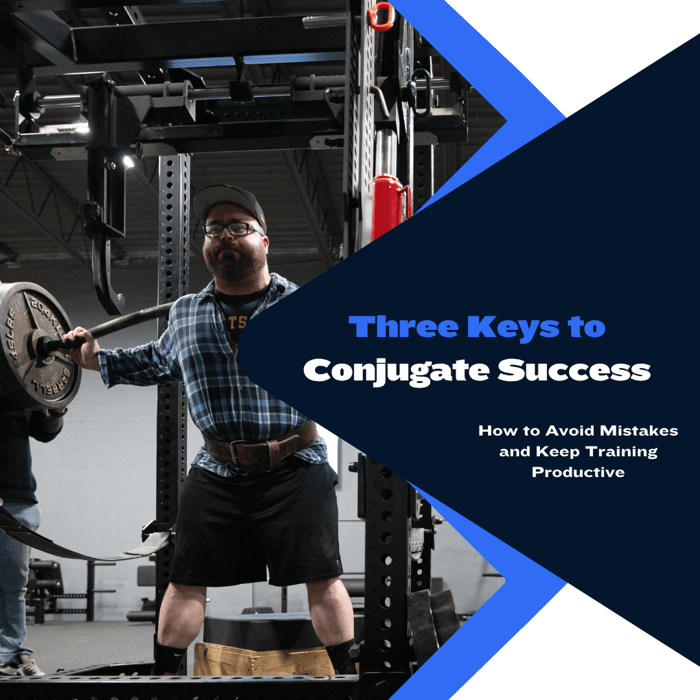
However, there are times when Conjugate Method training can fail. Is this due to a fault within the methods? Absolutely not. Conjugate Method training fails when the coach or athlete misunderstands the methods and programs and executes their training improperly.
In this article, we will discuss a few common mistakes that can negatively impact the efficacy of Conjugate Method training.

Respect the Schedule
One of the quickest ways to reduce the effectiveness of your Conjugate Method training plan is to reorganize the schedule and work outside the recommended rest periods. At Westside, we maintain roughly 48 hours between maximal effort workouts, and roughly 72-96 hours between maximal and dynamic effort workouts focused on the same muscle groups (lower/upper).
Adhering to the suggested rest periods allows athletes to recover properly and ensures energy levels will be optimal to exert the proper intent for each specific training day. Failure to do so can quickly result in lackluster results and missed lifts during maximal efforts, as well as an inability to meet velocity parameters during dynamic efforts.
If improper workout scheduling continues for too long, the risk of both overuse and catastrophic injury can increase. Overuse injury risk rises due to a lack of recovery between workouts. In contrast, catastrophic injury risk increases due to both a lack of recovery and the inability to maintain proper technique due to compounding fatigue.
We also want to ensure we are executing workouts in the proper order. If we begin rearranging training days, we will naturally throw off the recommended rest times between lower- and upper-focused maximal and dynamic effort workouts.
Can we change the days we train? Of course, that is no problem. However, even when we change the days we train, we still want to maintain the order of workouts as well as the rest times between workouts.
Exercise Selection: Simple to Complex
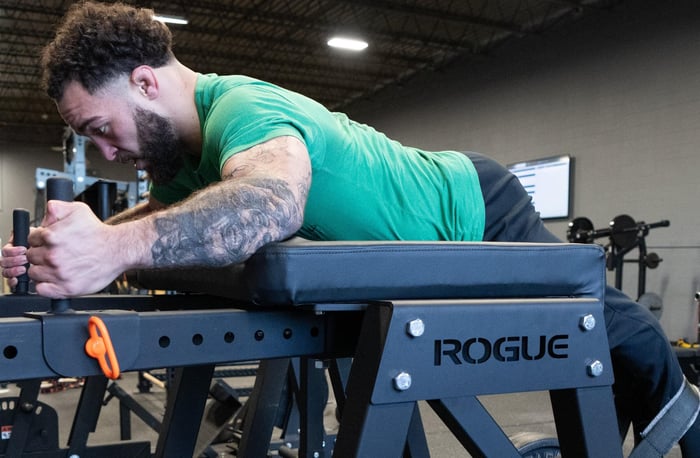
Another common mistake coaches and athletes new to Conjugate make is becoming overly focused on complicated exercise variations. For instance, if we are dealing with an athlete new to Conjugate, I am not going to start them off with a giant cambered bar low box squat with forward pulling bands. I am going to start them off with basic movements such as a barbell squat, front squat, or a box squat.
Too often, those new to Conjugate treat it as a license to kill when it comes to constructing exercise variations. They will see a picture or video of an athlete at our gym performing a specific exercise variation and automatically assume it is best for them. What they fail to realize is the athletes we work with have training time under their belt, and the variation you’re seeing is what we have decided is the best option for them to make progress based on their individual training feedback and data.
In the era of social media coaching, content creators have resorted to coming up with all sorts of exercise variations to garner likes, shares, and follows. It is important to note that just because something is new or looks cool does not mean it is the correct exercise for you to make progress.
Let your training experience and data be the driver behind your exercise variation choices. Get the most out of the basics, and then increase the amount of variation needed as the training deems necessary. By doing so, you will likely achieve a higher rate of improvement, and you will be able to accurately decide which variations you respond best to and which variations need to be changed up.
If you are new to Conjugate and start running through as many different variations as possible, you limit your ability to estimate which exercises you respond best to, and you run out of options when progress slows. Get the most out of the basics, add variation when the training data dictates, and you will continuously make progress.
Execute With Intent
The Conjugate Method features three primary strength training methods: the maximal, dynamic, and repeated effort methods. Each of these methods addresses a specific aspect of athletic performance, and each method requires a specific level of intent to be effective. As with most things in life, your success with each method depends on the effort you put into the work.
With maximal effort, athletes must find balance between aggression and focus. This method requires athletes to work up to a top set single (or triple when performing good mornings), which means we are training at high intensity. Given the demands, athletes must be mentally locked in and focused each rep to ensure the training remains productive and injury is avoided.
The dynamic effort method calls for athletes to train at submaximal intensity, while moving the weight at maximal velocity. To rapidly improve their rate of force development, athletes must meet specific velocity parameters each set. Being passive is not an option; athletes must be aggressive, well-conditioned, and focused to meet the demands of this method from both a velocity and training density standpoint.
Repeated effort work is often where less disciplined athletes struggle the most. The intensity and velocity parameters of maximal and dynamic effort training often force an athlete to meet the demands. However, repeated effort work places a bit more responsibility on the athlete for the training to be effective.
With repeated effort training, we do not work off of precise percentage or velocity requirements. Our basic recommendation is to train each set using the heaviest weight you can while completing all prescribed sets and reps with strict technique. This leaves room for interpretation, and is often where less motivated athletes will begin to go through the motions.
What these athletes fail to realize is that accessory work makes up essentially 80% of our overall training volume. So, failure to hold yourself or your athletes to a standard during accessory exercise training will severely limit progress. If repeated effort work is not taken seriously, athletes will fail to appropriately address the individual muscles and muscle groups that contribute to strength and success within the squat, bench press, and deadlift.
When utilizing the Conjugate Method, it is imperative to take each method seriously and execute with the highest level of focus and intent possible. Failure to meet the requirements of any of the three methods will result in lackluster results and an unsatisfactory rate of progress. As an athlete, you must hold yourself to a standard and put effort into each aspect of Conjugate Method training.