Table of Contents
The dynamic effort method is one of the three primary strength training methods in the Conjugate Training System. Dynamic effort training involves lifting submaximal weights at maximal velocity. This style of training allows us to specifically focus on improving an athlete’s rate of force development.
Improving the rate of force development is a critical aspect of training for all athletes. This training allows athletes to reduce the time required to reach peak force output. As an athlete’s rate of force development improves, they become more explosive when performing sport skills and movements.
At Westside, we conduct two dynamic effort training days per week: one for the lower body and one for the upper body. This training is executed following a three-week wave format.
Our three-week wave approach calls for increasing training intensity over the three weeks while decreasing overall training volume. The three-week wave allows our athletes to work through productive levels of training intensity while keeping fatigue in check by gradually reducing the overall training volume.
Once the third week is complete, we will revert to the intensity and volume of the first week of the wave, while changing the barbell and the accommodating resistance used.
Over the years, this training has produced incredible results. In the geared powerlifting world, it has resulted in numerous 1000lb+ squats, 800lb+ benches, and 800lb+ deadlifts. In the raw powerlifting world, we have achieved 800lb+ squats, 600lb+ benches, and 900lb+ deadlifts, with raw lifting never being a primary focus of the gym.
If you’re new to Conjugate, the standard dynamic effort approach should be used for at least 1 year. However, there are ways we can modify this training to attain greater levels of adaptation for more experienced athletes.
In this article, we will discuss a few ways experienced athletes can modify their dynamic effort training.
Modifying Dynamic Effort Lower
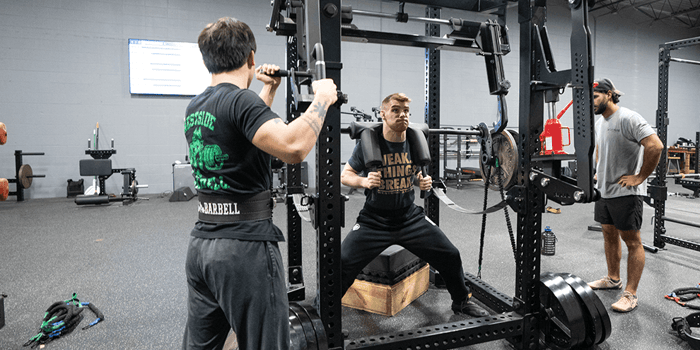
The dynamic effort lower training day is executed once weekly. At Westside, we will train maximal effort lower on Monday and dynamic effort lower on Friday. Considering the fatigue caused by maximal effort, this timeline allows optimal recovery so athletes are prepared for the demands of dynamic effort work.
It is important to note that while you can change the training days, the rest periods between training days must be maintained. Over the years, these timelines have proven to be most optimal. Proper adherence to the prescribed rest times ensures training remains productive and fatigue remains in check.
Now, before we talk about modifications, let's review the standard WSBB DE lower training wave. The standard WSBB dynamic effort lower squat approach calls for athletes to perform box squats and complete the following three-week wave:
Week | Training Intensity | Sets/Repetitions |
1 | 75% (50% bar / 25% AR) | 12 x 2 |
2 | 80% (55% bar / 25% AR) | 10 x 2 |
3 | 85% (60% bar / 25% AR) | 8 x 2 |
Again, this programming approach has produced tremendous results over the years. Truthfully, an athlete could run this approach throughout their competitive career and still expect to continue making progress. It should be noted that our dynamic effort deadlift training will follow the same wave and training percentages, while the set counts will be cut in half.
Now, let's discuss ways we can modify this base approach to drive greater adaptation or focus on developing specific traits and abilities.
The first way we would adjust the standard dynamic effort squat wave would be to transition to a 5 x 5 set and rep scheme. This scheme allows us to accrue high levels of training volume, which increases the number of reps to support motor pattern development and enables greater lower-body hypertrophy.
Here is how we would go about executing a 5 x 5 box squat wave:
Week | Training Intensity | Sets/Repetitions |
1 | 65% (40% bar / 25% AR) | 5 x 5 |
2 | 70% (45% bar / 25% AR) | 5 x 5 |
3 | 75% (50% bar / 25% AR) | 5 x 5 |
As you can see, the overall rep count per workout has increased, while the weekly training percentages have decreased by 10%. This reduction in intensity helps ensure athletes can perform each rep at the proper velocity. If velocity targets are consistently missed when using the 5 x 5 scheme, we would lower the weekly training percentages by 5% until the targets are met.
When running the 5 x 5 scheme, we can perform our dynamic effort deadlifts either following the standard approach or using the 5 x 5 scheme. This would depend on the athlete's ability to tolerate 5 x 5 squat training accompanied by 5 x 5 deadlift training.
The final dynamic effort lower training wave modification we will discuss is an old-school Westside approach to lower body dynamic effort training: three-rep sets. With this set and rep scheme, athletes will perform three reps per set. Additionally, we will execute this work without the box, opting for free squats instead.
Here is what a three-rep squat wave would look like:
Week | Training Intensity | Sets/Repetitions |
1 | 70% (45% bar / 25% AR) | 8 x 3 |
2 | 75% (50% bar / 25% AR) | 7 x 3 |
3 | 80% (55% bar / 25% AR) | 6 x 3 |
As you can see, the weekly training percentages are reduced by 5%. Considering the additional rep per set, the reduction in training intensity helps ensure athletes can maintain optimal velocity set to set.
This is an effective way of training the adductors for the demands of the raw competition squat. When raw squatting, the adductors play a tremendous role in controlling the eccentric phase and extending the hips to complete a rep. Adding a dynamic effort component to this training emphasizes reversal strength and adductor tissue tolerance.
It is also a great way for athletes to refine their competition squat technique, considering the number of reps performed each workout. Week 1 provides 24 reps, week 2 provides 21 reps, and week 3 provides 18 reps. All performed at relevant levels of intensity to further develop and refine the competition squat technique.
Keep in mind, this approach would be reserved for the most experienced athletes. The demands of dynamic effort raw free squats are high and can lead to strain or injury for the unprepared athlete. It is recommended that an athlete demonstrate a high level of proficiency with the standard and 5 x 5 dynamic effort squat approach before moving on to dynamic effort free squatting.
When executing the three-set wave, we will also perform three-rep deadlift sets. When performing deadlifts during the three-set wave, we will reduce the set count by two from the squat set count recommendation.
One final thing I want to mention is ways to modify the dynamic effort deadlift. In the text above, we have provided alternative set and rep schemes. However, it should also be noted that we can further modify our dynamic effort deadlift training by changing the stance or lift position.
At Westside, we will pull dynamic effort deadlifts in a variety of ways. We will pull both sumo and conventional style, from a 2-4” deficit, 2-4” blocks, or from pin 3 in a rack. It all depends on the athlete, their sport, and their needs for strength and muscular development.
Modifying Dynamic Effort Upper
Similar to dynamic effort lower training, dynamic effort upper training is performed weekly. At Westside, this training focuses on improving the rate of force development in the bench press, emphasizing athletes rapidly reversing the barbell's direction and extending the elbows. This work has led to the development of 500-600lb+ raw benches, and even 1000lb+ geared benches.
Here is the standard WSBB dynamic effort upper approach:
Week | Training Intensity | Sets/Repetitions |
1 | 75% (50% bar / 25% AR) | 9 x 3 |
2 | 80% (55% bar / 25% AR) | 9 x 3 |
3 | 85% (60% bar / 25% AR) | 9 x 3 |
As you can see, the training percentages are similar to those used during our standard dynamic effort lower training, while the set and rep scheme is a bit different. This is because the lower body days require athletes to perform two movements (squat and deadlift), whereas the bench press features only one main movement.
Over the years, we have found that 27 reps per session is optimal for most.
Now, we will go over a few ways to modify dynamic effort upper training. Our first option is to go with a 5 x 5 wave. However, unlike our lower work, which we perform as a dynamic effort, our 5 x 5 upper work will be executed following repeated-effort parameters without accommodating resistance.
Here is how we go about programming a 5 x 5 bar weight only upper body wave:
Week | Training Intensity | Sets/Repetitions |
1 | 65% | 5 x 5 |
2 | 70% | 5 x 5 |
3 | 75% | 5 x 5 |
If athletes struggle to complete all prescribed sets in reps or have issues recovering from workouts, we can reduce the training percentage by 5%. We can also reduce the rep count on the third week, opting for a 5 x 3 set and rep scheme instead of the standard 5 x 5.
We can also increase the training percentage for advanced benchers. In this case, we would also reduce the final week’s set and rep scheme to 5 x 3 to ensure the total rep count does not exceed what would be considered optimal according to Prilepin’s chart.
This approach to bench press training will not only yield significant strength gains but also build muscle mass. If you are an athlete dealing with issues related to underdeveloped upper torso and arm muscles, this scheme could be right for you.
It should be noted that while this work is technically repeated effort work, we still want to aim to press each rep as explosively as possible while remaining in control of the barbell.
The final modification to the dynamic effort upper training we will discuss is a vertical pressing wave. At Westside, we most often execute horizontal pressing movements. However, for athletes such as strongman competitors or Olympic weightlifters, it is important to accrue reps on vertical presses each week.
When we opt to add vertical pressing to our dynamic effort, we can choose to follow the standard scheme or the 5 x 5 repeated effort approach. When executing the standard scheme, we will perform reps using accommodating resistance, typically in the form of resistance bands.
Chains can be used, but the instability caused by the chain toward lockout can be unmanageable for some athletes.
When we go with the 5 x 5 repeated effort overhead approach, we will press with bar weight only and focus on adding a compensatory acceleration element to the work. Just as we discussed with the bench press, we are trying to press all reps of our repeated effort work explosively while maintaining control of the barbell.
Manipulating the Programming
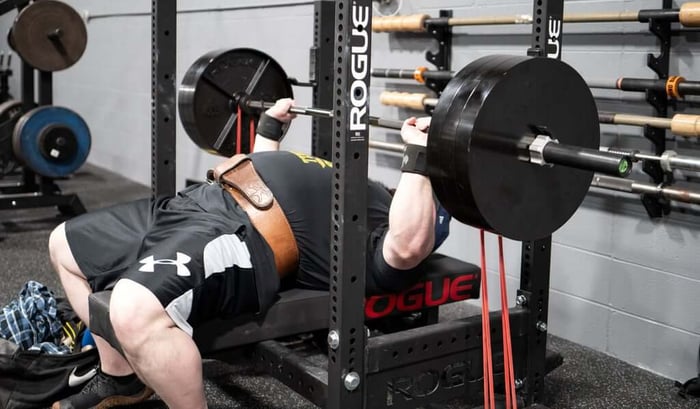
One thing Lou has said about programming that has always stuck with me is that everything works, but nothing works forever. No matter the method or lift, if nothing changes, accommodation eventually sets in. That is why we constantly adjust our exercise selections to ensure athletes continue to improve without being held back by exercise accommodation.
With beginners and intermediate-level athletes, simply changing up the barbell and accommodating resistance used wave to wave will be enough to avoid accommodation and make consistent progress.
However, as athletes gain more experience with the Conjugate Method, it may be necessary to adjust the dynamic effort programming approach by using alternative set, rep, and percentage schemes, or by adding repeated effort work in place of dynamic effort work.
It should also be noted that 5 x 5 repeated effort work can be useful for beginners who lack the strength or work capacity to properly execute dynamic effort training. A few waves of repeated effort volume work will provide beginner-level athletes with adequate training volume to build strength, work capacity, and movement competency.
In my training, I prefer to utilize an alternative approach to dynamic effort work every other or every third wave. Typically, I will alternate between a standard dynamic effort approach for both upper and lower, then a dynamic effort 5 x 5 for lower and a repeated effort 5 x 5 for upper.
With the 5 x 5 repeated effort upper training, I will also add a pause on each rep. This introduces static-overcome-by-dynamic training and helps develop familiarity with the competition bench pause.
These suggestions are just a few ways to manipulate programming when using the Conjugate Training System. Ultimately, how you modify training will depend on your experience level and your current response to training.