Table of Contents
The repeated effort method is one of the most important aspects of the Conjugate Method training approach. This method is used in each training session to drive muscular hypertrophy, target weak muscle groups, and improve overall work capacity and physical conditioning.
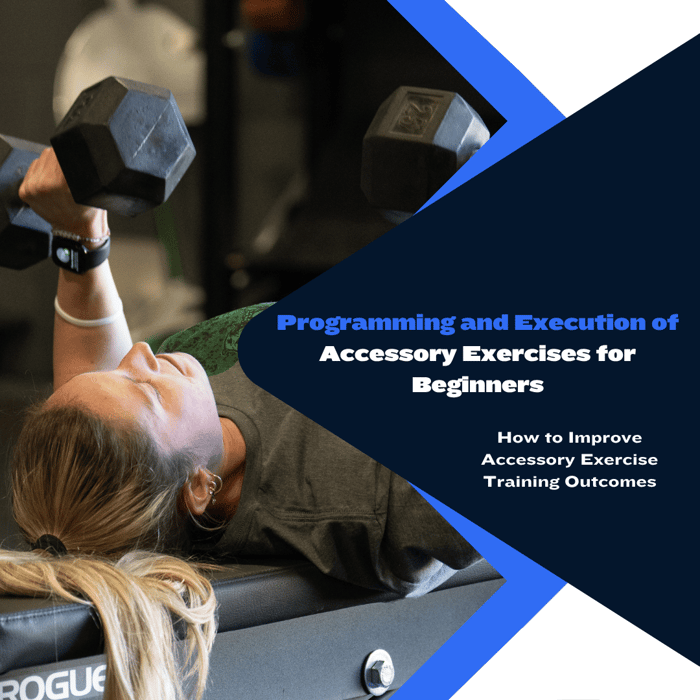
At Westside, we take our accessory training as seriously as our main exercise work. You may be familiar with the 80/20 rule, which states that 80% of our training will consist of accessory exercises. With such a great emphasis placed on this work, failure to program and execute it properly will lead to lackluster gains and a slow rate of improvement.
Accessory exercise training can be as simple or as intricate as necessary. Ultimately, the athlete's needs dictate the proper selection of accessory exercises. As a coach or athlete, proper accessory exercise programming starts with the ability to correctly evaluate the athlete to determine their strengths and weaknesses.
In this article, we will discuss how to program and execute accessory exercise training to ensure beginner-level athletes make continuous progress when utilizing the Conjugate Method.
Crawl, Walk, Run
The first step to achieving success with your accessory exercise programming is to avoid overcomplicating the situation right off the bat. Often, those new to Conjugate think our training approach is a license to perform absurd exercise variations with as many bands and chains as possible added to the mix. However, as anyone who truly understands Conjugate knows, this is not the way we go about it.
A common mistake Conjugate beginners make is thinking that their training must reflect what they’ve seen with experienced lifters. However, what the beginner fails to realize is that the experienced athlete’s exercise selection is based on what it takes to make progress at their current level, and is likely not where they got started.
Take the good morning exercise, for example. The first step to good morning training would be to execute a standard barbell good morning for 8-10, 10-12, or 12-15 reps with strict technique. Then, down the road, when strength has increased, and a new stimulus must be introduced to make progress, that could turn into a giant cambered bar, good morning, for a few heavy sets of 3-5 reps.
To keep training optimal, we want to maintain a crawl, walk, run approach to our exercise selection and programming design. It wouldn’t make much sense to have an athlete who has never touched a barbell immediately jump into a set of good mornings where training intensity is high, and the room for error is slim.
Aside from the training intensity side of things, we also have beginners who want to start out with advanced exercises that are unnecessary for their current ability level because they look cool.
Nowadays, online coaches are constantly posting new exercises for likes and shares. This does not mean these movements are effective or the right choice for a majority of the training population; it just means the online coach needs some algorithmic traction to land a few new clients. However, beginners see these exercises and immediately add them to their plan.
Instead of the beginner-level athlete executing simple barbell good mornings and improving their technique, they are now executing good mornings with a giant cambered bar, 100lbs of chain, and forward-pulling minibands in their first month of Conjugate Method training.
This is where the Conjugate Method gets a bad rap. Experienced lifters at the gym see this, know the athlete in question has no idea what they’re doing, and write off Conjugate as a joke because the beginner in their gym is constructing a band and chain obstacle course.
The proper approach is to keep things simple. Start by mastering the base-level exercise before adding accommodating resistance or any other modifications. This will lead to improved exercise execution, positively impacting the overall rate of improvement while reducing the risk of injury.
Don’t Become Obsessed with Weaknesses
As anyone familiar with the Conjugate Method knows, we use accessory exercises to address weak or lagging muscle groups. However, that is an aspect of accessory training, not the entire point. Our main goal with accessory exercise training is to ensure all muscle groups are adequately trained.
When working with beginners, there will be multiple weaknesses. Why are these muscle groups weak? Because the athlete lacks proper barbell training.
Knowing this, the most reasonable approach for a beginner is to build accessory exercise plans that adequately target all involved muscle groups on each training day. For example, on lower-body days, we want to ensure our accessory work targets the back, hips, quadriceps, hamstrings, calves, and trunk.
After a few months of proper maximal, dynamic, and repeated effort training, we would have enough data to determine which muscle groups are lagging and need additional focus.
However, once we identify weak muscle groups, we still maintain a reserved approach. Too often, coaches and athletes find a weak muscle group and immediately shift the entire accessory exercise programming strategy to focus solely on those weak points. This results in strong muscle groups being ignored and the eventual exchange of one weakness for another.
For instance, if we find an athlete has weak hamstrings, we are not going to reduce the amount of quadriceps-focused accessory work just to make room for more hamstring work. Ideally, we would add one additional hamstring-focused exercise to each lower-body day. We can even keep it simpler than that and just add an additional set or two to any hamstring exercise we perform.
The key for coaches and athletes is maintaining proper balance in their accessory exercise training plans. We want to consistently train all necessary muscle groups day to day, week to week, and year to year. If your accessory work is solely dedicated to current weaknesses, you will surely struggle to make meaningful progress.
Proper Execution of Accessory Exercises
The final aspect of accessory exercise training for beginners I want to discuss is execution. As I mentioned earlier, we want to maintain a crawl, walk, run approach to our exercise selection. This helps to ensure we are building movement skills from the ground up, with athletes mastering the basics before moving on to complex movements and setups.
Aside from building movement competency, coaches and athletes must also select optimal training weights. There is no doubt that proper movement selection and programming are critical to an athlete's success with their accessory work. However, selecting the correct training weights may be the most important part of the accessory exercise training process.
My preferred guideline for selecting accessory exercise training weights is to choose the heaviest possible weight while remaining capable of maintaining strict technique and completing all prescribed sets and reps. This does not mean use the heaviest weight you can possibly handle; it simply means pick the most challenging weight you can handle during each set while maintaining strict technique and completing all sets and reps.
This guideline also teaches athletes to increase or decrease training weights on the fly, set to set. The approach here is simple: if we feel we have a few reps left in the tank after the first set, we kick the weight up a bit. If, after that set, we feel we have reached a peak weight for the exercise, we can either keep the weight the same or drop back to our first-set weight based on how we feel.
Too often, you see beginners train with the same weight set to set, workout to workout, and week to week. This is the path to mediocrity and slow gains. No matter the experience level, all athletes must select challenging weights during each set of their accessory work to render that training as effective as possible.
As we discussed earlier, accessory work makes up 80% of our overall training volume. Imagine the gains you leave on the table if you complete this work with improper training weight.
Each set should be performed using a challenging weight while still allowing the athlete to maintain proper form, rep to rep, and set to set. If we feel good, we slightly increase the weight. If we begin to feel fatigued, we slightly reduce the weight.