Table of Contents
The Westside Barbell Conjugate Method is a strength and conditioning operating system that gives coaches the tools needed to improve sport-relevant strength and athletic traits. Louie Simmons developed this system and proved its efficacy not only in strength sports, but in conventional sports as well.
Within this system, there are no limitations on the sports and situations we can address. The only thing that limits the use of the methods is the mind of the coach employing them. If a coach has a sound understanding of the foundational principles of strength and conditioning, they can improve the sport performance of any athlete they work with.
The Basic Conjugate Training Advice series aims to ensure coaches and athletes have access to knowledge covering specific aspects of the Conjugate Method so that they can use the methods to their fullest potential.
Below, we will discuss a few topics that can help improve your training outcomes when utilizing the Conjugate Training System.
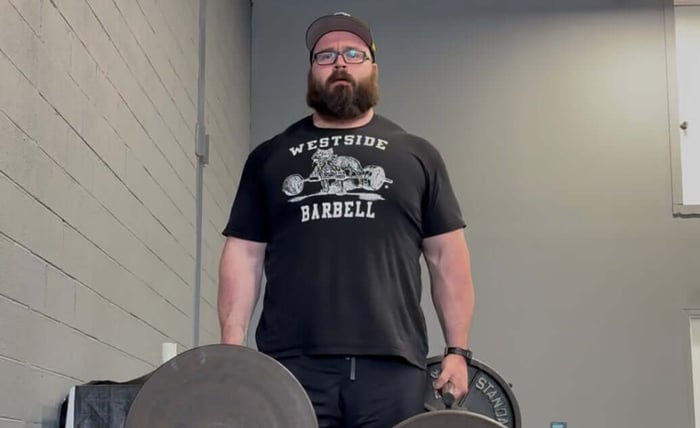
Combinations of Accommodating Resistance
Accommodating resistance is one of the most productive ways to improve force production and acceleration by adjusting how much force is applied based on joint angle. At the least advantageous joint angles, the overall load is decreased. At the most advantageous joint angles, the overall load is increased.
Typically, when using accommodating resistance, we often choose one option: either bands or chains. However, we can also combine the two types of accommodating resistance when performing maximal or dynamic effort exercises.
The reason is simple: to control the overspeed eccentric effect of the bands while allowing us to train at a specific amount of accommodating resistance.
For instance, say we are programming for a beginner or intermediate on a dynamic effort day, with the accommodating resistance set at 25% of the overall training weight. We begin working through the first few sets with bands only, and realize the athlete is collapsing to the box or losing their bench arch due to the overspeed eccentric effect.
In this case, we can introduce a combination of accommodating resistance by adding chains to lower band tension and reduce the increased kinetic energy experienced during the eccentric phase of the lift. Depending on the lifter’s tolerance, we would lower the band tension to 10-15% of the 25% AR and have the chain weight make up the rest of the accommodating resistance.
The same can be done when executing maximal efforts. However, in this case, we will use a specific prescribed accommodating resistance weight, not a percentage based on a one-rep max.
For instance, if we want to execute a barbell squat with 200lbs of accommodating resistance added, we can start with a 50/50 split of bands and chains. If during warm-ups we find the overspeed eccentric effect of the bands to be too much, we can go to a 40/60 or 30/70 bands-versus-chains split.
Ultimately, we want to find the right split that allows for overspeed eccentrics to be present within the lift, but at a level that is tolerable and does not cause egregious breakdowns in technique.
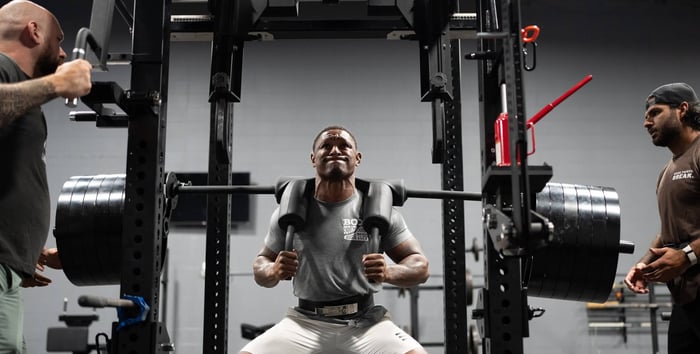
Analyzing Missed Max Effort Attempts
The maximal effort method is used within the Conjugate Training System to rapidly develop absolute strength. For maximal effort work to be most productive, athletes must consistently perform top sets at 90% intensity at minimum, preferably attaining a 5lb PR if possible. This level of training intensity recruits high-threshold motor units, which is key to optimal absolute strength development.
While we seek to avoid missed top sets, there are times when maximal effort attempts are missed. When this happens, coaches and athletes need to know how to handle the situation properly.
First, we want to look for data.
This means identifying where the miss occurred. Was a top set bench press missed due to anterior shoulder and pec strength? Was a top set squat missed due to issues related to knee extension or hip extension? The answers to these questions help us identify potentially weak muscle groups and adjust our approach to accessory exercise programming if needed.
Next, we want to know why the athlete missed.
Was the miss due to strength and energy levels, or was there an issue with technical proficiency? If the miss is due to a strength- or energy-related issue, we will move on to accessory work. If the miss was due to technique, we can consider taking the attempt one final time, provided the breakdown in technique is slight and not egregious.
Finally, we want to avoid jumping to conclusions.
This means we are not going to immediately overhaul our entire training approach because of one missed lift. At this point, we will know the joint angle the athlete missed at and whether the athlete missed due to a strength/energy issue or a technique error. If we believe the miss is due to a specific weakness, we will schedule a future maximal effort workout to confirm.
For instance, say an athlete misses a standard maximal effort bench press in a way that leads me to believe the issue could be the triceps. I will then schedule a close-grip bench press or a bench press vs. minibands max effort upper within the next three weeks to confirm. If the athlete underperforms on these movements, it would be reasonable to assume the weakness is triceps-related, and we can adjust the programming accordingly.
The key to successful maximal effort training and overall Conjugate Method programming is to accrue and confirm data. Too often, coaches will accrue data from one workout, jump to conclusions, and overhaul the entire training approach. Avoid this practice and always confirm the issue before adjusting programming.
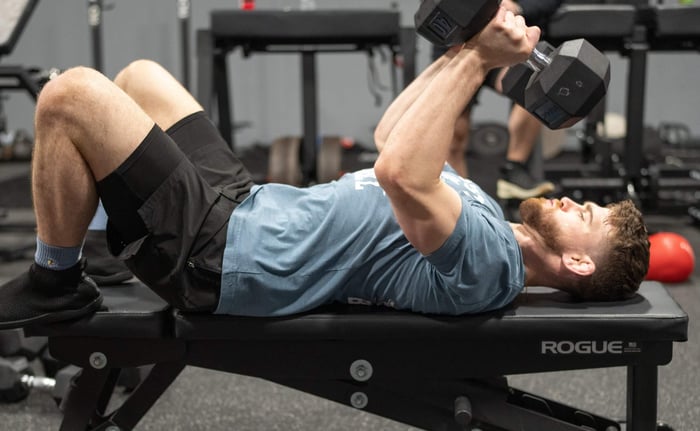
Proper Execution of Rolling Dumbbell Triceps Extensions
The rolling DB triceps extension is one of the primary triceps-focused accessory exercises used within the Conjugate Training System. This movement has been responsible for 600lb+ raw bench presses and 1,000lb+ geared bench presses. It is one of the most effective triceps extension movements any athlete can execute.
However, as with any exercise, this movement must be executed correctly. Too often, you see athletes using too much weight and turning the movement into a roll-and-press instead of a roll-and-triceps-extension.
This movement targets all three triceps heads, with a specific focus on the long head. Additionally, the roll and rapid extension help to improve the strength and density of the distal triceps tendon. Again, the key to attaining these adaptations is the correct execution of the roll and extension.
Here is how we go about executing rolling DB triceps extensions at Westside Barbell:
Break at the elbow and initiate the eccentric phase of the triceps extension.
Bring the head of the dumbbell to the anterior shoulder.
Roll the dumbbell toward the ears, seeking to reach parallel with the skull.
Rapidly reverse direction and begin the concentric phase.
Initiate the extension before the dumbbell becomes perpendicular to the shoulder.
Squeeze the dumbbell handles to stay in control and achieve a strong lockout.
There is no negotiating with the technique. You are either right or wrong. If you are struggling to achieve strict extensions, you must lower the training weight.
When performed correctly, this movement will rapidly improve triceps strength and bench press performance. However, when performed incorrectly, the movement becomes a modified dumbbell bench press and is rendered nearly useless. At the end of the day, nobody will care how much dumbbell weight you’re using on your rollbacks; they will only care what you can bench.
If you want to build strong triceps and achieve your bench press goals, execute the rolling dumbbell triceps extension with strict precision.
Westside Barbell Book of Methods — Louie Simmons

$50.00
What this book is The Westside Barbell Book of Methods is Louie Simmons' lifetime of work in 319 pages. It is the master text on the Conjugate Method and the training system Louie built at Westside Barbell over four decades.… read more