Table of Contents
What Is Maximal Effort Training
The principle, the science, and what it actually looks like in jiu-jitsu athletes.The Principle
The maximal effort method is the most effective way to develop maximal strength. That is not an opinion. It is the foundational conclusion of decades of Soviet sports science research, most notably the work of professor Vladimir Zatsiorsky at Penn State, and it became the backbone of the Conjugate system built at Westside Barbell.
The concept is straightforward: lift the heaviest load you can handle for a given movement on a given day. In practice, this means working up to a one-repetition maximum (often written as 1RM), which is the most weight you can lift for a single rep on that exercise. In some cases a coach may call for a three-repetition maximum (3RM) instead, but the principle is the same: expose the nervous system to the highest possible output. This is not about accumulating volume, which means doing a lot of total reps. It is about producing maximum force in a single effort.
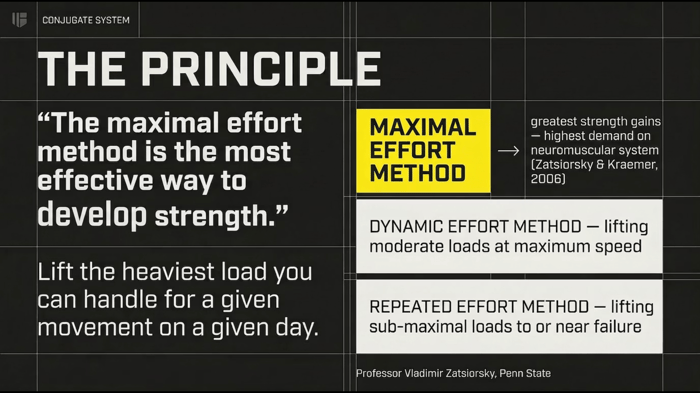
Zatsiorsky identified three methods for developing maximal strength: the maximal effort method, the dynamic effort method (lifting moderate loads at maximum speed), and the repeated effort method (lifting sub-maximal loads to or near failure). Of the three, he was explicit that maximal effort work produces the greatest strength gains because it places the highest demand on the neuromuscular system (Zatsiorsky & Kraemer, 2006). The Conjugate system uses all three, but the ME method is where the ceiling gets raised.
This matters for every athlete who needs to produce force, which is every athlete. A jiu-jitsu competitor executing a takedown, a lacrosse player driving through a check, a football lineman firing off the line of scrimmage: they all depend on the ability to produce maximum force in a short window. The maximal effort method trains that capacity directly. It is not a powerlifting method that happens to work for other sports. It is a strength development method, and strength is the foundation of athletic performance regardless of the sport.
At Westside, this principle was applied with a critical innovation: the constant rotation of exercises. Rather than testing the same competition lift week after week and stalling from what scientists call accommodation (the body stops responding to a stimulus it has adapted to), the approach was to rotate through variations of the squat, bench press, and deadlift. A variation might be a box squat instead of a free squat, a floor press instead of a bench press, or a deficit deadlift instead of a conventional pull. Each variation trains a slightly different range of motion or mechanical demand, but every session asks the same question: what is the most you can do today?
The Science
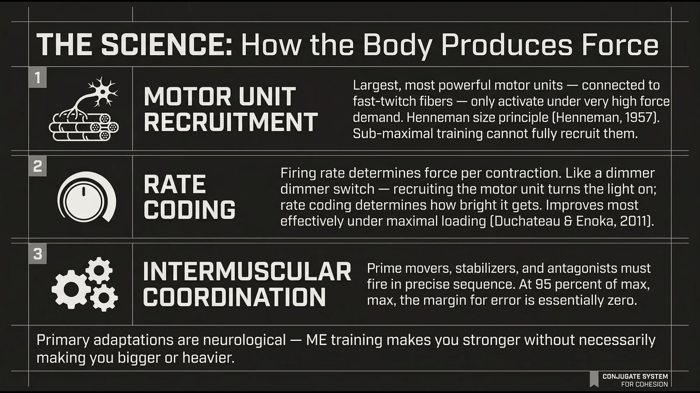
Understanding why maximal effort training works does not require a physiology degree, but it does require understanding a few key concepts about how the body produces force. The adaptations from ME training are primarily neurological, meaning they happen in the nervous system, not just in the muscles themselves.
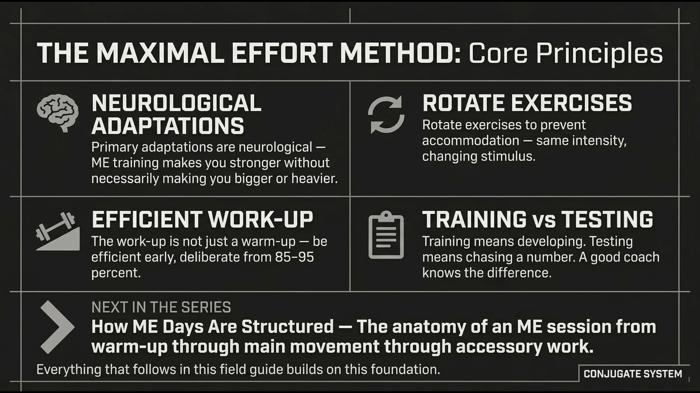
This is an important distinction for sport athletes especially: ME training makes you stronger without necessarily making you bigger or heavier, because the primary adaptation is your nervous system learning to use the muscle you already have more effectively.
Motor unit recruitment. A motor unit is a single nerve cell and the bundle of muscle fibers it controls. Your muscles contain thousands of motor units, and they are organized by size. When you pick up a coffee cup, your body only activates the small motor units, the ones that control a few muscle fibers and produce a small amount of force.
As the load gets heavier, the nervous system progressively activates larger motor units that control more fibers and produce more force. This is called the Henneman size principle (Henneman, 1957). The critical point is this: the largest, most powerful motor units, the ones connected to your fast-twitch muscle fibers, only get activated when the force demand is very high. Sub-maximal training, no matter how many reps you do, cannot fully recruit these high-threshold motor units. You have to lift heavy to reach them.
For a jiu-jitsu athlete, this has direct application. When you shoot a double leg or fight for an underhook against a resisting opponent, you need to produce a lot of force very quickly. If your nervous system has never been trained to recruit its highest-threshold motor units, you are competing with a portion of your available strength locked away. ME training unlocks it. The same applies to a lacrosse midfielder absorbing contact while changing direction or a football defensive end converting speed to force at the point of attack.
Rate coding.
Even after a motor unit is recruited, there is a second variable that determines how much force it produces: how fast the nerve sends electrical signals to the muscle fibers. This is called rate coding, or firing rate. Think of it like a dimmer switch. Recruiting the motor unit turns the light on; rate coding determines how bright it gets. Maximal effort training teaches the nervous system to fire at higher frequencies, which means each motor unit produces more force per contraction (Duchateau & Enoka, 2011). This is a trainable adaptation, and it improves most effectively under maximal loading.
Intermuscular coordination.
A heavy squat or bench press is not a single muscle working alone. It is a coordinated event involving prime movers (the main muscles doing the work), stabilizers (the muscles keeping your joints in position), and antagonists (the opposing muscles that control the movement). All of these must fire in a precise sequence and at the right intensities. Training at maximum loads sharpens this coordination because the margin for error at 95 percent of your max is essentially zero. If the timing is off, the lift fails. Lighter loads are more forgiving and therefore less effective at training this skill. For combat and field sport athletes who must produce force from unpredictable positions, this quality of total-body coordination under high force demands is essential.
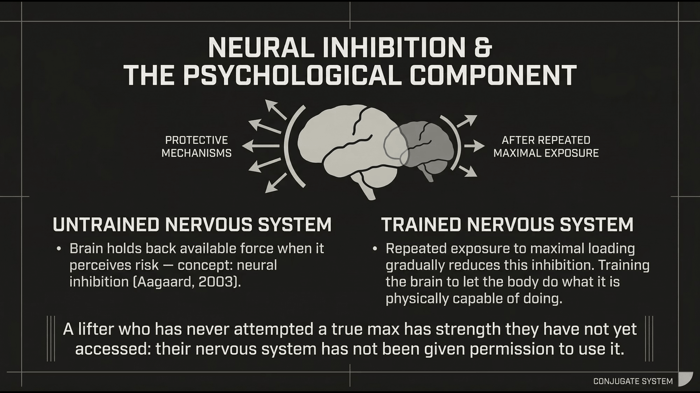
The psychological component is not separate from the science. It is part of it. The nervous system has protective mechanisms that limit force production when it perceives risk, a concept sometimes called neural inhibition (Aagaard, 2003). When you attempt a weight that feels dangerous, your brain literally holds back some of your available force. Repeated exposure to maximal loading gradually reduces this inhibition. You are training the brain to let the body do what it is physically capable of doing. This is why a lifter who has never attempted a true max has strength they have not yet accessed: their nervous system has not been given permission to use it.
Working Up: How to Select Your Attempts
One of the most overlooked aspects of ME training is how you get from an empty bar to your top single. The work-up is not just a warm-up. The jumps you take on the way to your max are themselves valuable training, and how you manage them determines whether you arrive at your top weight in a strong position or a fatigued one.
The general approach is to take progressively heavier singles (single reps) until you reach a weight that represents your best effort for that day. For a new coach, the most important concept here is efficiency: you want to get to heavy weights without wasting energy on too many reps at light and moderate loads, but you also do not want to skip the weights in the 85 to 95 percent range because those lifts are doing real work for your strength development.
Here is why that range matters. A single at 85 percent of your max is not a throwaway rep. It is a lift that requires significant motor unit recruitment, reinforces technique under meaningful load, and prepares the nervous system for what is coming. A single at 90 percent is even more demanding. A single at 95 percent is a near-maximal effort that produces substantial training stimulus on its own. Skipping straight from 75 percent to a max attempt means you miss all of that development and you arrive at your top weight with a nervous system that has not been progressively ramped up to produce its best output.
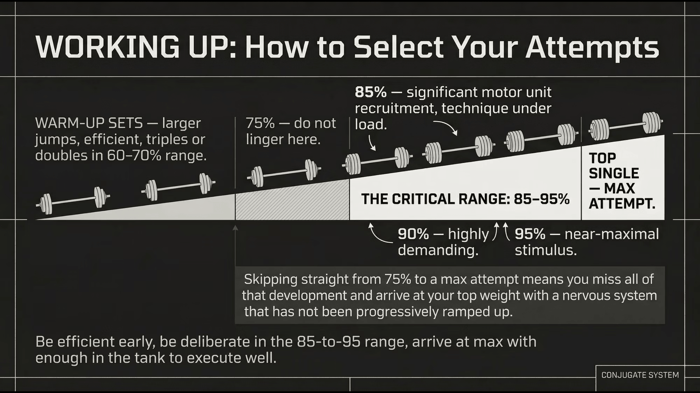
For intermediate and advanced athletes, the mistake to avoid on the other end is spending too long getting from warm-up weights to 80 percent. You do not need five or six sets in the 50 to 75 percent range. Get through the light weights efficiently. Use larger jumps when the bar is light, take triples or doubles in the 60 to 70 percent range if needed, and then shift to singles as you approach 80 percent. Save your energy and your focus for the weights that matter.
A practical approach might look something like this: a few warm-up sets with increasing weight, then singles at roughly 80, 85, 90, and 95 percent before attempting your max. The exact percentages do not need to be precise. The principle is clear: be efficient early, be deliberate in the 85-to-95 range, and arrive at your max attempt with enough in the tank to execute well.
This is especially important for sport athletes who are training the Conjugate system alongside their sport practice. A jiu-jitsu competitor who has mat time later that day or the next morning cannot afford to waste energy on an inefficient work-up. A lacrosse or football player in-season has a limited recovery budget. The work-up needs to be purposeful and economical so the athlete gets the full benefit of the ME session without unnecessary fatigue that bleeds into their sport training.
There will be days when everything is moving fast and the bar feels light. On those days, a lifter might compress the work-up and push for a PR. That is fine occasionally. But it is not the standard approach. Most weeks, the goal is to train the maximal effort method, not to test it. Training means getting the most development out of every rep from 85 percent up. Testing means chasing a number. A good coach knows the difference.
What It Looks Like in the Field
The textbook description of maximal effort training is clean: work up to a one-rep max on a core barbell movement, rotate exercises weekly, and follow with accessory work targeting weak points. The reality in the gym has more texture, and the way the session plays out depends entirely on who is under the bar.
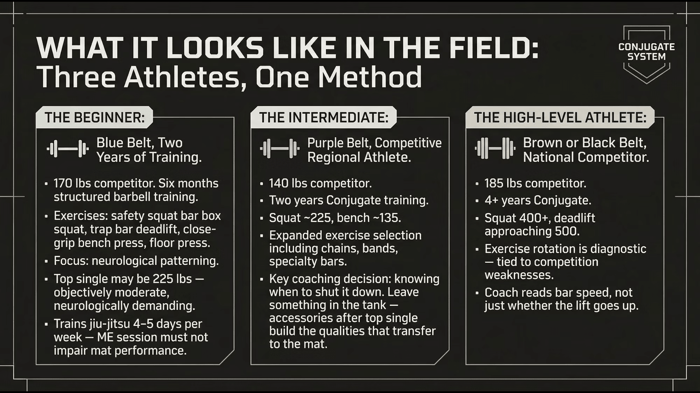
To illustrate what ME training actually looks like in practice, here are three jiu-jitsu athletes at different stages of development. Jiu Jitsu is a useful lens because these athletes need to produce high force from awkward positions, they need to do it without gaining unnecessary bodyweight, and they have demanding sport practice schedules that constrain their recovery. Every coaching decision on ME day is shaped by these realities.
The Beginner: Blue Belt, Two Years of Training
This athlete has been training jiu-jitsu for two years and has six months of structured barbell training. He competes at 170 pounds and has never worked up to a true one-rep max on any lift. His squat technique is functional but breaks down under heavier loads, and his training history is mostly higher-rep bodybuilding-style work and kettlebells.
For this athlete, the ME day might mean working up to a heavy single on a safety squat bar box squat. The coach is watching for technical breakdown: does the stance hold, does the back stay tight, does he lose position coming off the box. The weight on the bar is secondary to the quality of the attempt. He might work up to what feels like a hard single at 225 pounds, which is objectively moderate weight but neurologically demanding for him. That is fine. The adaptation at this stage is neurological patterning (the nervous system learning to coordinate the movement efficiently) and the psychological experience of handling loads that feel heavy.
The exercise rotation is narrow. Three or four movements rotated every one to three weeks: safety squat bar box squat, trap bar deadlift, close-grip bench press, maybe a floor press. These teach fundamental pressing and squatting patterns without the technical demands of a straight bar back squat or conventional deadlift, which this athlete is potentially not ready for under maximal loads. The coach makes the calls on when to add weight and when to stop. The jumps between sets are conservative.
The sport context matters here. This athlete trains jiu-jitsu four to five days per week. His ME session needs to build strength without creating so much soreness or fatigue that his mat performance suffers. The coach is selecting exercises and managing volume with this in mind. A safety squat bar box squat is a smart choice partly because it is less taxing on the shoulders and wrists than a straight bar squat, which matters for an athlete who spends hours gripping and fighting for wrist control.
The Intermediate: Purple Belt, Competitive Regional Athlete
This athlete has been training jiu-jitsu for five years and has two years of Conjugate-based strength training. She competes at 140 pounds, has a solid technical foundation on the main barbell movements, and understands the ME process. Her squat is around 225, her bench is 135, and she can work up to legitimate maxes without her technique falling apart.
At this level, the exercise selection expands. The coach can introduce closer variations of the competition lifts, chains and bands as accommodating resistance (adding external resistance that increases as the lifter moves through the range of motion, which changes the strength curve of the exercise), and specialty bars that target specific weaknesses. She is working up to genuine one-rep maxes, and the coach is reading each attempt to decide whether to push for another jump or call it.
The most important coaching decision at the intermediate level is knowing when to shut it down. There is a strong temptation at this stage to grind through ugly reps to hit a number. The athlete gets addicted to PRs and starts treating every ME day like a competition. This is a mistake, and the cost is not abstract. When an athlete grinds through a ten-second max attempt, she is depleting her nervous system to the point where the accessory work that follows becomes meaningless.
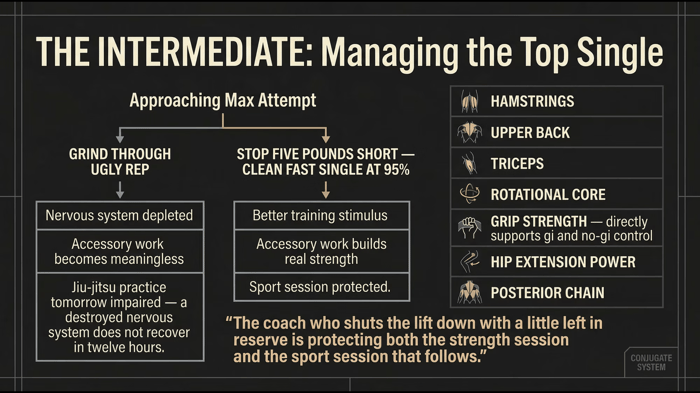
The accessories after the top single are where weak points get addressed: hamstrings, upper back, triceps, rotational core work, grip. For a jiu-jitsu athlete, these are not optional. Grip strength, hip extension power, and a strong posterior chain are what translate the barbell work to the mat. If she has nothing left after her top single, she cannot train those qualities with any real intensity.
The better approach is to leave something in the tank. If this athlete has a realistic shot at a PR but it would mean a long, grinding rep, it is often smarter to stop five pounds short and put that energy into the accessory work. A clean, fast single at 95 percent of a true max is a better training stimulus than a maximal grind, and the accessory work that follows will actually build something. She also has jiu-jitsu practice tomorrow.
A destroyed nervous system does not recover in twelve hours. The coach who shuts the lift down with a little left in reserve is protecting both the strength session and the sport session that follows.
The High-Level Athlete: Brown or Black Belt, National-Level Competitor
Westside Barbell trains competitive jiu-jitsu athletes at the highest levels of the sport, including Dante Leon, Max Hanson, and Ademir Barreto Araujo. The example that follows reflects the kind of coaching decisions that go into programming maximal effort work for athletes at this caliber.
This athlete has been training jiu-jitsu for eight-plus years and has four or more years of structured Conjugate training. He competes at 185 pounds, has deep technical proficiency on the barbell, and a training history extensive enough that both the coach and the athlete can make informed, real-time decisions about every aspect of the session. His squat is well over 400, his deadlift is approaching 500, and he knows his body well enough to auto-regulate within the structure the coach provides.
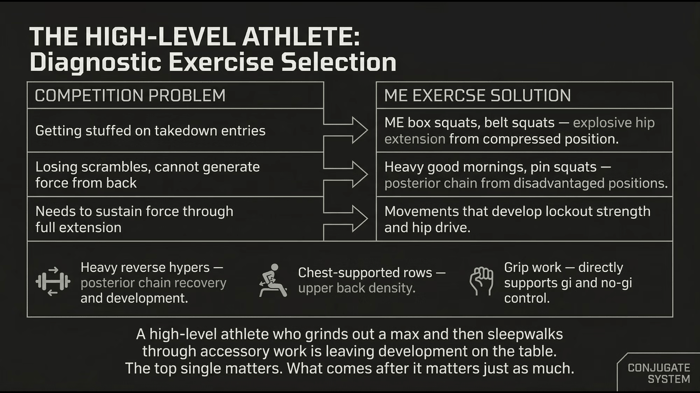
At this level, exercise rotation becomes highly strategic. The coach and athlete are selecting movements based on specific weaknesses that show up in competition. If this athlete is getting stuffed on takedown entries, the programming might emphasize ME box squats and belt squats to build explosive hip extension from a compressed position. If he is losing scrambles because he cannot generate force from his back, the rotation might include heavy good mornings and pin squats that train posterior chain strength from disadvantaged positions. The movement selection is diagnostic, not random.
The work-up is precise and efficient. This athlete does not need six warm-up sets. He knows how to get from the empty bar to 80 percent quickly, and he understands the value of the singles at 85, 90, and 95 percent. The coach is watching bar speed, not just whether the lift goes up. A single at 90 percent that moves slowly tells the coach something different than one that moves fast, and that information shapes whether they push for another attempt or call it.
The high-level athlete also manages the top single with a longer view. The neurological cost of a true maximal effort at advanced loads is substantial, and it echoes through the rest of the training week. Sometimes the smartest call on ME day is to work up to a solid single that is five percent below what the athlete could do that day, because the jiu-jitsu training later that week is more important.
The accessories are programmed with precision: heavy reverse hypers for posterior chain recovery and development, chest-supported rows for upper back density, grip work that directly supports gi and no-gi control. The athlete needs to be able to execute these with real effort, not just survive them. A high-level athlete who grinds out a max and then sleepwalks through accessory work is leaving development on the table. The top single matters. What comes after it matters just as much.
Why Exercise Rotation Matters
The constant rotation of ME exercises is not variety for its own sake. It is a direct response to the law of accommodation, a well-established principle in exercise science that states the response of a biological system to a constant stimulus decreases over time (Zatsiorsky & Kraemer, 2006). In plain terms: if you do the same thing over and over, your body stops adapting to it. If you max out on the same lift every week, your progress will stall within three to five weeks regardless of how hard you try.
Rotation solves this problem by changing the stimulus while keeping the intensity constant. A max effort box squat, a max effort safety squat bar squat, and a max effort front squat all train the squat pattern at maximum intensity, but each one presents a different mechanical challenge. The nervous system is forced to adapt to each new demand, which prevents accommodation and drives continuous improvement.
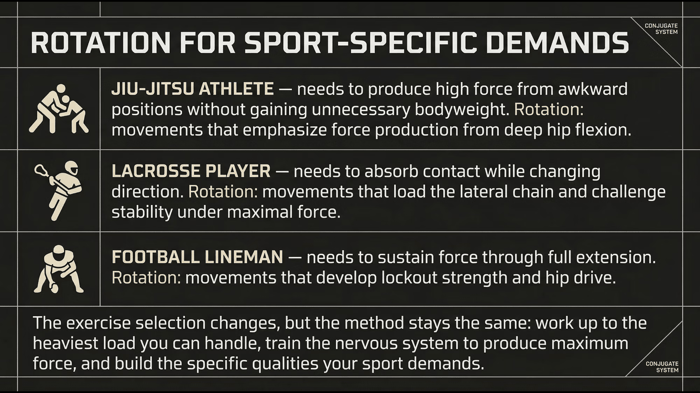
For sport athletes, rotation has an additional benefit: it allows the coach to select exercises that address sport-specific demands without ever leaving the ME framework. A jiu-jitsu athlete who needs to be stronger from bottom position can rotate through movements that emphasize force production from deep hip flexion. A lacrosse player who needs to absorb contact while changing direction can cycle through movements that load the lateral chain and challenge stability under maximal force.
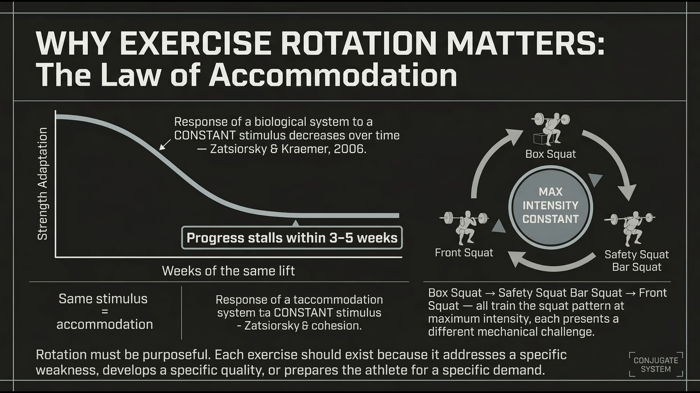
A football lineman who needs to sustain force through a full extension can rotate through movements that develop lockout strength and hip drive. The exercise selection changes, but the method stays the same: work up to the heaviest load you can handle, train the nervous system to produce maximum force, and build the specific qualities your sport demands.
The key is that rotation must be purposeful. Each exercise in the rotation should exist because it addresses a specific weakness, develops a specific quality, or prepares the athlete for a specific demand. A coach who rotates exercises without a rationale is just doing random training at high intensity, which is a recipe for stagnation or injury. Later articles in this series will cover exercise selection in detail for both upper and lower body ME work.
The maximal effort method is the engine of strength development in the Conjugate system. It is not complicated. It is demanding. It requires a coach who understands the athlete in front of them, a rational approach to exercise selection, the discipline to manage the work-up intelligently, and the maturity to value long-term development over short-term PRs. The top single is the centerpiece of ME day, but it is not the only thing that matters.
How you get there and what you do after it are just as important. Whether you are coaching a jiu-jitsu white belt learning to handle heavy loads for the first time, a college lacrosse player building a strength base for the season, or a national-level competitor managing training around a competition schedule, the principles are the same. The application is where coaching lives. Everything that follows in this field guide builds on this foundation.
References
Aagaard, P. (2003). Training-induced changes in neural function. Exercise and Sport Sciences Reviews, 31(2), 61–67.
Duchateau, J., & Enoka, R. M. (2011). Human motor unit recordings: Origins and insight into the integrated motor system. Brain Research, 1409, 42–61.
Henneman, E. (1957). Relation between size of neurons and their susceptibility to discharge. Science, 126(3287), 1345–1347.
Zatsiorsky, V. M., & Kraemer, W. J. (2006). Science and Practice of Strength Training (2nd ed.). Human Kinetics.
Recommended Reading
Supertraining by Mel Siff. The most comprehensive English-language text on strength training science. Dense reading but foundational for any serious coach.
WSBB Books - Supertraining by Mel Siff

$75.00
Supertraining by Mel Siff is widely regarded as one of the most comprehensive and insightful books ever written on strength training. Covering an array of essential topics such as explosive strength, power, speed training, plyometrics, flexibility, periodization, and more, it… read more
Science and Practice of Strength Training by Vladimir Zatsiorsky and William Kraemer. The source text for the three methods of maximal strength development. Required reading for understanding why the Conjugate system is structured the way it is.
Science and Practice of Strength Training

$99.00
Science and Practice of Strength Training is an essential resource for athletes, coaches, and strength training professionals. Written by Vladimir M. Zatsiorsky, a leading expert in biomechanics and strength training, this book provides a comprehensive overview of the science behind… read more
Westside Barbell Book of Methods by Louie Simmons. The practical application of the principles discussed here, written by the man who built the system.
Westside Barbell Book of Methods — Louie Simmons

$50.00
What this book is The Westside Barbell Book of Methods is Louie Simmons' lifetime of work in 319 pages. It is the master text on the Conjugate Method and the training system Louie built at Westside Barbell over four decades.… read more
Special Strength Training: Manual for Coaches by Yuri Verkhoshansky and Natalia Verkhoshansky. Advanced reading on the periodization and programming concepts that informed the Conjugate approach.
FAQs
What is the maximal effort method in the Conjugate system?
The maximal effort method means working up to the heaviest weight you can lift for a single rep on a given exercise. It is the primary method for building maximal strength in the Conjugate system developed at Westside Barbell. Unlike traditional progressive overload programs that add weight to the same lift over time, the Conjugate approach rotates exercises weekly to prevent the body from adapting to a fixed stimulus while keeping intensity at or near maximum.
Can you use maximal effort training for jiu-jitsu and combat sports?
Yes. Maximal effort training develops the nervous system's ability to recruit and coordinate muscle fibers at maximum output, which directly translates to force production in grappling, takedowns, and scrambles. Because the primary adaptation is neurological rather than muscular, athletes can get significantly stronger without adding bodyweight, which matters in weight-class sports like jiu-jitsu and MMA.
How is maximal effort training different from just lifting heavy?
Lifting heavy without a system is just testing your strength. The maximal effort method is a structured approach that includes rotating exercises to prevent accommodation, managing the work-up so the singles at 85 to 95 percent contribute to strength development, and balancing the top single against the accessory work that follows. The method also accounts for the athlete's sport demands, recovery needs, and long-term development rather than chasing a PR every session.
Is maximal effort training safe for beginners?
Yes, when coached properly. Beginners are not attempting true competition maxes. They are working up to weights that are heavy relative to their current ability while a coach monitors technique. The loads are objectively moderate, and the exercise selection is limited to movements the athlete can perform safely under load. The goal at the beginner stage is to teach the nervous system to produce force efficiently, not to test absolute strength.
How does the Conjugate method work for field sport athletes like lacrosse and football?
The Conjugate system is built around developing maximal strength, speed-strength, and work capacity simultaneously, which matches the demands of field sports. Maximal effort training builds the force production that lacrosse and football athletes need for contact, acceleration, and positional strength. The exercise rotation allows coaches to select movements that target sport-specific weaknesses, and the system's structure allows strength training to coexist with in-season sport practice without overloading the athlete's recovery.