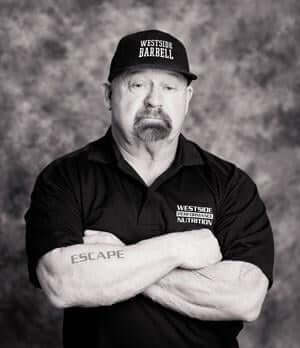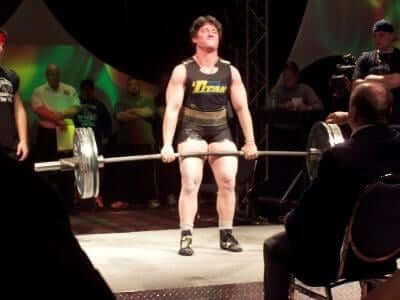
Box squatting has been around since the days of the original Westside Barbell Club (Culver City, CA), when Pat Casey became the first man to squat 800 pounds. Since then, most world-record holders in the squat have trained by squatting on a box. Today, there are nine lifters who squat 1,200 pounds and at least seven are box squatters. I began box squatting in the late 1960s. In 1973, I squatted 630 pounds and deadlifted 670 at a body weight of 181 pounds. 27 years later, I squatted 920 pounds at the age of 52. Westside Barbell has 19 members who squat more than 1,000 pounds, and they all box squat. Every member of Westside Barbell does box squats year-round with free squats done only in competition.
Despite this half-century history of box squatting by the world’s greatest lifters, I still consider box squatting to be a secret weapon because it remains a secret to most lifters and athletes. It’s also an exercise that is highly misunderstood and grossly underappreciated. Let’s see what I can do about that by giving you some reasons why you should be box squatting.
1. Box squatting produces less soreness, allows for faster recovery, and enables the lifter to train squats more frequently.
This is attributable to breaking the eccentric-concentric chain when the lifter sits down on the box, which in the world of physics is known as a “collision.” Although some of the kinetic energy generated during the eccentric phase of the lift remains stored in muscles such as the glutes and hamstrings, much of it is dissipated as a result of the collision. The loss of kinetic energy and any loss in stretch reflex in muscles that relax are the primary factors that determine the difference between the weights a lifter can use in a conventional free squat as compared with when squatting on a box of the same depth. We have determined that this difference is about 15% less. Being able to use less weight to produce a heavier squat on meet day is also an advantage.
2. Box squatting is safer.
When box squatting, the lifter uses less weight and is forced to use better form, which reduces spinal compression. Filling the abdomen with air when box squatting creates optimal abdominal pressure that also protects the spine. Properly performed box squats have also been shown to reduce spinal loading at S5-L1. Box squatting is also safer for the knees because the perpendicular shin position reduces pressure on the patellar tendons.
3. Box squatting places greater load on the larger, major squatting muscles of the hips, glutes, and upper hamstrings.
Box squatting allows for a wider stance and emphasizes squatting back by driving the glutes rearward, rather than down. This enables a deeper squat and the lifter to sit far back on the box, putting the glutes and hamstrings in a stretched position and the shins at or past perpendicular to the floor. The angle of the shin places a greater load on the glutes, hamstrings, and hip flexors. These are the major squatting muscles, the main muscles for sports performance, and the most commonly underdeveloped areas of a person’s legs.
4. Box squatting ensures that all squats will always be below parallel and teaches perfect squatting technique.
When free squatting, the lifter often doesn’t squat to parallel when warming up with lighter weights, just as there is an invariable tendency to squat higher as weights become heavier. This is eliminated during box squatting because the lifter sits down onto the box. Once the lifter has established a below parallel height for the box, all squats will be below parallel. Box squatting also teaches perfect squatting technique by allowing the lifter to sit completely back and not down while descending and by removing the speed aspect from the bottom of the lift.
5. Box squatting builds greater absolute and explosive strength, as well as developing tremendous pulling power in the deadlift and extraordinary jumping ability.
Two proven methods incorporated in box squatting for the development of absolute and explosive strength are relaxed-overcome-by-dynamic work and static-overcome-by-dynamic work. These methods describe the action of the major muscle groups involved in box squatting when the lifter breaks the eccentric-concentric chain. When the lifter sits down on the box, some muscles are relaxed while other muscles are held static. These relaxed and static states are then overcome by dynamic concentric contraction at maximal force when jumping off the box. This increases the rate of force development (RFD). By breaking the eccentric- concentric chain, box squatting produces a rate of force development (RFD) three to four times greater than other types of squatting and builds tremendous starting strength in the major muscles that dominate sports performance. Deep box squatting also develops explosive pulling power off the floor in the deadlift and increases jumping ability substantially. (Westside’s best box jump is 63 1⁄2 inches as of August 2012.)
6. Box squatting will make you a better athlete.
Explosive strength is an absolute requirement for all competitive athletes. An exceptional rate of force development (RFD) means greater acceleration, giving you an edge over an opponent. The static and relaxed-overcome-by-dynamic actions of box squatting will make an athlete strong, fast, and explosive.
7. Box squatting doesn’t require any gear.
Although as far as shoes go, Converse Chuck Taylor shoes are the best for squatting. (Don’t have $100 shoes and a 10¢ squat.)
Those of you who weren’t already box squatting before you read this article, I’m sure you’re now asking yourself how you’ve managed to get this far in life without it. Now that you’re ready, you need to know how to box squat correctly. So in the next Article I’m going to tell you everything you need to know to start box squatting the Westside way.
Stay Strong
Louie Simmons